« July 2009 | Main | September 2009 »
August 31, 2009
Redux: The Sacred, Immovable, No-Excuses Weekly Conference Call.
They are missed or canceled only for the most compelling reasons. Vacations, trips to Europe, Asia, South America, head colds, bad traffic, hangovers, my-wife-and-girlfriend-found-out-about-each-other? Sorry, no excuse.
My dog ate my notes, and the draft amended counterclaim? Or, the law schools tried to 'humanize' but instead emasculated the new law clerks (and they are all singing show tunes instead of fighting for clients)?
Nope. These don't cut it, either.
The Sacred, Immovable, No-Excuses Weekly Client Conference Call. It's one of our favorites. Click on it. If your firm currently is doing a litigation, transactional or other project which falls into the category of either "fast" or "intense", here's a practice you can institute today that your firm probably does not have in place. It's a no-brainer. It has enormous benefits right away. And it will both impress and help any good client. It will not put the hurt on your "WLB". It will help you too.
Posted by JD Hull at 11:59 PM | Comments (0)
August 28, 2009
We Americans? We lawyers? Too normal?
So, Justin, did you ever have an original thought in your whole damn life? Go ahead. Go crazy. It's Friday. Wear those spats for ten minutes. Americans, as much as any creatures on Earth, do have a passion for routine and ritual. And what of Lawyers--and other Dweeb Breeds? A recent WAC study of lawyers in Milwaukee, Indianapolis and Cincinnati--I have strong family and life ties to each of these Midwestern cities--states that True Lawyer Wildness, Originality and Flashes of Personal Anarchy are reflected in clothing: i.e., wearing a bow-tie, tasseled loafers and a trench coat--but all at once, and on the same day. But you never know. We always need to look beyond the veneer, and day-to-day patterns. "The Discreet Charm of the Bourgeoisie" (1972), by Surrealist Spanish director Luis Buñuel, is about the ritual of dining, and its more revealing and darker undercurrents.

Posted by JD Hull at 06:22 PM | Comments (0)
August 26, 2009
FCPA and China: Teleconference on September 3.
China is, after all, this century's Wild West show. See Dan Harris's China Law Blog for details about a seminar next Thursday on the Foreign Corrupt Practices Act of 1977--and China. FCPA, enacted during the Jimmy Carter administration as an amendment to the Securities Exchange Act of 1934, and amended in 1998, prohibits (and makes a crime) bribery of foreign officials to obtain or retain business, and requires companies with securities listed in the U.S. to keep accurate records and effective internal controls.
Posted by Rob Bodine at 11:59 PM | Comments (2)
Writing Well: Working at it.
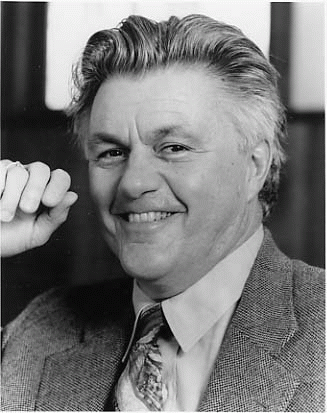
Half my life is an act of revision.
--John Irving (1942-)
Posted by Rob Bodine at 11:27 PM | Comments (0)
August 21, 2009
Client Town or Lawyer Town?
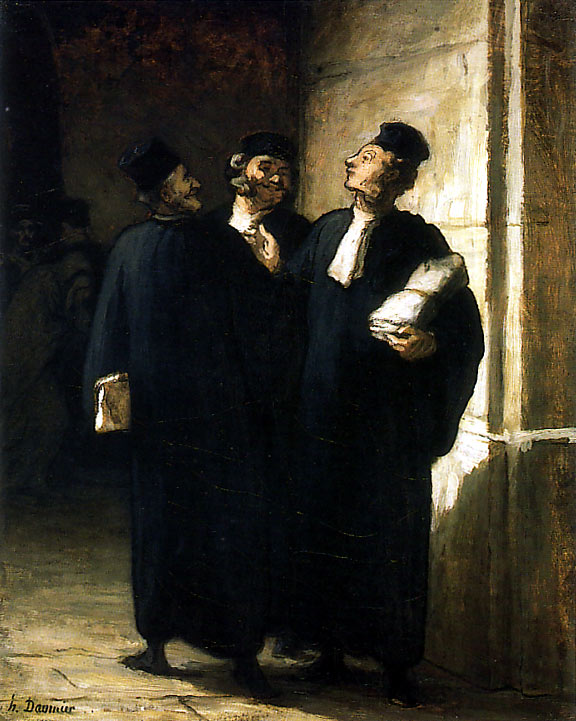
"The Lawyers", circa 1855, Honoré Daumier (1808-1879)
Are the three gentlemen in this famous sketch client-centric or "lawyer-oriented"? We will never know.
WLCs, maybe?
A WLC is a Weak or Wimpy Local Counsel engaged by your firm and/or your client for litigation or other contentious matters who, after being hired, instinctively, routinely, and most often inadvertantly place their relationships with local lawyers and other players in their jurisdiction ahead of the interests of your shared client, which is almost always "an outsider".
Signature noise: "I have to practice in this town." They are akin to rocks, plants, and household appliances. They are legion. They don't get it. Avoid them. See our October 2008 piece "Weak/Wimpy Local Counsel: The Next Epidemic?".
Posted by JD Hull at 11:59 PM | Comments (1)
August 18, 2009
Litigation: If you bill by the hour, why not bill twice a month?
Billing twice a month keeps the client more attuned in real-time to the actual economic demands of the project--and helps the client plan.
When things get fast and intense, invoice the client twice a month--just ask first. Hopefully, ideas included in this blog benefit both the client and firms. One theme is we can move from goofy "adversarial" (see this blog's first post in August 2005) and one-night stand relationships many lawyers seem have with clients to true partnerships with clients--by doing things the right way for clients we all "like".
Here's one idea that's unusual but effective. I got it from my Pittsburgh partner Julie McGuire, who does transactional work, and it really seems to work for intense or "fast-moving" projects.
If a new or existing client has litigation or a transaction which is particularly intense and time-consuming--especially in the initial stages--depart from your fee agreement or usual practice with that client and at least temporarily invoice the client every two weeks.
Obviously, you should check with the client and get permission; this could be balked at as an administrative burden or misunderstood as an insult if the client isn't on board.
But even a gung-ho sophisticated corporate client or GC you've serviced for years--which is accustomed to seeing over and over again monthly bills for day-to-day work in the, say, $5000 to $10,000 range--experiences a kind of sticker shock when the bill goes suddenly to $20,000, $40,000 or much higher, even if it's only for a short time.
Billing twice a month does two things: (1) keeps the client more attuned in real-time to the actual economic demands of the project (and lets the client plan) and, (2) assuming that the GC or other client rep is seeing work descriptions on bills that show value, effort and the range of things necessary to perform the litigation or deal, the details and intensity of the work are more "present-to-mind", better understood and more fully appreciated.
In other words, the invoice becomes more of a tool to impart a running report on what you and the client are doing together--and a better picture of your real value to the client on that project.
(from past posts)
Posted by JD Hull at 01:49 AM | Comments (0)
August 13, 2009
Litigation: The Miracle, Salvation, and Holy Surprise of Rule 56(f), Fed. R. Civ. P.
(f) When Affidavits Are Unavailable.
If a party opposing the motion shows by affidavit that, for specified reasons, it cannot present facts essential to justify its opposition, the court may:
(1) deny the motion;
(2) order a continuance to enable affidavits to be obtained, depositions to be taken, or other discovery to be undertaken; or
(3) issue any other just order.
Another WAC? Sensitive Litigation Moment. Trial lawyers know that Rule 56 of the Federal Rules of Civil Procedure, or summary judgment, gives a litigant an opportunity to win on its claims or dispose of the opponent's claims relatively quickly and without trial. Accompanied by sworn affidavits, and most often discovery responses, a Rule 56 motion tries to show that there is no real dispute about key facts and that the movant is entitled to judgment under the law.
If the trial court grants it, the movant wins on those claims.
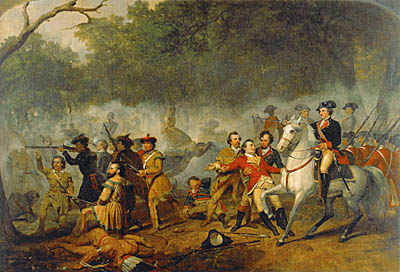
Disruptive as Hell: The "early-in-case" Rule 56 motion (note well-dressed Brit GC after taking a bullet here).
But what if a summary judgment motion is brought against your client--suddenly and out of the blue--and the local rules (or local folkways and practices) of the district court don't give you much time to develop and prepare an opposition. After all, Rule 56 lets a party who has brought a claim file for summary judgment after 20 days, and defendants can file "at any time".
In contentious, high stakes litigation, a quick summary judgment motion right after the commencement of a lawsuit can be extraordinarily disruptive--no matter how it is resolved by the district court. It will fluster even the most battle-hardened-been-there-seen-that GC or in-house counsel.
And it's an expensive little sideshow, too.
Subdivision (f) of Rule 56, "When Affidavits are Unavailable", provides a safeguard against premature grants of SJ. Lots of good lawyers seem either to not know about--or to not use--subdivision (f) of Rule 56.
In short, you file your own motion and affidavit--there are weighty sanctions if you misuse the rule, so be careful--stating affidavits by persons with knowledge needed to oppose the motion are "not available", and stating why.
The district court can then (1) deny the request and make you oppose the motion, (2) refuse to grant the motion for SJ OR do what you really want it to do: (3) grant a continuance so that you can "obtain" affidavits and, better yet, take depositions or conduct other discovery.
Granted, it's a delay-oriented rule, but if used correctly, Rule 56(f) can give you the breathing room and time you need to develop the client's case, and avoid the granting of summary judgment against it.
Note: Some months ago our friend John Day--a Tennessee trial lawyer recently honored by his peers, and a man who thinks it's a privilege to practice law--responded to an earlier and similar post we published, and he made this comment, which we wish we'd written:
Another tactic is promptly serving notices to take appropriate depositions before the Rule 56 response deadline (if you already have enough information to take a good deposition in the case). The opponent almost always objects to the timing of the deposition--and thus you can put the unavailability of a witness and/or counsel in your affidavit while at the same time illustrating your commitment to move the case forward.
A judge may well decline to give more time to gather evidence if no effort has been made to conduct discovery while the case has been pending. This is yet another reason to have a discovery plan in place very early in the litigation (and if you're the plaintiff before suit is filed) and promptly serve written discovery/take depositions/do discovery under Rule 45 [non-party] in a sequence appropriate for that case.
Posted by JD Hull at 11:20 PM | Comments (2)
August 12, 2009
Eunice Kennedy Shriver (1921-2009)

I grew up in a family of Depression Era-WWII Parents and Boomer Kids. For us, the U.S. economy overall was very good in the 1950s-1970s as we moved around in corporate America from D.C. to Chicago, Grand Rapids, Detroit, Chicago again, and finally southern Ohio. We were not poor. My brother, sister and I attended some of the finest secondary schools in the U.S. My parents--especially my mother, a 1960s prototype of the Strong Suburban Super-Mommy, and one with a caregiver's heart--stressed not only achievement in school and sports, and having constant paid part-time jobs, but also on working with the physically or mentally handicapped, or the otherwise unlucky.
And we were to do that without telling the world about what completely lucky and swell people we were. It meant spending your time, and part of your soul. Bonus: You need not be paid money in those part-time jobs. Secret: You got more than you ever gave. We volunteered--Stepping Stones Center in Cincinnati was just one venue--and my mother and sister each entered careers to work with special adults or special children. Eunice Kennedy died yesterday. No matter what your age, your politics, or your tolerance for social welfare programs, the middle child of Rose and Joseph Kennedy was a very big deal in making lucky people realize how much unlucky people had to give to them. See in the Washington Post this editorial.
Posted by JD Hull at 11:59 PM | Comments (0)
E-mail: Are you lawyering or typing? Is either one of them working for you?
Humans are damn fine machines when plugged into one another. Voices, vibes, faces, bodies, winks, hand gestures, touching another's hand or shoulder impulsively, stares, grins, frowns, hand-written thank you notes, human electricity, NOT-typing, non-virtual joking, yelling, ragging and flirting, real confrontation, intimacy and the "god-in-the-room" magic that starts with two breathing humans in one 3-D place. Stuff gets done, too--and done right. What happened?
--What About Clients? in past posts over the years.
I remember when I first got e-mail, back in the mid-1990s. I would rush home with great anticipation and dial in my 4800-baud modem and I would have...four messages from four very good friends....Now, of course, I get up in the morning and go to my computer and have sixty-four messages, and the anticipation I once felt has been replaced by dread.
--Malcolm Gladwell, The Tipping Point, in Afterword to 2002 edition, 274 (Little, Brown & Co.)
E-mail is an overhyped, misused tool. And so are you if you use it without thinking. I receive about 100 non-spam e-mails a day. I write about one third that many, most as replies. Usually short ones. They are often soulless, and easy to misunderstand, even when I try to be precise. Unless I am scheduling when and where to meet someone, I am not sure that I see the point of it anymore.
The e-mails I get back are often worse than the ones I write. The truth: most lawyers just can't write. When they write, they "talk to themselves"--like mental patients do rocking back and forth. Typing it themselves makes all that more of a problem.
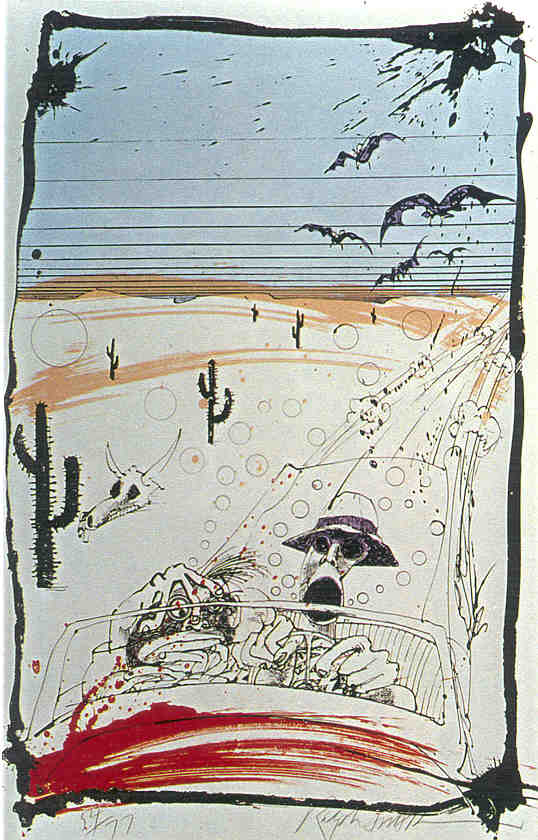
E-mailing "just because" is Bad Craziness--and you might start seeing those bats. Or worse. (Art: R. Steadman)
My rule, lately: If I spend more than two hours total a day facing a computer screen, I think of that day as a Failure. My job is to think, brainstorm, plan, organize, write, persuade and solve problems. If I spend more than a total of two hours being my own (and third) administrative assistant--and that includes both productive "thinking" and email-returning "non-thinking" typing--I am just another new Insular Robot Worker-Human.
Forget about being One with the Cosmos; I am barely One with the Zip Code, the Suburb, or the Office Building. Even in my office, with people around, I am an Electronic Island With Cool Toys. Alone. Cut off. Isolated. In reality, and ironically, I am not communicative at all. Ah, good morning fellow dumb-downed robots.
You have a good idea? About the firm, or solving a problem for a client? If you e-mail me about it, you have become insane. Whether you are down the hall, or 2000 miles away, you have lost it. Okay, e-mail me once. Yes, writing helps put your thoughts in order. Sure, get my attention. Then call me. Or meet with me. We can make your idea better while we are talking--and do that quicker. Get the juices flowing.
Voices and "bodies in the room" are perhaps 100 times faster and better at defining and solving a problem. At least. Add a third human--you will get more. Humans are damn fine machines when plugged into one another.
But, and I repeat: if you e-mail me about a truly great idea, and expect to develop the idea efficiently in an e-mail discourse, you are truly insane. Get the net.
Back to Galdwell, in the second opening quote. As it's been eight years since he wrote the above, and he is even more famous, Gladwell surely gets more than 100 each day. It's a mantra now that communications technologies save time and money, including bucks on brick and mortar rents for business. It's all true, exciting, Yankee innovative-cool and--a word film actor William Hurt uncannily slips into so many of his lines over the years--forever "evolving."
See Me, Feel Me, Call Me. But some of us don't even talk as much to people we see every day at work. We do e-mail. What happened to voices, vibes, faces, bodies, winks, hand gestures, touching another's hand or shoulder impulsively, stares, grins, frowns, hand-written thank you notes, human electricity, NOT-typing, non-virtual joking, yelling, ragging and flirting, occasional confrontation, intimacy and the "god-in-the-room" magic that starts with two breathing humans in one 3-D place? Or at least on the phone?
Folks, the electronic toys we have were supposed to be helping tools--not be the main event. Do we appreciate the way e-mail, search engines and social media (yes, including blogging) often degrade and dumb down the complexity of hard problems in this world? Has all this made us smarter and better? Or are we just lemmings, cattle and sheep--lulled into thinking we must be doing good work if these new tools are so amazing? Is Google--how many impulses, instincts, synapses does the otherwise useful Google Dude have?--more inspiring and useful than the wonderfully fast and storied brain of that lawyer next door?
Has "tech" permitted a large cross-section of previously functional humans to hide from--and never learn and benefit from--the complexity of life and work? And from each other?
Posted by JD Hull at 11:59 PM | Comments (0)
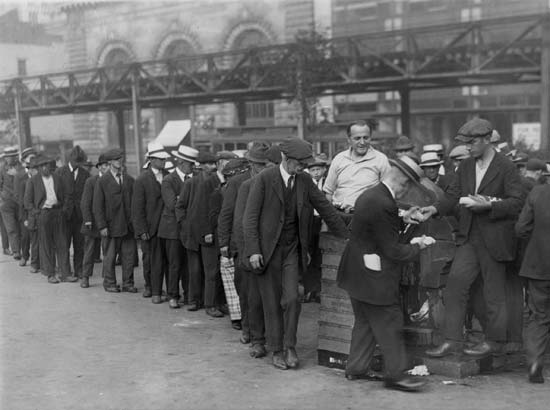
More Manhattan Moxie: "Notes from the Breadline" continues.
Going suddenly solo and writing about it takes big ones. See at Above the Law: "To Be On Your Own (Part II)", by NYC heroine "Roxana St Thomas" who, for obvious reasons, gets a WAC? Club Ned anonymity permit. Our blog, our rules. If you comment, please use your real name. If you do not, we will track you down, drag you out of your house at 100 Happy Street one Saturday morning, and humiliate you in front of your family, your neighbors, and your little white dog.
Posted by Rob Bodine at 12:50 AM | Comments (2)
August 10, 2009
Paris and Real Life: In black, white and fresh.
Work and life. I love both so I do not separate them. No need to. They usually merge, occasionally split, but always dance with one another.
And their quality depends in large part upon whether I can manage to see conventional things differently--with a sense of surprise. Put another way, can I see routine things--in life and work--as a child would see them for the first time? If I can, it helps me. Helps clients, too. It improves problem-solving at all levels.
On the countless stays I've had in Paris, I visited the Eiffel Tower just once, on my second trip. Even then I thought it was boring and a waste of time--except I met on the tower a woman named Linda who stayed in my life for nearly 10 years. She was smart, beautiful, regal and hopelessly difficult--but never boring. Her arrival forced me to grow and create.
However, unlike Linda, views from, or of, the Eiffel Tower did not excite, overwhelm or inspire. Linda is much much better--in person, in memory. In short, this world famous landmark, as extraordinary as it is, never did much for me. You can have it.
But I am wrong about something every day. You do need to keep changing eyeglasses for work and life. And maybe even for the Eiffel Tower. At Eye Prefer Paris, which ex-New Yorker Richard Nahem writes from the Marais district, Nahem shows in "My Most Unique & Unusual Eiffel Tower Photos" how tired landmarks can be interesting again. For example:

Photo: Richard Nahem
Posted by JD Hull at 02:59 AM | Comments (0)
August 08, 2009
Greater China: More than a feeling.
Dan Harris is no digital creep. In good and bad times, China is part of our new world. Visit China Law Blog. Bold, aggressive, never a generic "law weenie", and a stand-up Midwesterner like WAC?, Dan Harris (bonus: his real name!) thinks about and covers China business and culture better than anyone. Find out about "getting on" in China.

Posted by JD Hull at 09:52 PM | Comments (1)

Posted by JD Hull at 12:47 AM | Comments (0)
August 06, 2009
Nicely done, WJC.
Bill Clinton always did come to play. He and movie pals have excellent airplane adventure, do critical reconnaissance on the Dear Leader, secure release of Ling and Lee, and set stage for future talks on North Korea’s nuclear programs. Not bad, sir. See "Bill Clinton has quite a story to tell", a Reuters piece by Steve Holland, and "Let the Big Dog Run", a New York Times op-ed by Maureen Dowd.

It's not just Kim Jong-il. Even President Obama gets a little weird and excited around Wild Bill.
Posted by JD Hull at 11:56 PM | Comments (0)
Can "professionalism" be a smokescreen for mediocre lawyering?
"Professionalism"--like good crops, the flag and motherhood--is indeed hard to criticize. It is also tough to define. Is it always good for clients? Or can it even hurt?
It's not about the lawyers anymore. In litigation, and in other contentious projects, does the practice of routinely and without question granting extensions, expanding deadlines, and saying "yes" to an adversary's requests for an accommodation really help clients? Or are such courtesies merely effete and provincial folkways that take the focus off the main event: solving problems for clients? See "Professionalism Revisited: What About the Client?" in San Diego's The Daily Transcript of April 29, 2005. Has anything changed in five years?
Posted by Rob Bodine at 09:04 PM | Comments (0)
August 05, 2009
Speaking and Writing Well: The Overstatement.
If you're wonderfully but spectacularly Irish, like WAC?, and you try cases, you should also take notes here. And then take a year off from work. Just to study your notes and practice your speaking and writing.
Well, maybe take off two or three years. Think of it as an extended rehab for those who chew more than they bite off.
See at The Trial Practice Tips Weblog "The Only Writing Tip That Really Matters", which quotes William Strunk, Jr. and E.B. White's The Elements of Style:
When you overstate, readers will be instantly on guard, and everything that has preceded your overstatement as well as everything that follows it will be suspect in their minds because they have lost confidence in your judgment or your poise.

Blarney Castle, near Cork, Ireland, housing the Stone of Eloquence.
Posted by Rob Bodine at 11:59 PM | Comments (3)
August 03, 2009
Original Complaint
Ah, but it is hard to find this track of the divine in the midst of this life we lead...
Hermann Hesse, Steppenwolf (1927)

Posted by JD Hull at 11:59 PM | Comments (0)