January 20, 2015
Write "declination letters" confirming there is no engagement to two kinds of would-be clients: (a) unsophisticated users of legal services and (b) stone crazy people.

And now, my K Street pimp friend, you're going to write that Answer due tomorrow.
Lots of conversations with persons who approach your firm with a legal issue do not result in your getting hired. The matter might be too small, too insubstantial or not the kind of law you do. You usually know in the first few minutes. But very often the time from the initial call or meeting to saying "no" is protracted. You may need to review documents, or speak with someone they asked you to contact. However, that may take a few days, and involve a few conversations and emails.
In those cases in which you need to put off saying no, write a declination letter. Email. Regular mail. Something. Put it in writing that you are not her attorney. It's easy. It simply says you are confirming that you and your firm are NOT going to represent him, her or it in the matter at hand. It does not say why. It does not need to say why.
If the would-be client is an "unsophisticated user of legal services" or, in your view, a stone crazy person, the declination letter is especially important. You may even want to write one if there was only a short phone call or meeting to evaluate the matter followed by an immediate verbal "no". Again, if there may be any misunderstanding, write a declination letter. And do it quickly.
Frequent questions:
1. Do you really need to do this from time to time?
Answer: Yes. At least 4 or 5 times for would-be clients in a large or BigLaw firm during your career. In the smallest firms count on doing it at least 50 times in the course of a career. If you do plaintiff's PI or represent Mom and Pops business clients, you may do it more.
2. Who do you send them to and when?
Answer: (a) To would-be clients in situations where you take more time than usual to evaluate the matter they bring to you before saying no, (b) to unsophisticated users of legal services or, and most likely, (c) to crazy people who might tend to rely on your legal representation going forward despite the fact that you have declined the representation. Do it as soon as possible.
3. Why? Why would you ever need to send a declination letter?
Answer: Because unsophisticated and crazy clients are legion. They may not listen well. Or no one will represent them--and they may be so desperate for someone to move forward with their marginal or "dog" case that they in effect hijack you and your firm in hopes that you feel duty-bound to act or that you will change your mind. This is particularly true if a jurisdictional deadline is looming.
Posted by JD Hull at 11:59 PM | Comments (0)
December 31, 2014
William Carlos Williams: On Reinvention.
Without invention nothing is well spaced,
unless the mind change, unless
the stars are new measured, according
to their relative positions, the
line will not change, the necessity
will not matriculate: unless there is
a new mind there cannot be a new
line, the old will go on
repeating itself with recurring
deadliness.
William Carlos Williams in Paterson, Book 2 ("Sunday in the Park")

Posted by JD Hull at 12:59 AM | Comments (0)
December 15, 2014
Clients don't want perfect. They want excellent. Excellent is way harder.
Clients 99.5% of the time are not paying you to be perfect. Clients don't want perfect. In the rare instances they do want perfect, they will let you know. So clients want excellent. Be excellent, not perfect. See, e.g., "Rule 10: Be Accurate, Thorough and Timely--But Not Perfect" of our world-famous and irritating but life-changing 12 Rules of Client Service.

Perfectionism: The horror, the horror.
Posted by JD Hull at 12:18 AM | Comments (0)
August 29, 2014
NYT op-ed: 24/7 workplace email is Bad Craziness. How about time-outs evenings and weekends?
In the New York Times yesterday, contributing writer Clive Thompson, also the author of "Smarter Than You Think: How Technology Is Changing Our Minds for the Better”, suggests that Americans should strive to be more like our suddenly more-mellow cousins in Germany (yeah, Germany) and end the tyranny of 24/7 emails. We should have regular--yes, daily--off-periods or "time-outs" for workplace email. In America, would such a regime be wimpy, sane or something in between? At WAC/P, we like and support the idea. The Western preoccupation with constantly checking business and workplace email has become an hysteria that feeds on our employee-as-peasant mentality and increasingly has little to do with thinking and solving problems, i.e., doing work. Thompson's "radical" if sane piece begins:
This Labor Day weekend, odds are you’ll peek at your work email on your “day off” — and then feel guilty about it.
You might envy the serene workers at Daimler, the German automaker. On vacations, employees can set their corporate email to “holiday mode.” Anyone who emails them gets an auto-reply saying the employee isn’t in, and offering contact details for an alternate, on-call staff person. Then poof, the incoming email is deleted — so that employees don’t have to return to inboxes engorged with digital missives in their absence. “The idea behind it is to give people a break and let them rest,” a Daimler spokesman told Time magazine. “Then they can come back to work with a fresh spirit.”
Limiting workplace email seems radical, but it’s a trend in Germany, where Volkswagen and Deutsche Telekom have adopted policies that limit work-related email to some employees on evenings and weekends. If this can happen in precision-mad, high-productivity Germany, could it happen in the United States? Absolutely. It not only could, but it should.
White-collar cubicle dwellers complain about email for good reason. They spend 28 percent of their workweek slogging through the stuff, according to the McKinsey Global Institute. They check their messages 74 times a day, on average, according to Gloria Mark, an authority on workplace behavior and a professor at the University of California, Irvine.
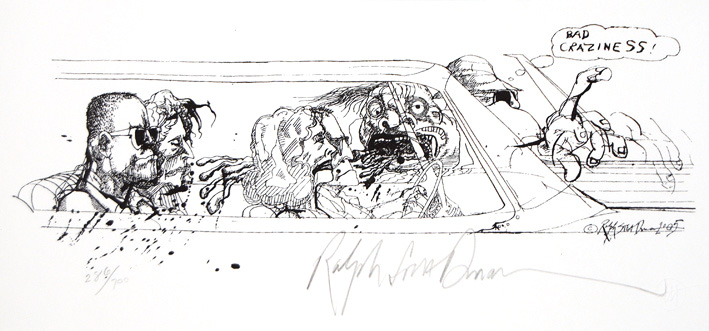
Image: Ralph Steadman
Posted by JD Hull at 08:35 AM | Comments (0)
August 08, 2014
What I learned at work today.
If there is something about a strategy, a client demand, a candidate for employment, a new firm policy, a document-in-progress or draft of a pleading, brief or contract for a client, and you just can't articulate the problem, your instincts are trying to help you. Articulate it. Discuss it. Fix it now.
(Sorry to be metaphysically clumsy. It happens.)
Posted by JD Hull at 03:11 PM | Comments (0)
June 13, 2014
Did we all die and go to Hallmark?
"Praise empowers people, criticism intimidates, ignoring confuses."
--Via LinkedIn mail this morning
Died and went to Hallmark. That's the feeling we had when we read this somewhat Orwellian sentence quoted immediately above. A few inches below, you see the cheery declaration again, this time in its original form, and the way it appeared this morning on the happy, positive thumbs-up image. Just two other things. First, we prize solving hard problems for customers. That's what we do. It's what any services provider does. Second, we would never build, and would not feel comfortable spending any time around, a workplace culture that: (1) praised employees for no reason except to make them feel good, (2) withheld criticism (even harsh criticism) from employees to avoid hurt feelings, (3) expected senior people and supervisors to worry about the effect of every word and action on employees, and (4) otherwise put employees ahead of customers.
Have a nice weekend, everyone. Whether you are working or playing, don't hold back.

Posted by JD Hull at 01:31 PM | Comments (0)
April 28, 2014
Rites of Spring: Evaluations based--at least in part--on client service standards.
This blog began nine years ago as a daily diversion from the demands of lawyering. It became an eclectic soapbox for a few pet issues and interests: discovery and trial, arbitration in the Americas and abroad, popularly-elected state judges, cultural literacy in America, online anonymity, Parker Posey, the wonders of London and Paris--and building and enforcing customer service regimes for professionals. Lawyers especially. If you are serious about building and keeping a client service culture, weave specific client service standards into every employee performance review. We think it's an idea here to stay.
.jpg)
Posted by JD Hull at 02:26 PM | Comments (0)
March 08, 2014
Peter F. Drucker: Managing Oneself.
Here is the starting point of all management. Thanks to my friend John Davidson, a St. Louis business lawyer, and a fine and refreshing thinker in his own right, for reminding us all of the enduring Wonder of Drucker and, in particular, of one of Peter Drucker's best essays. See "Managing Oneself" which last appeared in the Harvard Business Review in January of 2005. There are few real classics. This is one of them.
.jpg)
Posted by JD Hull at 11:56 PM | Comments (0)
February 10, 2014
You need a "New Mind" for Reinvention--Part 2.
Last week, Reinvent Law came to the Great Hall at Cooper Union in New York City. Scott Greenfield, trial lawyer, writer and my second favorite New Yorker (after Parker Posey), was there. Over at Simple Justice, his daily Speakers' Corner, he has these two posts: #ReinventLaw NYC: A Survivor’s Tale and A Plea Agreement With An Easy To Use Handle.
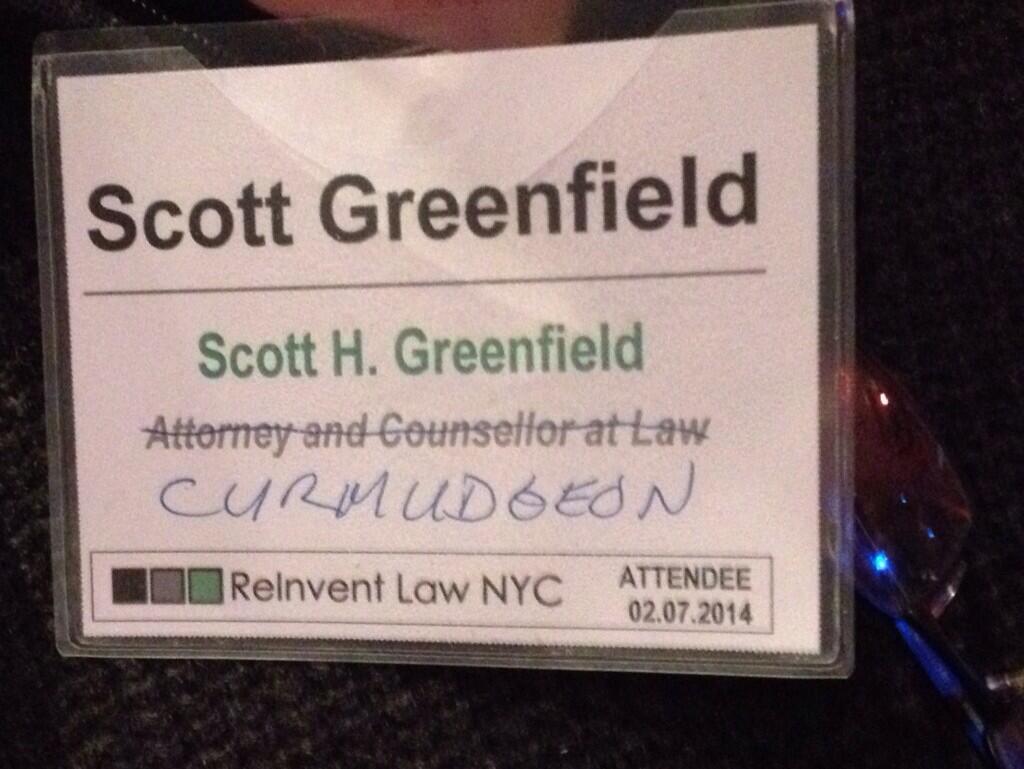
SHG
Posted by JD Hull at 11:03 PM | Comments (0)
February 06, 2014
Curse of the Silo: "An Aggregation of Narrow Views."
If there’s anything that kills customer experience, it’s the territory wars inside organizations.
--Jeannie Walters, Founder, 360Connext, Chicago, Illinois
The creation of "silos" inside the largest Western law firms became an issue a few years ago. For those firms, a "silo", of course, meant something other than a tall agricultural storage device for grain. It had become instead a metaphor for the following: a part or process of a business that operates in isolation from other parts and processes of that business.
Silo mentality and silo cultures develop in organizations which are growing, multi-specialized and committed to separately managing and promoting each new area of sales. As a result, distinct "feifdoms" arise which seem to compete with or, worse, cavalierly ignore one another. The feifdoms (a) don't collaborate with each other to serve clients, (b) don't cross-sell together to acquire new clients or to keep existing ones, (c) do compete with each other internally for shares of the client's legal spend or (d) have all of the foregoing problems. Both the firm and client/customers it serves are compromised, and in ways that are probably measurable.
About five years ago,
Morrison and Elefant had a compelling point. To take just one example, and based on my own experiences, I do have the sense that corporate lawyers in smaller firms or boutiques are better issue-spotters than their counterparts at larger firms. They excel at seeing "the big picture". They may even thrive on working in, or at least identifying, cross-practice issues. They are like quarterbacks and point guards. Kaleidoscopic is another word that comes to mind.
Lawyers at larger firms work at some of the most storied and exciting problem-solving labs in the world. They are well-trained, energetic, smart and often gifted (even if the gene pool is a bit diminished from the good old days). Not only do I trust them, I tend to prefer them. And while they are sought-after professionals of rare abilities within a given specialty or sub-specialty, their excellence comes at the price: the myopia of uber-specialization.
Lawyers with similarly superior credentials in smaller shops who service the same corporate clients--yes, that does happen, folks--are arguably more versatile and broad-gauged. Smaller firm lawyers issues under practice areas about which they are not expert, but know enough about to have a competent instinct. Silo mentality and the "aggregation of narrow views" is not part of their day-to-day experience.
Silos, of course, can arise almost anywhere. Clients, the companies we serve, can have the same problem. In fact, most of them do. Last week, Jeannie Walters, the Chicago-based consultant and writer, and founder of 360Connext, wrote on "How To Expand Your C-Suite Without Creating New Silo" at Business2Community. It's an interesting piece, confirming that silos cultures can hamstring our clients, if under much different circumstances. If your firm represents large or sophisticated companies, you should read it. Here's an excerpt:
As the C-Suite becomes more crowded, it’s important everyone feels heard. ....Chief Digital Officers are not necessarily replacing Chief Information Officers. So where is the line? Do they know? What about the Chief Marketing Officer and the Chief Customer Officer? Where does one role end and the next take over? It’s so tempting to think another role, another department or another leader will fix all the ills. But that’s just not the case. Leaders show the way to their teams, and if they are confused or worried about overstepping, their people will pick up on that.

Photo: Dale Mahalko, Gilman, WI,
Posted by JD Hull at 11:22 PM | Comments (0)
January 22, 2014
Got sand?
Posted by Holden Oliver (Kitzbühel Desk) at 12:00 AM | Comments (0)
January 15, 2014
Employee Reviews on CS Standards: How Do Your Firm's Dweebs Measure Up?
Are you serious about all that client service stuff on your website? Then talk about real customer service every single day, as if it were a substantive area of law practice. Make it a running conversation. If you are serious about building and keeping a "client service culture", you need to underscore it at every performance review. It's an idea that is here to stay in this, or any other economy.
.jpg)
Posted by Holden Oliver (Kitzbühel Desk) at 01:59 PM | Comments (0)
January 06, 2014
Redux: In Praise of Structure
For a long time I've thought that American business schools and the training programs of global and often publicly-traded companies do a much, much better job than do law firms of training recruits to value and adhere to the structure of a plan on an item for action.
Do we lawyers know how to get things done, done right and done on time? Do we even value that? I wonder.
I am not talking here about the simple "keeping face" and survival requirements of meeting client deal or court deadlines, or even about the cliches of working hard, creative thinking, "out of the box", working smart or being persistent. I mean structure, a real standard, and "practicing structure" every day--the discipline of (1) having a plan or strategy for any one project, client or non-client, (2) meeting internal project deadlines no matter what, and (3) applying the will to work that plan and timetable.
"Structure" is not just the hard process of getting things done. It's a frame of mind and a value which must be sold to others in your shop--like the importance of making that 5 minute call to a client about a loose end at the end of the worst day you can remember, even while you could do it the next morning at 8:00. It's realizing that letting anything but emergency tasks "slide" makes you inefficient, unlikely to meet your real goals, and tired.
Do you get up early every day with a idea of what needs to be done on each project, and knowing the difference between "important" and "urgent"? Example: Monday is your deadline to have the final changes and notes to your web designer on your new firm website, an important but not urgent project you've talked about at internal meetings for months. So far, for once, you have been on track. But on Monday a longstanding client calls with two new projects; the new projects are exciting but not THAT urgent in the sense they need to cut into internal deadlines and other goals for Monday. You need to take some first steps, though, to get on top of the new matters for your client. After all, these folks are the main event.
Key ongoing internal project v. new client project. Which gets the most attention that day? Which slides? Answer: they both get attention, and neither slides. The website (long-term important) and the new client project (short-term important) are both critical projects. Years ago the Stephen Coveys and Edwards Demings out there pointed out that business people burn themselves out by waiting around only for "the urgent" in a kind of manic crisis management that keeps other important things from ever getting done or ONLY getting them done when they morph into a crisis. For lawyers, other examples would be only respecting deadlines like transaction closing dates and court-filing deadlines--to hell with everything else.
For a long time I've thought that American business schools and the training programs of global and often publicly-traded companies do a much, much better job than do law firms of training recruits to value and adhere to the structure of a plan on an item for action. It's almost as if law school and firms deem us all such "professionals" and "artists" that we are beyond learning skills of project planning and execution. What a crock. Not learning the value of pushing non-urgent but important things along at a steady pace has cost us dearly. As motivated as lawyers often are, our discipline for sticking to anything and seeing it through is often poor; again, unless it's urgent, we just don't see its value. Do our best clients run their businesses that way?
This attitude is the norm, and we lawyers--who rarely innovate or take a leadership position on anything in commerce--are just fine, thank you, with it. After all, "all the other law firms" are mediocre on the discipline of getting things done, and have "crisis-only" mentalities--why shouldn't we be that way? So we waste time blowing off important but longer term projects. Worst of all, we send to others in our firms, and especially to younger lawyers, the message: "No worries--just work on a barely adequate level; don't do things until you have to; and if it's not urgent, let it slide." As with client care and service, our standard is not only embarrassingly low, we are exporting that low standard internally whenever and wherever we can.
Posted by JD Hull at 08:54 PM | Comments (0)
December 06, 2013
Robert Frost: Work-Life Scottish.
The difference between a job and a career is the difference between forty and sixty hours a week.
--Robert Frost, Poet and Yankee. He won the Pulitzer Prize four times.
.jpg)
Posted by Holden Oliver (Kitzbühel Desk) at 11:59 PM | Comments (0)
November 16, 2013
Try This At Work: Change How Clients Think About Lawyers.
The work of a bricklayer goes to the blue.
The knack of a mason outlasts a moon.
The hands of a plasterer hold a room together.
The land of a farmer wishes him back again.--Carl Sandburg (1878-1967), author, editor, poet, Pulitzer winner.
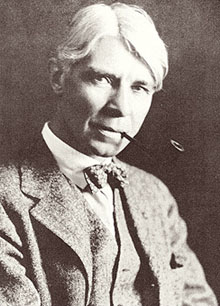
"The lawyers, Bob, know too much..."
But first: hearse horses, anyone? Do you love what you do? Step back from the canvas and try some simple tool sharpening. Bone up on your fundamentals, maybe. Your techniques. Do you need some new ideas? How does your firm do its work these days? Do you get things right? What do you teach associates?
Now step back further. What of this Lawyering Thing? Clients? What is it you really do for them? You serve, right? You mix your products and services with an overall experience that makes you unique, right? Or are you and yours indistinguishable from the rest of the generic law cattle out there? Is your firm really different?
Step back again.
Are you problem-solvers? Or just part of a "club" that needs clients as equipment to pursue a daily game? Does practicing law and serving turn you on?
Or is it just a past choice you, or your partners, made--one that hardened around you long ago--and now regret?
Too many people practice law who should not. Practicing law is hard.
Client service is just as hard. But many people with law degrees--there are way too many of us in the U.S.--don't get that. Or they don't love it. If either applies to you, or to your colleagues, it's not too late to "get it", to get it back, to love it (again or for the first time) or just to try something different and new.
The law is not for everyone. And to do it right day-in and -out is a hard order. A privilege, too.
If you wish to stay in the profession, try to make it what it can and should be. Visit our world-famous, annoying, counter-intuitive but dead-on accurate 12 Rules of Client Service. See "Rule Four: Deliver legal services that change the way clients think about lawyers".
Posted by Holden Oliver (Kitzbühel Desk) at 12:19 AM | Comments (0)
November 09, 2013
Euripides: On Dog Fights.
Ten soldiers wisely led, will beat one hundred without a head.
--Euripides (480-406 BC)

Posted by JD Hull at 11:59 PM | Comments (0)
September 23, 2013
Lawyering: Invoice some hourly work promptly every 2 weeks.
For relatively urgent things, or for transactions or litigation when they get fast. Here's a suggestion to make both clients and firms more efficient, better informed and way happier on any fast-moving project whenever an hourly rate is in the mix: real time billing. It's a no-brainer. But it takes some discipline. And ask that the invoice be paid in 15 days.

Posted by JD Hull at 12:01 PM | Comments (0)
September 09, 2013
What happens when you think on your own, anyway?
At Saatchi & Saatchi, Paul Arden's ad campaigns changed everything for British Airways.
Posted by JD Hull at 11:50 PM | Comments (0)
September 04, 2013
Got New Associates?
See "What are you thinking?" Also entitled: "If a neuron fires in a brilliant young lawyer's head, and no one hears it go off, did it even happen?"

Posted by JD Hull at 11:00 PM | Comments (0)
December 03, 2012
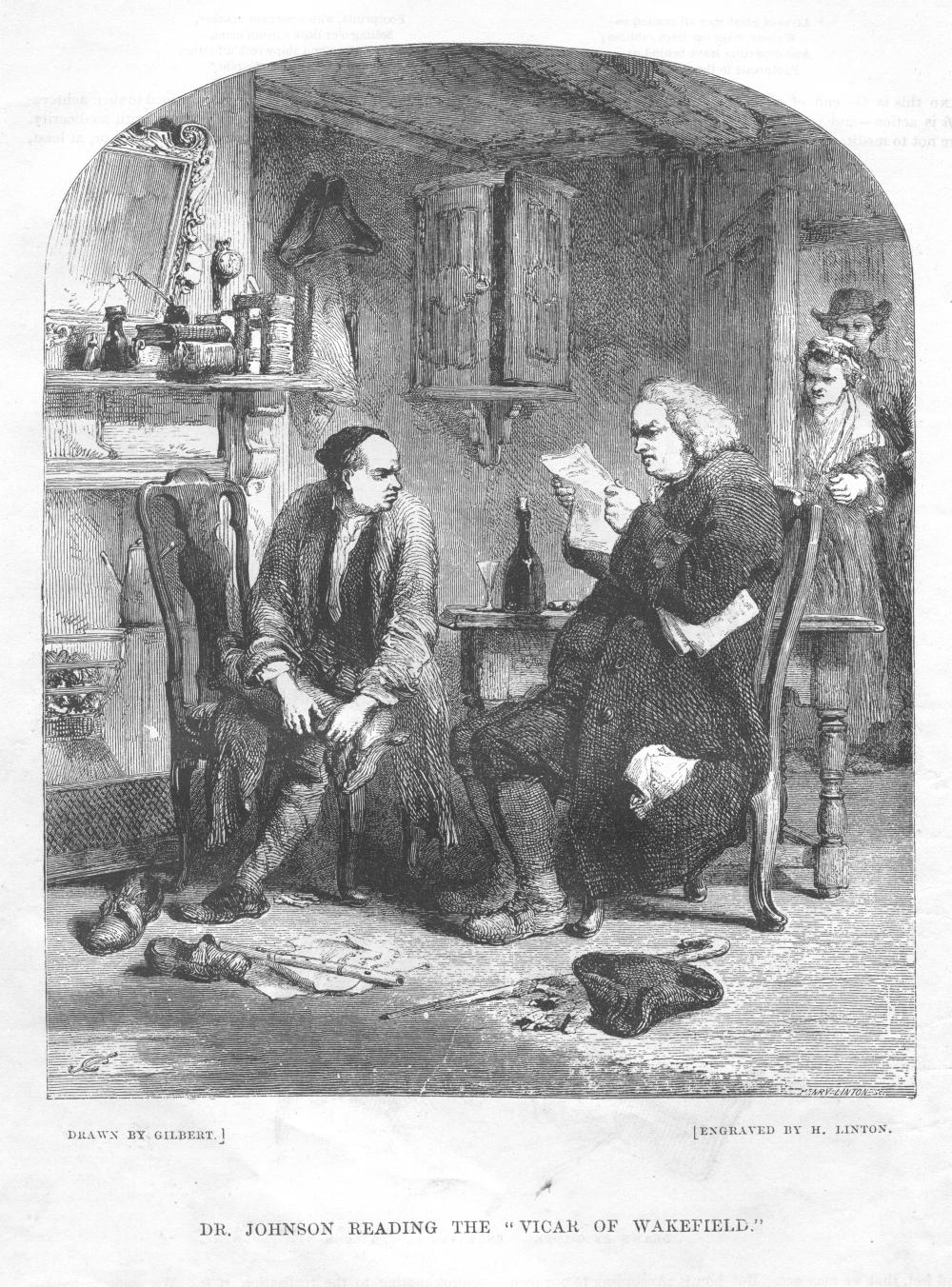
Samuel Johnson: Habits, Work and Straight-Up Magic.
What we hope ever to do with ease, we must learn first to do with diligence.
--Samuel Johnson (1709-1784)
Posted by Holden Oliver (Kitzbühel Desk) at 11:59 PM | Comments (0)
November 19, 2012
Charon QC's UK Law Tour: Why does it matter?
Answer: Because Western lawyers are famously resistant to change. English and North American lawyers, especially. We simply do not roll that well with the ups and downs of changing markets. And, certainly, we rarely see changes coming. Last month our friend Charon QC began his UK Law Tour--a legal Domesday census, if you will--to see how we are all dealing with the "new normal" for the profession. See his podcast yesterday with London-based Jeremy Hopkins, the operations chief of Riverview Law, a new kind of firm launched in North West England in May of 2011. And what does "customer-centric" mean? Is that something lawyers can be? Surely, you jest, sir.
Posted by JD Hull at 12:09 PM | Comments (0)
November 05, 2012
Getting Paid: Pedestrian Tip No. 3 on Invoicing to Avoid Hating Life.
If you are a professional services biller, your bills should genuinely reflect value and effort. Your descriptions in each bill of the work performed should be honest, in plain English and bounce off the page with "problem-solving". If they do not, don't bill that work.
Posted by JD Hull at 09:53 PM | Comments (0)
October 26, 2012
Lawyers and Depression: It Happens.
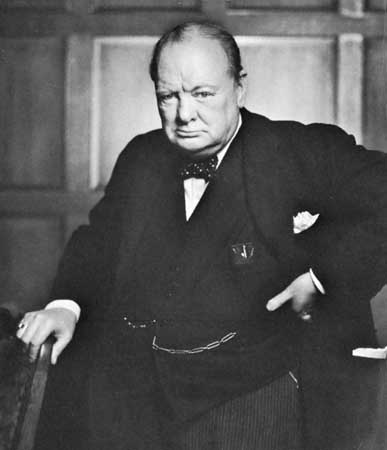
Speaking of the Black Dog, a term Winston Churchill gave to his bouts with depression, I've often wondered why the subject of lawyers with booze and drug problems has been out in the open for a fairly long time--at least since I started to practice law--but the discussion of clinical depression in our ranks is much more recent. Given the Type A personality of many (if not most) of us in the profession, you'd expect the discussion to at least keep pace with the one on substance abuse. It hasn't. When the Recession hit lawyers hard about three years ago, I started to notice some changes in more than a few of my friends and colleagues. But I am not an expert. It turns out there's an interesting blog called Lawyers with Depression, and it's a brave and thorough resource. Its author writes especially well. See his October 21 post, "Lawyer Blues or Depression? It begins:
I can spot sadness on lawyer’s face. Like a craggy poker player reads dog-eared cards in a smoke-laden backroom bar, world-weary drooped eyelids, even on young lawyers, which suggests a great weight borne, a solemnity. To others, their expressions may seem like a seasoned lawyer’s humorless, steely resolve. But, I know better. Their faces a subtler shade of grey, the somber hue of a 1L’s textbook on Contracts.
Their humorous repartee amongst each other, if any, can be a deeply cynical and sarcastic. It is a tough life for many in this boat; many dream, sadly, of a different life. “Every man has his secret,” wrote the poet Henry Wadsworth Longfellow, “which the world knows not; and often times we call a man cold when he is only sad.”
Posted by JD Hull at 11:59 PM | Comments (0)
October 25, 2012
Getting Paid: Pedestrian Tip No. 2 on Invoicing to Avoid Hating Life.
Make sure the client representative who actually requests or directs your work sees the bill each month or quarter. For long-standing clients, it's not unusual for a company employee who does not routinely deal with outside law firms to be directing the work your firm will do from time to time.
In the case of a client with more than one office or plant--and especially when in-house counsel or the the usual client representative is in just one central location--you may be working for an engagement or two with a client rep in another location who does not normally see the bills from outside firms. An environmental permitting project for one of your clients' plants or terminals in the boonies is a good example. The local person with the company will be in charge. And he or she do not regularly work with the client's lawyers.
Or maybe your client may have just one office or plant--and a sporadic or "new user" of your firm is suddenly calling the shots on what you are doing. They may not even think that much about the lawyer charges they might be ringing up.
In either case, BOTH (1) that local, sporadic or "new user" of your law firm AND (2) the usual rep or in-house counsel who normally approves invoices and pays them need to see the bill whether anyone suggests such a protocol or not. And you, as outside counsel, need to make sure that happens. Obvious reasons: Don't give a blank check to the client's local, sporadic or "new user" to use your law firm without some accountability. Make sure the rep or in-house counsel knows what the local project manager is spending. Those two operatives at the client need to be on the exact same page.

Another creature hating life.
Posted by JD Hull at 11:59 PM | Comments (0)
October 24, 2012
Getting Paid: Pedestrian Tip No. 1 on Invoicing to Avoid Hating Life.
Send the bill to more than one person. Everyone has a back-up these days, including "Opal" in the back rooms of Accounts Payable at your longstanding client down in Mobile. And everyone takes time off, gets sick, travels, has family emergencies and, well, you get the idea. Of course, whoever asks you to do the work you are trying to get paid for should always see your invoices (more on that in another post). But you should always find out right away and before the first bill is sent who Opal's back-up is (her name is often "Nadine") in the administrative section of your client and send your invoices to both Opal and Nadine. Whether it's by regular mail or e-mail, send invoices to both.
.jpg)
Vengeful animal hating life.
Posted by JD Hull at 11:01 PM | Comments (0)
October 01, 2012
HBR: "The Rise of the General Counsel."
GE's former general counsel Ben Heineman, Jr. has this one right. See his "The Rise of the General Counsel" appearing last week at Harvard Business Review. The in-house community is smarter and stronger than ever. And, no, apart from some GCs and their key lieutenants at a some publicly-traded and private companies, depth and great talent in in-house regimes was not the rule twenty years ago. But that has changed. And it's good news for great outside corporate lawyers.
.jpeg)
Posted by JD Hull at 09:08 PM | Comments (0)
August 27, 2012
The Trinities: Why "Threes"--with siblings, kids, dogs, cats, women, neighbors, co-workers--are always the most Instructive.
1. Just one (1) is one creature alone.
2. Two (2) means #1 has a Friend or Ally.
3. Three? Three (3) is Politics. And it is politics in its most basic, primal, emotional, methodical, swing-voting, fickle, devious, productive, infinite, uplifting and interesting form.
But dogs and cats are just as much fun to watch--and a lot easier than humans. A lot more.

The Trinity on "Dogmatic Sarcophagus", c. 350 AD, Vatican.
Posted by JD Hull at 01:37 PM | Comments (0)
August 17, 2012
Redux: Special Projects Groups for Expertise-Imprisoned Firms: Quarterbacks, Point Guards, Project Managers. These are your New Lead Dogs.
Increasing Complexity, Ambiguity and Multi-Practice Issues: The Need for One "Special Projects Group" in Every Larger Law Firm.
No matter what larger corporate law firms want to think, with five or six exceptions--e.g., think perhaps Baker, Kirkland, Skadden, Covington, Williams & Connolly, Boies Schiller--most GCs and CEOs have enormous problems distinguishing one large firm (i.e., 250 lawyers or more) from another. Clients are beginning to see peer law firms as generic. An SPG, done the right way, might make the right law firm stand out--and even do much better work.
Like others, we've written on several occasions and with different twists about the "silos" mentality of law firms in America and Britain serving higher-end corporate clients. And we do think--well, we simply know--that right now is the time for every one of the largest 250 Western law firms to develop, establish, carefully maintain and market to clients one strong Special Projects Group:
No, get over yourselves. If you are a larger firm, the entire operation will never be one SPG. It is our smaller firm's idea--based on the way we've delivered services to clients for over 15 years--and it has three parts. 1. Control whenever you can the kind of clients you serve long-term by researching and targeting only solid companies with savvy management and sophisticated general counsel. Choose your clients. 2. No matter how the work comes to you, be nimble: do the work better, faster and cheaper--but without reducing your “rack” hourly rates. In the end, deliver Value. 3. Operate on the assumption that many projects fall immediately into several practice areas and or even areas which have “no name.” Advise, transact and litigate that way.
Parts 2 and 3 of the idea address a problem Julie McGuire (from an in-house culture) and I (from a larger law firm culture) keep seeing repeatedly over the last 15 years. Many law firms that service large and publicly-trade companies take a fragmented approach to working for clients (as well as to prospecting for them). Lawyers in one specialty can’t or won’t spot issues that should get the attention of lawyers in different specialties that the great client really needs. Rather than being “full service,” the law firm is relegated to “an aggregation of narrow views” (a Carolyn Elefant term). The best clients and law firms on earth suffer from this problem. Some lawyers think of this as the competing “silos” mentality.

Walt Frazier, the best defensive point guard ever.
One possible solution is for larger firms is to (a) formally establish and (b) actively brand a special projects group (SPG). The SPG would be led by two or three lawyers who would be most likely to recognize the need for multi-specialty approaches to novel, complex engagements. They are full-time roving Quarterbacks--or Project Managers. The managers build a different team for each complex project and of course draw upon, whenever possible, lawyers from their own firm. But no law firm has the best of everything; good clients now know this. So SPG managers could in special cases go outside the firm to retain talent from another law or professional services firm.
Think of it as “unbundling” or freeing talent from sources outside the firm. In any case, work by an SPG--the law firm equivalent of special forces--would be done aggressively, quickly and at premium (i.e., higher) lawyer rates or equivalents.
Better Expertise. Apparently, no American or British law firm has yet established an SPG. But other large service companies have. For example, Turner Construction ($8 billion/5,000 employees) has a Special Projects Division with branches in several of its offices dedicated to lucrative but smaller-scale and higher-end design projects. The Division hand picks a different team for each project. Some construction industry folks regard Turner’s Special Project Division as operational and marketing brilliance.
Better Market Profile. Apart from delivering better services, an SPG can help differentiate a law firm from its competitors. No matter what large firm lawyers think, with five or six exceptions (e.g., Baker, Kirkland, Skadden, Covington, Williams & Connolly, Boies Schiller), most GCs and CEOs have enormous problems distinguishing one "large" firm (i.e., 250 lawyers or more) from another. Clients are beginning to see them as generic. An SPG, done the right way, might make the right law firm stand out.
.jpg)
Julie E. McGuire, Visionary.
[Updated 8-17-12]
Posted by JD Hull at 11:54 PM | Comments (0)
July 26, 2012
Late July, 2012: We Are Short-Handed This Week.
Ben, bring me everyone. We need people who know what the Hell they are doing. Somehow, we will find them and get things done for the next two days. Note: Do not call or e-mail. If you think you know what the Hell you are doing, you clearly don't. Yeah, we're impossible, I know.
Posted by JD Hull at 10:33 PM | Comments (0)
June 19, 2012
A Few Good King-Hell Eccentrics: Do you think rank-and-file employees are boring? Well, we do, too, Jack.
And is there a market, too, for the well-rounded geek? Is that coming? We all love employees, payroll soldiers and others from our multi-colored galaxy of white-collar dorks. They are essential. They execute and implement. They get stuff done. Certainly, no one could survive without them. But what kinds of personalities make businesses, make money and make our day? See this one by Schumpeter at The Economist earlier this month we almost missed, "In Praise of Misfits: Why business needs people with Asperger’s syndrome, attention-deficit disorder and dyslexia". It starts out wonderfully, and somewhat wistfully, particularly if you came of age in the three decades following WWII:
In 1956 William Whyte argued in his bestseller, “The Organisation Man”, that companies were so in love with “well-rounded” executives that they fought a “fight against genius”. Today many suffer from the opposite prejudice. Software firms gobble up anti-social geeks. Hedge funds hoover up equally oddball quants. Hollywood bends over backwards to accommodate the whims of creatives. And policymakers look to rule-breaking entrepreneurs to create jobs. Unlike the school playground, the marketplace is kind to misfits.
Recruiters have noticed that the mental qualities that make a good computer programmer resemble those that might get you diagnosed with Asperger’s syndrome: an obsessive interest in narrow subjects; a passion for numbers, patterns and machines; an addiction to repetitive tasks; and a lack of sensitivity to social cues. Some joke that the internet was invented by and for people who are “on the spectrum”, as they put it in the Valley. Online, you can communicate without the ordeal of meeting people.
Wired magazine once called it “the Geek Syndrome”. Speaking of internet firms founded in the past decade, Peter Thiel, an early Facebook investor, told the New Yorker that: “The people who run them are sort of autistic.” Yishan Wong, an ex-Facebooker, wrote that Mark Zuckerberg, the founder, has “a touch of Asperger’s”, in that “he does not provide much active feedback or confirmation that he is listening to you.” Craig Newmark, the founder of Craigslist, says he finds the symptoms of Asperger’s “uncomfortably familiar” when he hears them listed.

Robert Edward Ted Turner, circa 1953.
Posted by Holden Oliver (Kitzbühel Desk) at 11:59 PM | Comments (0)
June 12, 2012
HBR: In Praise of The Generalist. Just in time, too. "Domain expertise" was getting on everyone's nerves.
This appeared on June 4 in the Harvard Business Review and what we've been trying to tell you lately in any event: All Hail the Generalist, by Vikram Mansharamani. It begins:
We have become a society of specialists. Business thinkers point to "domain expertise" as an enduring source of advantage in today's competitive environment. The logic is straightforward: learn more about your function, acquire "expert" status, and you'll go further in your career.
But what if this approach is no longer valid? Corporations around the world have come to value expertise, and in so doing, have created a collection of individuals studying bark. There are many who have deeply studied its nooks, grooves, coloration, and texture. Few have developed the understanding that the bark is merely the outermost layer of a tree. Fewer still understand the tree is embedded in a forest.
Approximately 2,700 years ago, the Greek poet Archilochus wrote that "The fox knows many things, but the hedgehog knows one big thing." Isaiah Berlin's 1953 essay "The Fox and the Hedgehog" contrasts hedgehogs that "relate everything to a single, central vision" with foxes who "pursue many ends connected...if at all, only in some de facto way." It's really a story of specialists vs. generalists.

Mansharamani, at Blair Academy, Blairstown, NJ, in 2011.
Posted by JD Hull at 08:35 PM | Comments (0)
May 24, 2012
Clients to Firms: Keep your Myopics and Silos of Expertise. But let there be Quarterbacks and General Managers.
.jpg)
Clients: "We need Quarterbacks and Project Managers."
Redux and Tribute to the Prescience of Carolyn Elefant and Reese Morrison: The Big Law Firm Curse: "An aggregation of narrow views." We wrote this November 10, 2008:
The Big Law Firm Curse: "An aggregation of narrow views. Boom! Morrison nails it. Elefant names it.
Via Legal Blog Watch, and the alert eye of Ed. of Blawg Review, I read Rees Morrison's comprehensive and perceptive piece in the New York Law Journal about what larger law firms can and cannot do for clients.
My take: As a general rule, if you are that rare GC who doesn't know the terrain yet, and have no idea where else to turn, go to a big firm first. I can name 10 good ones I like between 500 and 3000 lawyers in five key practice areas that my firm and other boutiques conduct as well. Why not? The talent is there. It's still a good bet.
The Hitch: it's there somewhere--not throughout, and not in all areas--and you do have to find it.
On talent, both abroad and in the U.S., large law firms currently are a double-edged sword. They do have, and always will have talent; however, in recent years, they've diluted the gene pool on lateral hires in order to get bigger. So Ferraris, Jaguars, Chevy Aveos, pick-up trucks and rickshaws all run on the same track. And their offices in smaller cities abroad can be spotty, mediocre and even scary. (Do you really want "Borat" as your company's lawyer in, say, Eastern Europe?--because that is what you might get.)
Further, and as Morrison points out, there are in larger firms troublesome inflationary pressures on hours billed. Value questions. Forget about what the markets will bear; on a good day, first and second year associates are worth about -$50.00/hour, once you factor in what it takes to teach, guide and monitor them, and "remediate" their work.
An even bigger problem for WAC?, however, is what Morrison calls "deep specialization, but narrower perspective". Oddly, in the last year I have heard two in-house counsel mention this themselves about mega-firms: the lack of "broad-gauged" lawyers. These are leaders and facilitators who, in addition to a their own specialty, have an expansive frame of reference about the world, business, other practice areas, and how they all fit together. As Ari Gold would say, "Boom!" Morrison has nailed the biggest substantive large law firm problem. In her summary of Morrison article at LBW, Carolyn Elefant describes it the lack of "the ability to offer a broad perspective--only an aggregation of narrow views." Bravo, Morrison, and Elefant.
Posted by JD Hull at 10:59 AM | Comments (0)
May 02, 2012
In The Economist: Seriously, two (2) managers in each position makes a lot of sense.
You need one firm leader. But customers and clients need two folks on each project, no matter how small. Two people need to be available for both questions and a reserve of fresh ideas. But just two. Two project managers, and perhaps one with a "veto power". See The Economist: "In one's company, two's a crowd". And see our post "The Wonderful Twos".

Posted by JD Hull at 11:59 PM | Comments (0)
April 15, 2012
We thought "Unbundling" applied to lawyers was a Hull McGuire term/concept for 15 freaking years but...
...it's good it's out there. It's a team effort, anyway. Ah, hubris. Ego. Pride. And the license for unbridled grandiosity that attends all Anglos, cads, trial lawyers, dreamers, workaholics, the part-Irish and recovering addicts. (Hey, it was. Doing/saying it mixed with brick/mortar context for over 15 years.) But see "Launch of Unbundling Book at ABA Techshow", via our friend and ADR guru Don Philbin. We are so angry about this. May need to call Scott Greenfield or Bennet Kelley for a little IP Justice.
Posted by JD Hull at 02:49 PM | Comments (0)
April 14, 2012
WAC/P? Media Hit: "Keep Your Beginner's Mind."
[Verbatim below from 2.2.09. Will seem familiar to a few of you; no, we're not trying to make anyone feel guilty.]
The ability "to think like a lawyer" is about 10% of what you need to be an effective lawyer.
Lots of people finally acquire it. Some are famously better and faster at it than others. A revered Skadden M&A partner wrote years ago that, at a minimum, it requires thinking about something that is "inextricably attached" to something--but without thinking about that something to which it's attached.
Legal reasoning is critical--but it's never enough by itself to become an outstanding lawyer. The rest is frame of mind: energy, ambition, organization, logistics-sense, re-thinking everything all the time, a take-charge orientation, genuine people skills, and an urgent passion to solve tough problems. If you think you want to be a litigator or trial lawyer, you will also need Very Tough Hide--something which you can learn the hard way.
Finally, no matter what, you need Will, and Big Ones.

Almost all of students we have interviewed in the last five years made law review, and will graduate at the top of their class. Again, not enough. Lawyers need to learn to think and act on their own from the first day. You need the traits listed above. Think of it as an inside job.
If you are new, "steal our clients", please. Be that good. That will take a while. While you are learning, please understand that you are getting more than you are giving. You don't know much. So it's not unreasonable for us to ask you to try to do perfect research, editing and proofreading.
But we love your ideas, your first impressions, and the trick is to be confident enough to ask dumb questions and make comments. Often, your first impressions or "reactions" to a problem or project are very good--but we don't always hear them right away.
So maybe read Alan Watts. Or at least read a lot of David Giacalone at f/k/a..., an HLS grad who really gets it. Think of David as your spiritual leader and technical adviser in one person. Read, for example, his "Phoenixes and Beginner’s Mind". Keep reading him.
You may not know at first very much law, or how to apply it to facts for a fee, and then give the "right advice". But you have instincts evolving all the time--they have little to do with law school--that may surprise you.
You had them all along.
Posted by JD Hull at 11:25 PM | Comments (0)
February 15, 2012
Besides, who else at your shop can make floral vests, khakis and wing tips work?
Just kidding. Old Boomers at WAC/P? continue to evolve. So please visit Schumpeter at The Economist and his/her excellent "Of Companies and Closets: Being Gay-Friendly is Cheap and Good for Business", a gem we missed published four days ago. Eye-opening, timely, brave and very well done. Excerpt:
The Human Rights Campaign (HRC), an American pressure group, measures corporate policies towards sexual minorities in its annual “equality index”. Of the 636 companies that responded to its survey this year, 64% offer the same medical benefits for same-sex partners as for heterosexual spouses. Some 30% scored a fabulous 100% on the group’s index.
Progress has taken place in a wide range of industries. The 100% club predictably contains plenty of talent-driven outfits such as banks and consultancies (including Mitt Romney’s old employer, Bain & Company). But it also includes industrial giants such as Alcoa, Dow Chemical, Ford, Owens Corning and Raytheon.
Lord Browne, the boss of BP who resigned after his sex life made headlines in 2007, said he always remained in the closet because “it was obvious to me that it was simply unacceptable to be gay in business, and most definitely the oil business.” Today Chevron, one of BP’s toughest competitors, has a 100% rating.

Graphic: The Economist/Brett Ryder
Posted by JD Hull at 11:55 PM | Comments (0)
February 08, 2012
The Economist: Must a U.S. MBA degree take 2 years? (And must our law degree take 3 years?)
Probably not, to both questions. See at The Economist "Which MBA? Kellogg School of Management: The 21st-Century Knocks" on Dean Sally Blount's rethinking of things at Northwestern's fine B-school in Chicago. She has some brave and interesting thoughts to share. Quote from her:
...as I look back, 2000-2010 was some kind of worm hole that got us from the 20th to the 21st century. If you had told me in 2000 that in a decade the World Trade Centre would fall from a terrorist attack, we’d go into a number of wars, we would elect a black president and Bear Stearns and Lehman Brothers would vaporise, I would have been stunned.
You can almost see the simplicity of the 20th century in retrospect. Business is still the dominant social institution of our time, as it was in the late 20th century, but it is very different now. The depth of understanding that you cannot separate private enterprise from public policy is far more profound than anyone saw. And that has huge implications on what you do as a business educator.

Posted by JD Hull at 11:47 PM | Comments (0)
January 06, 2012
Peter Friedman: Problems, Creativity and Uncertainty.
For many of us, "Weird Done Well" (to borrow a great phrase from my school chum Jay Harris) can never be Smart or Workable, and we will balk at it, and even jeer, when we see it.
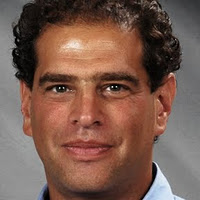
Over the last few years we've written a lot about the (1) elegance and (2) utility of complexity in the workplace. See, for example, "The Great Things at Work: Novelty, Complexity and Ambiguity." Last month, Legal OnRamp's Paul Lippe took the subject another step in his fine "How Client Complexity Will Shape the New Normal For Firms and Law Schools". And yesterday Hull McGuire's Peter Friedman commented at his own blog on a Cornell study last year which showed that humans, precisely at the times they seek and even come up with "creative" solutions to problems, paradoxically exhibit a firmly-entrenched bias against creativity. In "Creativity? YOU CAN’T HANDLE CREATIVITY!", Peter explained that "creative responses to problems create uncertainty, and that people reject those creative ideas because they can’t handle the uncertainty". So the equation might be put roughly this way: Problems or Complexity + Creative Responses (read: sound but "outside the box" possible solutions) = Uncertainty. So why bother being "creative" if it wastes time and leads to just another workplace moment of paralysis?
This, of course, is not what we all wanted to hear as being the knee-jerk response for co-worker reactions to tougher issues at work. However, it does ring true. Most of us are uncomfortable with anything beyond cookie-cutter solutions to problems or, at a minimum, solutions to problems that somehow seem tried, tested and "normal". We have difficulties, moreover, in distinguishing between the unconventional and the illogical. For many of us, "Weird Done Well" (to borrow a great phrase from my school chum Jay Harris) can never be Smart or Workable, and we will balk at it, and even jeer, when we see it.
Solving problems, addressing complexity and even "thinking like a lawyer"--once described by a legendary Skadden partner as thinking about something inextricably attached to something without thinking about the thing to which it's inextricably attached--does not mean Group-Think. It doesn't mean shooting from the hip, either. It does mean a little eyes-wide-open risk taking. But most of all, you need balls. Or courage. Peter, thankfully, is that rare business lawyer who can sell "different" to clients and employees alike--and then deftly implement it. A respected and versatile IP expert and litigator with a Big Law background who has gone from private practice to law professor and back again to practice, he can be counted on to look at things freshly but practically. In his post, Peter puts it succinctly and, I think, accurately:
I’ve always told students and colleagues that being genuinely creative requires courage and the ability to persevere in the face of rejection. There’s good reason for that. As much as “innovation” is the catchword of our age, very few people in decision-making positions are really brave enough to accept innovative ideas (whether they’re teachers, school administrators, politicians, lawyers, or corporate executives).
Peter Friedman
Posted by JD Hull at 08:19 PM | Comments (0)
October 22, 2011
Working for Clients & Customers: It's Not About You, Dude. Ever.

"Job and His Friends" by Vladimir Borovikovsky, 1810s. We're not conventionally religious but we do admire Job. Some days lawyering you will just have to suck it up. You suffer.
There are bad days. A parent is sick. A child gets stitches. You are coming down with the flu. You learn your girlfriend is cheating on you. In fact both of your girlfriends are cheating on you (and not even with each other).
Rule 10: Be Accurate, Thorough and Timely--But Not Perfect. Practicing law is getting it right, saying it right and winning--all with a gun to your head. Being "accurate, thorough and timely" are qualities most of us had in the 6th grade, right? Back when everyone told us we were geniuses and destined for great things?
Well, school's out--now it's about real rights, real duties, real money and personal freedom. That's a weight, and it should be.
Suddenly facts are everything--and the actual law less important than you ever imagined. In time you learn to research, think and put things together better and faster. You develop instincts.
You learn there is really no boilerplate and no "cookie-cutter" work. You learn there are no "right answers"--but several approaches and solutions to any problem. You are being asked to pick one. But at first, and maybe for a few years, being accurate, thorough and on time is not easy to do.
"I Have Clients?!" One day, you start to visualize your clients as real companies and real people with real problems. These are your clients--not your parents or professors--and they are all different. You "feel their pain", and it's now yours, too.
Mistakes. If you work with the right mentors and senior people, they will allow you to make mistakes. You need freedom to make mistakes. You'll be reminded, however, not to let those mistakes out of the office. It's a balancing act, a hard one.
Really bad days lately? So sorry. But your problem, Justin. You are expected to be "professional"--no, that is not about being polite and courtly with other lawyers--and put clients first on your worst damn day. And it's going to happen.
A parent is sick. You are coming down with something yourself. Your boyfriend is cheating on you. Both your girlfriends are cheating on you (and maybe with each other). Your teenage kids "hate" you. Or this morning you had to abandon that 12-year-old Honda you had in law school on the 14th Street Bridge.
And minutes before your big afternoon meeting or court appearance, a GC or co-worker calls you with the worst possible development, something unexpected and beyond your control, in a project for your favorite client.
These things will happen. And happen together. You think you're pretty tough. But you sag visibly--like an animal taking a bullet.
And in five minutes, you have to be at your very best. Again, it's not about school. It's no longer about you. You're beaten, beaten completely--and right now you have to get up and fight for someone other than yourself.
You up for this? Because, in our experience, very few of your peers are.
Bucking Up, Using Fear. And while you can't work in a state of constant worry, fear and paralysis, talking yourself into heroics, getting a little paranoid and even embracing a little fear won't hurt you, and may even help. You are being paid both (1) to be accurate, thorough, timely and (2) to just plain "not screw up".
“Thorough” means "anticipating", too. What makes you really good in a few years is being able to "see the future" and spot a ripple effect in a flash. To take a small example, if your client is in an active dispute with the government or on the brink of a full-blown litigation with a competitor, the client's and many of your own letters and e-mails aren't just letters and e-mails.
Whoa, they are potential exhibits, too. They can be used for you or against you. So they need to be written advisedly and clearly so that they advance your position and so that a judge, jury or someone 5 years from now can look at it cold and figure out what's going on. No "talking to yourself" here; think "future unintended consequences" when you think and write.
"But Not Perfect." Not talking about mistakes here. I refer to the paralysis of high standards. I know something about the second part of Rule 10--because I tended to violate it when I was younger. And I still want to.
Finally, note that Perfectionism is the Great Destroyer of Great Young Associates. Don't go there. Don't be so stiff and scared you can't even turn anything in because you want it "perfect" and you keep asking other lawyers and courts for extensions. It's not school, and it's no longer about you. Think instead about Rule 8: Think Like The Client--and Help Control Costs. Balance efficiency with "being perfect", and err on the side of holding down costs. If a client or senior lawyer in your firm wants your work to be "perfect", and for you to charge for it, believe me, they will let you know.
Finally, and I almost forgot: always use the Blue Book/Maroon Book for your citations. No one gets a pass on that one.

"Patient Job" by Gerard Seghers (1591–1651), National Gallery, Prague. Just suck it up.
Posted by JD Hull at 12:59 AM | Comments (1)
October 20, 2011
Rule 12: Have Fun. If you're a professional, and it's Not Fun, please reevaluate.
Here's how my "boss", an unhappy energetic young Midwesterner, found fun, love, hard work, humility, a little sanity, power, friends and enemies--and kept them all--by practicing law in our nation's capitol. Rule 12 is from the grating but highly correct Rules of Client Service. Anyone can do Rule 12. First, be born good-looking, athletic, and charming into an affluent WASP family that settled here almost four centuries ago. Have family money. Date only twins or actresses who go to Smith. Second, go to school, work hard, make some more money. Third, build your own firm. Fire all but one pessimist. Get a grandiose notion of your targeted client base--and keep them coming back so you don't have to "market". Finally, start up your own "blog", even though you're not at all sure what a "blog" is--but you sure think a "blog" sounds suspiciously show-tunes and at best nerdy and passive-aggressive. Have someone teach you how to "work" the blog. Say anything. Ignite relationship-killing arguments in upstate New York towns you'll never visit; upset inept fellow suits you see every day. Paint older lawyers as Dorks, younger lawyers as Looters. And Do Have Fun.

WAC in 1967 with the Pennington Twins.
Posted by Holden Oliver (Kitzbühel Desk) at 11:59 PM | Comments (0)
September 16, 2011
Where Do You Practice Law? In ClientTown? Or LawyerTown?
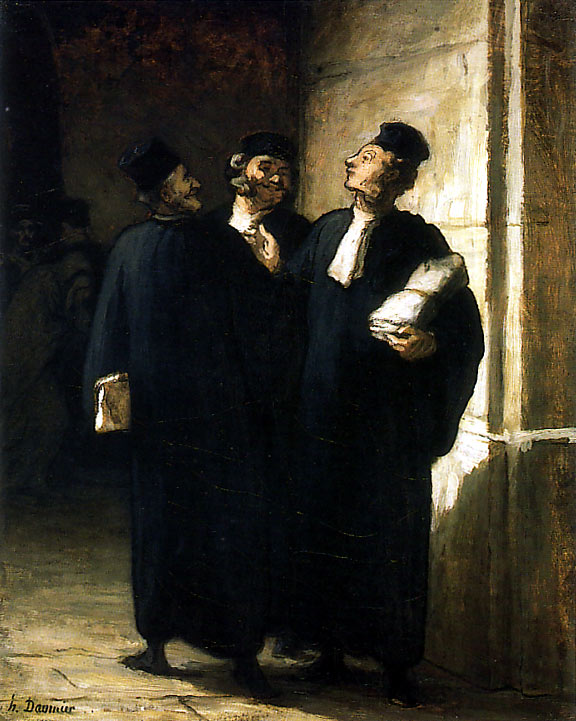
"The Lawyers", circa 1855, Honoré Daumier (1808-1879)
Are the three gentlemen in Daumier's famous sketch "client-centric" or merely "lawyer-oriented"?
We will never know. WLCs, maybe? A WLC is a Weak or Wimpy Local Counsel engaged by your firm and/or your client for litigation or other contentious matters who, after being hired, instinctively, routinely, and most often inadvertantly place their relationships with local lawyers and other players in their jurisdiction ahead of the interests of your shared client, which is almost always "an outsider".
Signature noise: "I have to practice in this town." They are akin to rocks, plants, and household appliances. They are legion. They don't get it. Avoid them and hire someone else (or shop for a different forum). See our world-famous October 2008 piece "Weak/Wimpy Local Counsel: The Next Epidemic?".

Posted by Holden Oliver (Kitzbühel Desk) at 11:59 PM | Comments (0)
August 31, 2011
Good Habits: Can You Teach Them to Straight-Up Looters?

M.G. Krebs, Hero of Work-Life Bongo.
Only about 1% of employees--if that--have a "passion for excellence" 24/7. The rest have their moments. These other employees, even if brilliant and energetic, constitute, say, about 90% of the work force.
And like anyone else, even your Coif and Law Review people after a few years can lapse into complacency, smugness and the work ethic of your no-good Uncle Seamus, who went out for a pack of Luckies one day and never came back. You know?
The above is from one of our favorite posts, of November 30, 2007, called "How Do You Teach Great Habits at Work?" It begins:
What the poets and philosophers say about Man (and Woman) is true: we are all miracles capable of miraculous things. But how do we get there? Well, someone much smarter than me said that excellence at work and in life comes from great habits. In life, examples would be eating fruit instead of glazed donuts or Egg McMuffins in the morning, running two miles 5 times a week, or each day without fail saying thank-you and praying for guidance to God, Allah, Yahweh, [more]

Ari Gold, Enemy of The Slackoisie.
(Photos: 20th Century Fox, HBO)
Posted by Holden Oliver (Kitzbühel Desk) at 11:45 PM | Comments (0)
August 11, 2011
Fear Kills--but first it Paralyzes, Enslaves & Stupefies.
A celestial character played by actor Rip Torn in the 1991 Albert Brooks movie Defending Your Life referred to earth-bound humans as "little-brains"--because their fear and inability to seize moments and take risks rendered them immobilized, self-imprisoned and "dumb". So, in the movie, humans couldn't learn anything, get anything done, have new and better relationships, grow and be happy. The Stage Manager in the Thornton Wilder play Our Town makes similar comments about the lives of the town's people. Are you doing the stuff now you can't do when you're, well (gulp), dead. Why have regrets?

Posted by JD Hull at 03:59 AM | Comments (0)
July 30, 2011
It's Saturday morning. Know where your wife or girlfriend is?
Willie Dixon: "I-YAM..."
Posted by JD Hull at 09:28 PM | Comments (0)
June 30, 2011
Time Management Simplified: 6 Things. 11 Words.
1. Family, friends, customers first.
2. Espresso
3. Food
4. Plan Work
5. Work
6. Exercise
7. Sleep
Questions?

Serigraphy, "The important thing is not always important", Adi Holzer 1976.
Posted by JD Hull at 11:59 PM | Comments (0)
June 03, 2011
The Unbearable Lightness of Lawyers.
Risk-aversion can be annoying. Get off your knees. Tell the client what it can do, too. What it should do. Take a stand. And just say it. See "The 7 Habits of Highly Useless Corporate Lawyers" and "Just Say it: More Good Things on Good Writing".
Posted by Holden Oliver (Kitzbühel Desk) at 11:59 PM | Comments (0)
May 24, 2011
Those Geniuses You Hired? How's That Working Out For You?
Energy. It's 75 percent of the job. If you haven't got it, just be nice.
--Paul Arden, Saatchi & Saatchi legend, in 2003.
.jpg)
Posted by JD Hull at 11:12 PM | Comments (0)
May 11, 2011
Redux - Prof. Bruce Antkowiak: "Why Law Schools Must Reform".
Law firms cannot be expected to do 95% of the work of lawyer-building. In that regime, clients suffer the most.
The U.S. Law Degree: As immediately useful as "a Ph.d in Poetry"? Bruce Antkowiak, a storied Pennsylvania defense trial lawyer, ex-DOJ section chief and 1977 Harvard Law grad, is now a full-time law professor at Duquesne University. This op-ed piece, "Law Schools Must Reform", appeared in the January 4, 2011 Pittsburgh-Post Gazette. Antkowiak's article is subtitled: "They need to leave the ivory tower--and teach practical lawyering."
Antkowiak's piece is at once both an important call to arms and, frankly, a modest proposal. In addition to making law firms truly efficient, could we ask law schools to perform even minimally and produce something of value? I.e., What are you folks really accomplishing in those 3 years, anyway? We practitioners don't get it. You are making things not only frustrating--but very very expensive. Clients suffer the most.
Can you help even a little? Step up? Firms will train. But we cannot be expected to do 95% of the work of lawyer-building.
Question: What can schools do to prepare students for the day-to-day world of work and commerce?
Excerpts from Antkowiak:
You would think that law schools would make fundamental changes to their programs in the wake of the job crisis, fearing that law degrees might someday be assessed like a Ph.D. in poetry -- soul-satisfying but potentially impractical. A few have responded dramatically, but most have held fast to the traditional law school model or made superficial changes. Why the resistance?
For many law schools, their institutional identity dictates that they be largely disconnected from the practice of law. This is done (I suppose) in the belief that we "in the academy" will thereby establish ourselves as an intellectual elite worthy of praise for the intricacy of our philosophical analysis.
The crisis in the law job market has not occurred because the world has miraculously become such an inherently just place that lawyers are no longer needed. The cries for justice remain as loud as ever. You can hear them no matter how high your ivory tower may rise.
.jpg)
New Siwash Law Grad: Do Law Schools Keep Getting It Wrong?
Posted by Holden Oliver (Kitzbühel Desk) at 12:22 AM | Comments (0)
March 28, 2011
How should you really handle "Difficult People" and "A-Holes" at Work?
Answer: Learn from them. Hire them. Try to keep them. Work with, for, through and around them. Cultivate The Difficult and even The Offensive. These two often overlapping groups--with infrequent exceptions--are exactly what we all need in our workplaces. They rule. They have built, managed and and lead empires, and inspired others, for centuries. Leadership styles vary. But we'll take the often-blunt Difficult Leader over the more political, politically-correct Lilly White Diplomat. Any day. Every day. Don't kid yourself. And read--but never follow--anything written by Stephen Covey. His message is Nice and Eloquent but Lame and Unrealistic. And Bordering on Evil. We're not that "evolved" yet, Justin. We don't have to be.
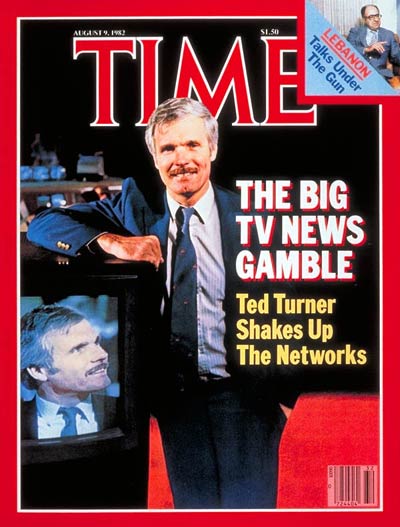
This is Ted. He's "difficult". Listen to him.
Posted by JD Hull at 11:59 PM | Comments (0)
March 21, 2011
Employees are Third. What did yours do for you last week?

(Warner Bros.)
Sorry. But it's not about Your Employees. Ever.
It's about Customers, Clients, and Buyers. If one employee does not put clients first, you have a problem.
Expect something great from employees. Well, this past week, did they help you add value for your clients and customers? It starts in your shop with your employees--who are important and valued, but always "third".
If you are training support staff, paralegals and associates properly, and giving them meaningful things to do, good for you. Make them part of your client work, and get them to "think like" (a) a client which wants problems solved and (b) you--the owner, shareholder or partner.
And on item (b), are they treating you like a client? What did employees do for you this week?
How are they adding value?
Do they advance things--or hold you back?
Practicing law correctly is hard. Learning it is hard. Client service is hard. And a job is a privilege--not a right.
"Training"? To be sure, it is likely a myth. Good associates and other support people train themselves, jump into the fray with energy and resolve, and learn by doing. You can't teach it. So find them.
If you have to spend additional time "training" or explaining things to employees, and you still want to keep them, that's fine. (But maybe they should pay you?)
Are they buying into the ethos of great substantive work, and 24/7-availability client service--like it's a crusade, a religion, and a way of life?
After all, you are only asking for the minimum.
Posted by JD Hull at 11:59 PM | Comments (0)
March 03, 2011
Bang Bang for Customers: Step Up. Sound Off. Change It All.
Warner Bros./Columbia Records
The very best reformers commence on themselves. -- George Bernard Shaw
Break out of captivity...your heart's still wild. -- Patty Smyth
No time for Weenie lawyers--of either (a) the Lazy Blowhard or (b) Skittish Dweeb variety. It's time for lawyers to lead. Put clients first.
Tell clients what you really think. Give advice--not just options. Stop covering your ass. Take risks.
Stop pretending you are "special". (That's over.) Minimize clubbiness. Stop making the law about your convenience and schedule. Fire bad clients. Fight mediocrity. Fight mediocre lawyering.
Stop writing documents which sound like hopelessly incurable mental patients talking to themselves.
Surround yourself with strong talented people who challenge you. Fire employees who who don't buy into your goals--or who don't or won't get it--and stop pretending they'll see the light.
Demand that law schools give you minimally functional, motivated, self-reliant graduates who can think on their own--and who believe that any kind of work is an honor and privilege to perform.
Think like a business person and not a mere academic. Practice discipline and structure. Help clients control costs. Become a trusted consigiliere.
Change the way people think about lawyers. Stop being Passive Weenies and Ineffectual Dorks. Act. Serve.
Posted by Holden Oliver (Kitzbühel Desk) at 12:59 AM | Comments (0)
February 23, 2011
Ms. Golden: How to Mishandle Specialization.
This is a clip professionals in America and abroad should watch. Short, packed, maybe surprising--and right to the point. And Michelle Golden is a Flat-Out Total Betty.
Posted by Holden Oliver (Kitzbühel Desk) at 12:59 AM | Comments (0)
January 28, 2011
If You're First-Rate, Lean & Mean, Do Charge More. (And Please Get Off Your Knees.)
Go ahead. Take their best clients to a better world and experience.
If your firm's under 100 lawyers, has publicly-traded clients and is efficient, it's in a tiny minority. So charge more than bigger firms. These days most (not all) large brand name law firms in the West--to quote an ex-U.S. president from Texas--have trouble pouring piss out of a boot if the instructions were written on the heel.
Those firms now gladly hire weak people, they carry too many idle people, and they charge clients to support weak and idle people. They make money on mediocrity and waste. For too many firms, it's a long-time business model. The way they make money. Now's the time to take their best clients to a better world and experience. Get off your bottom-feeding knees.
.jpg)
Posted by JD Hull at 11:59 PM | Comments (0)
January 13, 2011
Bruce Antkowiak: "Why Law Schools Must Reform".
Law firms cannot be expected to do 95% of the work of lawyer-building. In that regime, clients suffer the most.
The U.S. Law Degree: As immediately useful as "a Ph.d in Poetry"? Bruce Antkowiak, a storied Pennsylvania defense trial lawyer, ex-DOJ section chief and 1977 Harvard Law grad, is now a full-time law professor at Duquesne University. This op-ed piece, "Law Schools Must Reform", appeared last week in the Pittsburgh-Post Gazette. Antkowiak's article is subtitled: "They need to leave the ivory tower--and teach practical lawyering."
Antkowiak's piece is at once both an important call to arms and, frankly, a modest proposal. In addition to making law firms truly efficient, could we ask law schools to perform even minimally and produce something of value? I.e., What are you folks really accomplishing in those 3 years, anyway? We practitioners don't get it. You are making things not only frustrating--but very very expensive. Clients suffer the most.
Can you help even a little? Step up? Firms will train. But we cannot be expected to do 95% of the work of lawyer-building.
Question: What can schools do to prepare students for the day-to-day world of work and commerce?
Excerpts from Antkowiak:
You would think that law schools would make fundamental changes to their programs in the wake of the job crisis, fearing that law degrees might someday be assessed like a Ph.D. in poetry -- soul-satisfying but potentially impractical. A few have responded dramatically, but most have held fast to the traditional law school model or made superficial changes. Why the resistance?
For many law schools, their institutional identity dictates that they be largely disconnected from the practice of law. This is done (I suppose) in the belief that we "in the academy" will thereby establish ourselves as an intellectual elite worthy of praise for the intricacy of our philosophical analysis.
The crisis in the law job market has not occurred because the world has miraculously become such an inherently just place that lawyers are no longer needed. The cries for justice remain as loud as ever. You can hear them no matter how high your ivory tower may rise.
New Siwash Law Grad: Do Law Schools Keep Getting It Wrong?
Posted by JD Hull at 11:59 PM | Comments (5)
December 06, 2010
New, Appalling: Google-Based Naked Bongo Lawyering For Teacups.
WAC/P? needs to get out more--and bone up on threats to Customers, Clients and Buyers. This development involves marketers, lawyers and the Happysphere. See these posts by Brian Tannebaum at My Law License, this one by Josh Dickinson at Above the Law and finally this one by Scott Greenfield at Simple Justice. Our advice? If you're a social media marketer, don't do anything to mangle or compromise the clients lawyers are already struggling to serve, and often poorly to boot. Try not to make it worse. If you're a lawyer--and especially a new one--work at the Wal-Mart or with street people or retarded children for a while until you earn an opportunity to learn the right way from the right people.
.jpg)
Posted by JD Hull at 12:00 AM | Comments (0)
September 17, 2010
UPDATED: Employees 1, Clients 0, Firms 0. What about Customers, Buyers and Clients?

"Bring it, Skippy." Two partners excited about their evaluations.
Pardon me. But isn't employee (and associate) satisfaction the responsibility of both employers and employees--but mainly of the employees themselves?
How did our priorities get so backward, myopic and screwed up? And so anti-customer? Why not evaluate law firm partners--and associates, paralegals, messengers, techs, assistants and law firms generally--based on client and customer service standards? Rather than on what associates think?
And on the opinons of "other little people" who pay our businesses and allow our businesses to exist. I must ask. Do law school profs live in an alternate reality? Does it happen as soon as they enter law school hallways? Does it happen to even to-die for academia acquisitions like fine higher-end lawyers who actually practiced law for longer than 18 months--the kind we at this blog get so jazzed about when they are infrequently permitted to teach? And those who work for world-class litigation shops for decades?
We do worry. See at the always-improving and growing (and we mean that) ABA Journal the short article "Partners Should Be Evaluated Based on Associate Satisfaction, Prof Suggests", inspired by a longer and, frankly, very well-done--if overly polite and risk-averse--AmLaw Daily piece.
The author of the ALM article is correct: it's "treacherous" to overgeneralize. But we're all wasting so much money on associates, many of whom are viewed as increasingly "helpless" in recent years--and often running a con on great clients in many cases by even billing them out at all--that a Purple Prose Cry from the Wilderness may make sense here.
Isn't employee (and associate) satisfaction the responsibility of both employers and employees--but mainly of the employees themselves? How did our perspective get so backward and myopic? Stephen Covey's campaign to bliss out the old corporate model? Mr. Rogers? The Phil Donahue Show? Didn't the Covey-esque "employees are oh so precious" overtures of the last 20 years presuppose a U.S. economy and Western markets that did well: green grass, good crops and a TV in every room? The big bonus at the holidays?
These are not those times, Jack. These are the times of tool sharpening--and going back to the places of definitions. Adjustment. Correction. And a reexamination of commercial value itself. The good news: clients, law firms and other service providers and vendors who learn from the present economic troubles will come out stronger.
Look, employee satisfaction is always important. But employee happiness, while desirable, ranks "third" (#3) in the scheme of work things. Or perhaps even fifth (#5) in the scheme of overall priorities. So let's run through it all again, shall we? Here's one possible list that might make sense so we can all be "better people" and know true caring-sharing new age holistic Sweetness and Life in our lives.
Consider these "new metrics", in order of their importance in the scheme of All Things:
1. God, the Buddha, Jesus, Muhammad, The Moral Order in the Cosmos, Great Spirit, Sacred Oaks, the Watchers, Eric Clapton.
2. Your family. Close friends.
3. Your customers, buyers, clients. #1 for Work.
4. Your company. #2 for Work.
5. Employees, associates, and the help. #3 for Work.
6. Pets. Animals. Being nice to street people.
7. Plant life.
8. Rocks. Cars, household appliances, PI and insurance defense lawyers, some books, a few other material things.
9. Airports that make sense. Cheetos. Possession of the 1968 Chicago Convention-era "drug implement" of some kind crafted from an actual billy club and given to me in 1985 by a now-dead famous writer. (Please, no jokes or comments; too easy. No, it wasn't Lillian Hellman.)
10. Traveling the world. Reading the classics. Dinner with Annabeth Gish or Parker Posey. (Should be #5, #6 and #7 if you can "afford" them.)
I have it. How about evaluating partners--and associates and law firms generally--on client service standards? Far-out, huh?
Posted by JD Hull at 11:59 PM | Comments (0)
June 14, 2010
Redux: "An aggregation of narrow views". Curse of the modern law firm?
Years ago, I was a partner in a D.C. branch office with about 40 other partners firm-wide and several offices in the East and Midwest. This financially successful and very able law firm was my home for 12 years. I was fortunate through some good mentors--which I hustled to get--to have an interesting corporate practice in federal courts litigation, energy and environmental law. However, I was amazed to watch over the years how narrow (i.e., insular) a lot of the firm's brightest stars became in their practices--and how that insularity seemed to be carried from one associate class to the next.
In short, our "specialty culture" and "largeness" had worked against us. We weren't building broad-gauged lawyers anymore. Partners who had been friends for decades rarely knew how to explain (much less cross-sell) what other partners did. Worst of all, the art and ethos of seeing lots of different multi-disciplinary issues while working for a client was no longer valued. The result: (1) highly-talented but narrow and "non-collaborating" specialty fiefdoms with rare overlaps; (2) less value and lower efficiencies for clients.
Below is a November 11, 2008 post--not our normal re-run--based on the wisdom of two fine lawyer-writers. A very belated thank you to Rees Morrison and Carolyn Elefant; people in my firm think about this idea and these phrases of yours every day as we try to build a law firm with lawyers who are specialized--but also have big-picture sensibilities for large corporate clients.
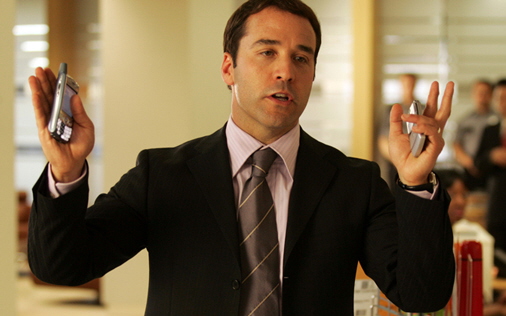
"Boom. Morrison nails it. Elefant names it." (Photo: HBO)
"An Aggregation of Narrow Views": Curse of the Larger Law Firm?
By "broad-gauged" lawyers, I mean law firm leaders and facilitators who, in addition to their own specialties, have an "expansive frame of reference" about the world, business, other practice areas, and how they all fit together.
Thanks to Carolyn Elefant at Legal Blog Watch, and the alert eye of the mysterious Ed. of Blawg Review, I read Rees Morrison's comprehensive and perceptive piece in the New York Law Journal about what larger law firms can and cannot do for clients. It's called "Why Law Departments Should Beware Super-Sized Firms". Despite its title (apparently given by ALM editors to get our attentions), Morrison's article is thoughtful, fair and generally flattering to large law firm (1000 plus lawyers) cultures. On size, we're talking about total headcounts here, not gross revenues or profits per partner. There are about 30 in the world this size (1000 or more)--all out of the UK and the US--and at that size they are a relatively new phenom.
My take, and orientation: I "like"--and have always liked--"larger firms" more than I like smaller ones, even though I am a shareholder in an aggressive and varied boutique that works all over the U.S. and abroad in some unique ways. I am a product of one, and in my own firm prefer senior lawyers who made partners in one as my colleagues, and associates who can work at one (but have advisedly chosen not to) as associates.
In fact, I strongly prefer "larger" firms--Morrison uses 1000 lawyers as a number, but let's use 500 or more lawyers here--even while many larger firms don't get, and will never get, the client service cultures they will need to survive. But I do like their energy, combativeness, spirit and moxie, when those features are present. If I don't know where to go, I go there; a functional larger firm with good leadership and management is a wonderful library of humans you just don't get everywhere. And seven or eight ideas or viewpoints is always better than one or two.
(By the way, small and medium-sized firms often make noises that their size somehow naturally ensures a greater "client service" focus in their performance. Well, this is a huge, if entertaining, crock. Smaller firms as a group are way less CS-savvy than larger firms because, unlike their bigger brethren, they have never really thought about, studied, implemented or "enforced" CS regimes at their shops. Reasons: many smaller and medium-size firms make money and survive in spite of themselves; think they already "know" about CS; or think they don't really need to know about CS.)

"I want Quarterbacks--not dweebs. Value--not size. Send me workaholics with brains and perspective who don't all dress like goddamn FBI agents." (Photo: HBO)
Moreover, I buy into three different notions about larger firms. First, more aggressive and competitive lawyers, and some very fine law students, are attracted to larger firms. Second, to the extent those firms represent corporate clients--and most of them do--the work is often way more interesting, complex and challenging than you will find at smaller firms. Third, larger firms do try to hire, and pay for, promising young lawyers, even if their younger talent is unproductive and a drain in the first few years. So, as a general rule, if you are that rare GC who doesn't know the terrain yet, and have no idea where else to turn, by all means go to a big firm first. I can name seven or eight good ones between 500 and 3000 lawyers and professionals in five or six key practice areas that my firm, and other boutiques, conduct as well. Why not? The talent is there. It's still a good bet.
The Hitch: That talent. It's there somewhere--not throughout, and not in all areas--and you do have to find it.
On talent, both abroad and in the U.S., large law firms currently are a double-edged sword. They do have, and always will have talent; however, in recent years, they've diluted the gene pool on lateral hires in order to get bigger. So Ferraris, Jaguars, Chevy Aveos, pick-up trucks and rickshaws all run together on the same track. And large firm offices in smaller cities abroad can be spotty, mediocre and even scary. (Do you really want "Borat" as your company's lawyer in, say, Eastern Europe?--because that is what you might get.)
Many, if not a majority, of the partner-level lawyers my firm has seen in cases and transactions over the past ten years from "name" law firms have been disturbingly mediocre, and are often malpractice threats to their own firms. Morrison, who is one of the few writers to even mention this, calls it "global coverage, but inconsistent quality and coordination". I think of it as the "Borat syndrome"--and in larger firms you see it both in the U.S. and abroad.
Further, and as Morrison points out, there are in larger firms troublesome inflationary pressures on hours billed. Value questions. Forget about what the markets will bear; on a good day, first and second year associates are worth about -$50.00/hour, once you factor in what it takes to teach, guide and monitor them, and "remediate" their work.
"An aggregation of narrow views." The biggest problem, however, and one I don't see a solution to any time soon, is what Morrison calls "deep specialization, but narrower perspective". Oddly, in the last year I have heard two in-house counsel mention this themselves about mega-firms: they are seeing few "broad-gauged" lawyers. By this, I mean leaders and facilitators who, in addition to their own specialty, have an expansive frame of reference about the world, business, other practice areas, and how they all fit together.
As Ari Gold would say, "Boom!" Morrison has nailed the biggest substantive large law firm problem. In her summary of Morrison article at LBW, wordsmith and D.C. lawyer Carolyn Elefant describes it the lack of "the ability to offer a broad perspective--only an aggregation of narrow views."
Bravo, Morrison, and Elefant.
Posted by JD Hull at 03:02 AM | Comments (0)
May 09, 2010
The man who found proof of lame lawyer habits.
Stand-Up Guys: Ernie (left), a dead-ringer for 1950s icon Neal Cassady, and WAP, during their pre-lawyer Beat years at Nathan's, a D.C. saloon for older players until July of 2009. Washington Examiner called on Nathans "a well-stocked, man’s bar, though the men brought lovely women."
Sir Ernie of Glen Burnie. Lawyers who won't take a stand is a time-honored tradition. Our hero, Ernie from Glen Burnie, who is not such a lawyer, is a life-long friend. He'll stand up for people who pay him--and people he just met on the subway.
It's his nature.
He stands up.
Ernie's "available" and "comes to play". He will tell you what he thinks. He will act. He is a trial lawyer with business sense.
Ernie played football for one of the Ivies. He thinks in terms of both collaboration and getting things done. He's smart but friendly. Guys' guy. Ladies' man. Lawyer's lawyer. Renaissance Human. Charmer. Playful rogue. A reveler in words.
He's a partner in a well-known DC law firm. (He does exist.)
He does not like "cookie cutter" thinking or people. If you need him, he's there. You don't have to ask.
Standing up for friends? "A pretty easy standard, and a no-brainer," he once told us. Stand up for friends, sure--but also for humans who need or deserve it. Do it for free.
Things you and your co-workers and friends have to think about for a long while? Ernie just does them. He always has--since grade school. Instinct. On gut. He never hesitates.
Even though he does securities litigation, if you are a GC, you can call him in the middle of the night with your insider-trading problem, or report that your kid at Dartmouth just thrashed a waiter and both Hanover cops.
He's very well-paid, our Ernie. But if you--you are an associate, client, paralegal, receptionist, messenger, street person--want, say, a cup of coffee, he does this amazing thing: he just gets you a cup of coffee. Just because. What a character.
And, best of all, as the Foggy Bottom, West End, M Street and Glover Park crowd will tell you, when he's not working, he's the kind of guy who never hits on married women over 40.
You can read Ernie's story--it's about an old parchment he claims was discovered in Alexandria, Virginia around the same time we both began practicing law in The District--at "The Seven Habits of Highly Useless Corporate Lawyers". This is a true story, mostly. So listen up.
Posted by JD Hull at 12:59 AM | Comments (0)
May 03, 2010
UPDATED: E-gadgets, E-toys, E-illusions: Making-us-dumb?
A new woodworking tool, in the hands of a master, makes the master more than he was before. In the hands of a fool, it makes the person more foolish.
--Patrick J. Lamb, Chicago trial lawyer, storied Irish-American, business law visionary, master woodworker.
We think the answer is--generally--yes. We've noticed that people keep mistaking their laptops and Smartphones for their brain. Rather than make work easier, e-tools may raise the bar for using your brain.
If e-tools and e-gadgets allow you to do better problem-solving, that may be because they help "open up" and expose the problem you are working on. In other words, the tools--from multiple regression analysis programs to WestlawNext and Lexis to Google Scholar and more--may reveal a different problem: more nuanced and complex, deeper, even bigger.
Now solving the problem will take more time than if you hadn't used them in the first place. There is more of, in and to your problem to sift through and analyze--but you are much, much better off. Good news: you have a bigger and better picture. Those e-tools work great. The bad news: there is more work to do.
That vast arsenal of Digital Tools. They just made your problem a lot fancier--but easier to fathom, and way more clear, even elegantly clear. Now start using your brain (and your e-tools, too) on the problem again. But don't tell us you were done the first time through. You're weren't.

Writer-lawyer-Renaissance man
Peter Friedman in a good mood.
So e-tools don't make you (a) smarter or (b) faster. Neither. And maybe just the opposite, especially if you think:
"Hey. Wait a minute. Complex problem-solving no longer requires anyone's energy, time, sweat, or full participation. Everyone's smart now. We have these tools."
Or if you just figure:
"Besides, this stuff at least makes me look smart. That should do it, right? If the going gets tough, there's always the Google search. No worries. Pass the Cheetos, please."
But we hadn't thought about PowerPoint as making-us-dumb before. Maybe we didn't want to.
We've been honest about everyone's struggle (including ours) with the actual utility of All That Tech out there. What really works? How much is overdone, silly or a numbing distraction? And, most importantly, do we know how to use it to get anywhere. See "Wanted: Improved, higher-functioning, digitally-competent Boomers".
With Tech, as with anything else, we put on no airs at this blog--or in our firm's practice--and either should you, about hard things we are all trying these days to get right.
Get over yourself. You're probably dropping the ball with Tech. (We all are.) No matter who you are, Tech poses lots of problems--sometimes very different ones--for people of all professions, ages and cultures. See, and for fun, "Reviewing E-mail: Are you lawyering or typing?".
To its credit, Powerpoint, the popular Microsoft product, over 25 years old and significantly improved in 1996, is still useful in Hull McGuire meetings, litigation and pitches--provided that, like other digital tools, it does not become the main event. But sure, PowerPoint's a flat-out keeper. Besides, and see above, it's something we can handle.
Cleveland-based lawyer Peter Friedman and others have thought about PowerPoint making-you-dumb, or at least rendering you or your audience far less effective. Friedman's a Case Western Law associate professor, visiting law prof in Detroit and Canada, former practicing lawyer (and, no, he's not a prof who gave it the old Siwash try of a full 18 months), former NYC law firm partner, litigator, and friend and fellow Buckeye who writes, among other places, at Geniocity.
Peter Friedman thinks that "PowerPoint might make you dumb, but understanding why can help keep you from being dumb even when you don’t use PowerPoint".
Got that? Read Friedman's piece. You'll appreciate the title even more. Excerpts:
It reminds me of my students when, in response to feedback they don't like, come to me with their work and argue that they really did include in their writing the important points I've said they've neglected.
They even can point me to the words that I can see they really did mean to make those points. But those points are either expressed in language that is too obscure or are put in places in which they do not fit....
All of us have those moments when we believe we have expressed our opinion on a subject effectively, but if that if that opinion is unconnected to the evidence, authority, and reasoning that supports it, if it is buried in words that don't support that opinion, or if in any other way its truth is obscured, it might as well not even be there.
Posted by JD Hull at 12:55 AM | Comments (0)
April 21, 2010
Law libraries poised to make comeback.
No names. Meet me at the Federal Digest alcove around 6:30. Wear red pumps or I won't show. I'm watching you.
Books and nooks. The way we use them as a substitute for thinking, computers have made everyone dumber anyway. Real lawyers still take advantage of books. But do they really take liberties with library staff? We've been trying to research, as it were, the librarians themselves. See, via our friend Redford, the UPI piece Survey: Librarians Get Frisky In Stacks.

Posted by Holden Oliver (Kitzbühel Desk) at 12:53 AM | Comments (0)
April 14, 2010
To American law schools: A little help, please?
The tone and atmosphere of an excellent law firm that quickly resolves problems and gets things done?
Often it will be more like Rahm Emanuel, John Wayne or Colonel Bill Kilgore in "Apocalypse Now" commanding brainstorming, hard-ass and fully-engaged troops.
It it will be less like Mr. Rogers or Alan Alda whispering kind and nurturing things to the latest crop of Teletubbies and making sure they are okay. Big Bird and Care Bears in the trenches is not an image most of us wish to project to clients.
We are desperate--and burning daylight and money here. Marc Randazza is a San Diego-based First Amendment specialist who writes The Legal Satyricon. Like the undersigned, he is hard-working, works out of several offices, and is obviously having fun. Randazza is irreverent, "not prissy", passionate, mega-competent, and not concerned about what people think. Hear his April 2 NPR interview on SLAPP suits. Or read about abolition of limitations periods in clergy child abuse cases in "If you’re still Catholic...". He and his other writers don't cower behind "anonymity" when they write. Randazza's his own man, and a stand-up guy.
In short, an American. And none of this would be that unusual except that Marc is an American lawyer. And let's face it. Being eccentric, wild and/or "edgy" in American Lawyerland is not a tough mark to hit. Just wear a bow-tie, tasseled loafers and a trench coat. But maybe, say, in public, and wear them all on once, and on a weekday.
One year ago this week, Marc wrote "The Worthlessness of American Legal Education", a piece we admired and which is certainly worth your time to read. The theme "what should we expect now from law schools, anyway?" has legs at Marc's blog and others.
We've written about that theme--from the standpoint of clients as always being the "main lawyer event"--here at this blog for nearly five years. And written about it enough to know it's a very touchy subject.
In the late summer of 2008, we wondered aloud--and just weeks before the federal government's late "announcement" that there was a "recession goin' on"--on whether law students and recent grads should start paying law firms (yes, new lawyers pay the firms) for training to be lawyers who could add value in a shorter amount of time.

Law Schools: Weenie Factories? Or Places of Training to add value to client work? Lawyering is not necessarily a "PC", gentle or even genteel culture. Do law schools tell students it is?
In fact, our August 27, 2008 post was probably our most clicked-on but yet "unpopular" piece: "Should associates pay their law firms in the first 2 to 3 years?"
American law schools are some of the most impressive places of higher education in the world. They are exciting intellectually, great think tanks for business, and attract mega-talented humans, particularly in the quality of faculty. They hatch presidents, senators, captains of industry, great authors and diplomats. But many law firms these days are meeting new grads who won't be even marginally productive for two to three years. Or longer. And new grads--at a shop that actually tries to train you--often (not always) "get more" than the firm does out of the relationship in those years.
Law schools, certainly, are not in business to pay students to be trained. Students pay the tuition--not the reverse. The schools get the money. The schools don't pay the students to be there to learn.
Which gets us wondering again. Why should law firms pay new grads--even top students from fine schools--if they are often years away from being productive, and the law schools, for all their promise, potential and cache, are doing about 10% of the lawyer-creating job?
In many instances, the new grad is the only real beneficiary in the law firm-employee relationship. Turnover everywhere is relatively high. Many firms get zilch--and start over again. The current situation is bad for clients because it compromises value--and it cannot be good for students who think they are equipped to add value when they are not even close.
We suspect that legal education in recent years appears to have done many students a disservice by making them think that law school--by its very nature of being focused on teaching you "to think" like a lawyer--could ever give students more than 10% of what they need to be full-gauged lawyers and problem solvers.
Law done right is a hands-on profession and takes everything you have, and organizational and managerial skills the schools cannot teach or be expected to teach.
"Thinking like a lawyer" does not inform your every synapse, breath, and moment.
Moreover, lawyering is not necessarily a "PC", gentle or even genteel culture. Are the schools telling them it is?
To be fair, the substance of the work at a client-focused law firm doing higher-end problem-solving (in deals, courts, international work, etc.) may be very cerebral and challenging. A feast of exhilarating ideas and causes. Lucky people leading a Life of the Mind.
But the actual tone of the same place is more like Rahm Emanuel or John Wayne commanding brainstorming, fully-engaged troops. It will be less like Mr. Rogers or Alan Alda whispering kind and nurturing things to the latest crop of Teletubbies. Big Bird and Care Bears in the trenches is not an image most of us wish to project to clients. (If we ever do that, please get a big net, okay? )
Bosses at law firms may be Coif, former Law Review editors, and writers of famous Matthew Bender tomes. But they are still bosses who "want stuff". They do not understand (or even like) younger people who can't get it for them. Many law firms are dominated by type-A problem solvers with strong personalities who live to get things done. Let's hope that never changes. It's good for the customers.
You may ask: has the "recession" or downturn in the global economy helped? Has it made students and graduates more likely to stick it out, and compensate for things they may not have gained from their legal educations? Are students and new grads "stepping up" to train themselves?
Answer: No. We, at least, are not seeing it. Nothing has changed.
And finally there's the question: Is it really necessary for law students to be in classroom settings for three years?
At a minimum, we wish that law schools could convey a few truths, and what might be called "old verities", to part-time clerks, summer clerks and grads:
1. Even for the most brilliant, motivated, resourceful and ambitious people, law practice is time-intensive and very hard--especially in the beginning.
2. Graduating from law school with top grades and willing to give practice the old Siwash try is only the beginning of your travail. Again, practicing law is hard. Even harder to learn how. And hard to maintain as years roll by at a comfortable and honorable level of quality. You don't get to say this much: "Sorry, Jack, but I'm on my break."
3. Real-life client problems pose extraordinary ambiguity and complexity (you can't "Google" the answers; you may fret over some projects and have to stay late; at first, it may interfere with your relationships and your "real life").
4. Maybe you'll find that private practice is not for you. It's not about the lawyers, courtliness, lawyer-centric cults of "professionalism", bar associations, wearing cool suits, prestige, money or being in a special club. If you stay in it for all that stuff, even if you make big bucks, you will regret it. No, you will hate it.
5. Clients. Talented people with JDs are legion. It's really about those you serve: the gritty details, hardships, and joys of "getting it right" for them.
(Photo: The Situationist)

(from a Dec. 21, 2009 JDH post)
Posted by JD Hull at 11:59 PM | Comments (2)
March 11, 2010
Patrick Lamb: Get used to it, Jack.
It's time to step back and re-think things when a hardworking optimistic trial lawyer and innovator like Pat Lamb writes this: "The "good old days" are not coming back". Quoting a Hildebrandt report he links to:
We enter 2010 with little prospect of a robust recovery and with mounting evidence that the profession is entering an era in which the fundamental economics of legal practice are likely to be significantly different.
Posted by JD Hull at 02:11 PM | Comments (0)
March 10, 2010
Read it, brush yourself off, get to work.

Posted by JD Hull at 12:12 AM | Comments (0)
January 18, 2010
Hassan: You can't teach attitude.
Sorry--but I'm no Stephen Covey. Most employees cannot be "saved". Burning inside 99.5% of all employees worldwide is an overwhelming ambition to Get Home, Eat Twinkies and Watch Wrestling.
What About Clients?, July 2, 2009
But some of us keep make-believing we can "inspire" attitude. We get hurt. Worse, buyers, customers, and clients get hurt.
This MSNBC video is worthwhile. The attitude "can't be taught in a course" part starts at about 2:50. A native of Pakistan, Fred Hassan was chairman and CEO of Schering-Plough from 2003 until late 2009, when in merged with Merck & Co. (Merck Sharp & Dohme Corp. outside of North America). Hassan is now on Time Warner's Board.
Nearly everyone sane believes what Hassan is saying. But hardly anyone (except maybe Jack Welch) has the sand to both say and act on it. You don't need to be mega-rich and have attended HBS to tell the truth. Straight talk is not a luxury of the world's elite.
Say it out loud first: "Very few humans will amount to the dream employees my customers and my firm want and deserve."
To be sure, "nice", "intelligent", "good", "talented" and even "brilliant" is not enough. It was never enough. You need people on fire. Is that what you have? Do you feel as though you have to demand quality? (If "yes", a bad sign.) Are you hiring and keeping people who are poor to mediocre--and then "pretending" they are good or will come around? (If "yes", a bad plan.)
Unless you have it in writing from your buyers, customers and clients that retaining "so-so" employees thrills them, get a new strategy.
Posted by JD Hull at 12:57 AM | Comments (0)
January 14, 2010
More on law schools providing value some day and hopefully before we all die.
Or, "You Got Anyone On That Campus Who Can Chew Gum, Cite-Check, And Look You In The Eye At The Same Time?". We note that practical skills are being mentioned more in writings about law school education. Bravo. Show us. We're tired of wasting our money.* Last month we wrote about American law schools--and this time only a few people complained. More recently we noticed these: "Problems in the law school 'business plan'" at From Burke to Kirk and Beyond, which shares a few things in common, mostly good, with this blog, and "The changing face of the early stages of law practice" at Libertas et Memoria, which comments on the recent ABA story about a possible new premium placed on practical skills that got us so excited we forgot to fire people last Friday.
Finally, an interesting excerpt from FBTK:
Law schools will be the last to abandon speculative debt as the means of financing themselves through their willing applicants, because a very large number of applicants are smarty-pants who couldn't make it as scientists, engineers, bankers, financiers, etc. The applicant doesn't realize how speculative his investment is until he is one to four years in.
*WAC? could care less about student debt. Your problem, Teacups. Don't any of you have family money? Enrique, would you be good enough to decant the Port? Kindly leave the bottle as well.
Posted by JD Hull at 11:44 PM | Comments (2)
December 10, 2009
Can we change how good clients think about lawyers?
The work of a bricklayer goes to the blue.
The knack of a mason outlasts a moon.
The hands of a plasterer hold a room together.
The land of a farmer wishes him back again.--Carl Sandburg (1878-1967), author, editor, poet, Pulitzer winner.
But first: Hearse Horses, anyone? Do you love what you do? Step back from the canvas and try some simple tool sharpening. Bone up on your fundamentals, maybe. Your techniques. Do you need some new ideas? How does your firm do its work these days? Do you get things right? What do you teach associates?
Now step back further. What of this Lawyering Thing?
Clients? What is it you really do for them? You serve, right? You mix your products and services with an overall experience that makes you unique, right? Or are you and yours indistinguishable from the rest of the generic law cattle out there? Is your firm really different?
Step back again. Are you problem-solvers?
Or just part of an insular and self-important "club" that needs clients as equipment to pursue a daily game?
Does practicing law and serving turn you on? Or is it just a past choice you, or your partners, made--maybe one that hardened around you too long ago--and now regret?
Carl August Sandburg: "The lawyers, Bob, know too much..."
Too many people practice law who should not. Practicing law is hard.
Client service is just as hard. But many people with law degrees--there are way too many of us in the U.S.--don't get that. Or they don't love it. If either applies to you, or to your colleagues, it's not too late to "get it", to get it back, to love it (again or for the first time) or just to try something different and new.
The law is not for everyone. And to do it right day-in and -out is a hard order. A privilege, too.
If you wish to stay in the profession, try to make it what it can and should be. Visit our world-famous, annoying, counter-intuitive but dead-on accurate 12 Rules of Client Service. See "Rule Four: Deliver legal services that change the way clients think about lawyers".
Posted by JD Hull at 11:59 PM | Comments (1)
November 15, 2009
Clients: How to ditch bad ones.
Just drop off the key, Lee. Even hard-working, über-competent and genuinely service-oriented companies--all 5 or 6 of them on the planet--have at one time or another found themselves with a client, or customer, they no longer "like". To deal with that problem, see "Top 10 Ways to Fire the Client from Hell" at InsideCRM.
It's full of useful tips for dealing with just-not-getting-it or lawyer-paranoid clients like (1) the bargain shopper, (2) the control freak, (3) the "one who's never satisfied" or (4) the client who sees evil and imperfections everywhere.
Posted by Tom Welshonce at 12:59 AM | Comments (0)
September 21, 2009
Redux: Martindale-Hubbell: Should we all just say no?
Note: The following is from an August 5, 2008 post. Any new takes on this?

Is a Martindale-Hubbell listing worth it anymore?
We're not unhappy with the M-H ratings process; generally speaking, if done responsibly and without in effect requiring the "purchase" of the rating, a credible if imperfect ratings process for the global legal community makes lots of sense. And M-H accomplished that decades ago.* But, in view of other and newer ways for law firms to have visibility and credibility, the price of listings at M-H is now officially a rip-off. Lots of fine lawyers seem to be complaining about it, at least in private, both in the U.S. and non-U.S. It's not that Martindale hasn't tried. See, for example, at Law.com the piece "Martindale-Hubbell Gets a Makeover" (mentioning Avvo, LawLink and Legal OnRamp, as new alternatives for marketing, networking and lawyer ratings).
*Martindale-Hubbell is no joke. It has a fine, time-honored and even classy reputation, and a history of good work and real utility in the profession. Our firm, Hull McGuire, has actively and earnestly participated in the M-H ratings processes for years; we are happy with the ratings our lawyers received. But, in good times or bad times, the current cost to list firm attorneys for any size firm, with or without multiple offices, is prohibitive and should be resisted on principle given other alternatives. It just isn't worth it. We predict that lawyers will bolt in droves in the next 2 years.
Our humble take: as other ways to locate lawyers emerged, M-H never saw the light fast enough, and didn't successfully change or expand its other services to preempt a backlash. It continued to charge big listing fees that everyone complained about for years. More recently (say, the last 3 years), M-H expenses managed to stay in law firm budgets--but exceeded just about everyone's irritation levels. M-H listings now makes no business sense to anyone sane. Only the embarrassingly lame, gimmicky "Super Lawyer" concept could make Martindale look good these days.
Start the revolution?
Posted by JD Hull at 11:59 PM | Comments (2)
September 05, 2009
Plan B for recruiting "Grunts"?

The "elite" associates you recruited: Would they fight for your clients? Would they fight for anyone? (Columbia Pictures, 1981)
Uh, "associates", rather. But maybe grunts is the "right" word. Who said their life was ever supposed to be easy? Who without a love and yen for complexity, challenge and hard things in life would ever chose private law practice? Well, many young people are; frankly, the law is "too hard" for them--way too hard--and they are failing.
Not much fight in these humans, either. Not much gospel. Remember: we're not taking about divinity, forestry or hotel management grads. People who attend law schools are signing up for war. And we're often getting Teletubbies on Thorazine.
Don't look to blame law firms or their clients. The demands of practice have not changed very much in the last 30 years. Blame the other "us": parents, and law schools. We are raising and educating Mega-Wimps. And they are miserable in any demanding job.
The Point. Are we recruiting from the "right" schools? Plan A: law review from top schools. Plan B: non-elite law school grads. (Plan C: dirt poor kids from evening divisions who think any work is a great privilege and honor--we'll get there yet, and it's probably the answer.)
Plan B. While you think about it--and we are as we are fascinated by the subject--see this month's issue of American Lawyer magazine, and a piece by Ronit Dinovitzer and Bryant Garth, "Not That Into You". Dinovitzer and Garth find that graduates of lower-tier law schools are more appreciative of their jobs at large law firms, so they start those jobs with the intent to work towards partnership. But graduates of elite law schools are less satisfied with the long hours associated with those jobs, in part because they view them as mere stepping stones towards their actual target positions. Nevertheless, large law firms cling to the policy of preference for the elite graduates. Should they?
Our thanks for the heads up to our coach, spiritual leader, and lawyer's lawyer Ray Ward. They broke the mold on you, sir.
Posted by Rob Bodine at 12:51 AM | Comments (0)
August 21, 2009
Client Town or Lawyer Town?
"The Lawyers", circa 1855, Honoré Daumier (1808-1879)
Are the three gentlemen in this famous sketch client-centric or "lawyer-oriented"? We will never know.
WLCs, maybe?
A WLC is a Weak or Wimpy Local Counsel engaged by your firm and/or your client for litigation or other contentious matters who, after being hired, instinctively, routinely, and most often inadvertantly place their relationships with local lawyers and other players in their jurisdiction ahead of the interests of your shared client, which is almost always "an outsider".
Signature noise: "I have to practice in this town." They are akin to rocks, plants, and household appliances. They are legion. They don't get it. Avoid them. See our October 2008 piece "Weak/Wimpy Local Counsel: The Next Epidemic?".
Posted by JD Hull at 11:59 PM | Comments (1)
July 16, 2009
The Divine Mr. Greenfield: Policing Your Kool-Aid for You.
Because let's face it: a lot of us drink the work-life balance Kool-Aid before we even read the instructions. See Scott Greenfield's from-the-heart "'Cause You Got To Have Friends". This is the most eloquent writing we've seen this year on (1) the meaning of lawyering, (2) why clients matter most, and (3) the hard but important reality that there are simply no short-cuts in this profession. Excerpts:
There are clients, real people who suffer real consequences, as a result of the delusions perpetrated on the internet.
They come to lawyers believing them to be competent, even expert, and willing and capable of helping them, saving their lives sometimes. And the lawyer's primary focus is to get paid and be home by dinner, with the client merely the conduit for the transfer of revenue and proof of the mastery of the secret to success.
So I leave my niche in criminal law from time to time to be a voice in the wilderness, that we are not selling laundry detergent, but are lawyers, professionals, in whom people repose their trust. I've seen their children cry when their lawyers fail to fulfill their duty. The need to enjoy a happy lawyer life will never wipe away their tears.

The Divine Mr. G, without eyeglasses. Scott Greenfield worries about the the profession because you and the WLB consultants won't.

The Divine Ms. M never mailed it in, either.
Posted by Rob Bodine at 09:57 PM | Comments (1)
July 07, 2009
Indiana Ivy-Leaguer goes national, makes good: Above The Law Editor on "The Law School Indicator".
One well-done, smart and useful interview by one tough guy. Bravo, ATL Editor Elie Mystal. Publisher Lat: Give this man a raise already.
Posted by Rob Bodine at 11:59 PM | Comments (1)
June 30, 2009
Speeding the progress to useful lawyer.
Here's one thought-out solution to the "low value-added" problem associated with starting lawyers. Over the last 18 months, other writers and commentators, in bits here, and pieces there, may have suggested what LOR co-founder Paul Lippe says here--but certainly not as well or as comprehensively. See at the June 22 AmLaw Daily Lippe's article, "Welcome to the Future: Time for Law School 4.0".
Posted by JD Hull at 11:59 PM | Comments (0)
June 23, 2009
It hovers, takes hostages, and moves on to the next town.
"I see defeated people. They're everywhere. They walk around like everyone else. They don't even know they're defeated." It's a choice--in your life and in your work. You always know if you are "there". You just don't know how you got there. You started compromising on things you once embraced as essential. Redford sent us this short Seth Godin post called "On the Road to Mediocrity" about "settling along the way". Avoiding mediocrity? Keeping the monster at bay? WAC? is no Seth Godin. But our take is that great habits learned early on difficult work is step one. Step two is vigilance. The fine thing about posts like Godin's? If it bothers you, you needed to read it.

"I see people who keep mailing it in." (Buena Vista Pictures)
Posted by JD Hull at 11:59 PM | Comments (0)
May 20, 2009
Towards a reinvented Martindale-Hubbell?
Martindale-Hubbell also represents many other solutions that help law firms establish...a full range of marketing and client development services. One of our most recent, and proudest, releases is Martindale-Hubbell Connected, our premier legal professional network. Thousands of corporate counsel and attorneys have joined this network since it's launch earlier this year.
--Dave Danielson, Martindale-Hubbell/VP LexisNexis Client Development
A New Martindale-Hubbell? We'll certainly listen to that idea. Five days ago we ran a recycled yet timely post entitled Redux: Martindale-Hubbell: Should we all "just say no"?. In response, Dave Danielson, Martindale-Hubbell/Vice-President, LexisNexis Client Development, commented back. Dave's response is both honest and instructive. For some readers, it will even break a bit of news. We print it in its entirety below:
Mr Hull raises a fair point, one that we definitely hear loud and clear at Martindale-Hubbell. But, the picture in this original post ironically helps me make a very important point - that Martindale-Hubbell is viewed by many lawyers as "just a listing" or "just a book". This could not be farther from the truth. Let me explain...
Martindale-Hubbell subscribers are paying for a "listing", yes, but that listing puts them in Martindale.com as well as Lawyers.com and also syndicates their profile/contact information to many alliance partners like Google, Yahoo, CitySearch, MSN, superpages, and many others. If you see a law firm listed in Google "Local" there is a fair chance that our syndication was involved. We believe that this syndication value online is worth a lot in reduced cost and complexity for the typical law firm.
Also, between Lawyers.com and Martindale.com we have over 3 Million unique visitors each month with even more lawyer searches. Surveys have consistently put Lawyers.com and Martindale.com as a trusted source for ratings, content, and discussion - more of a decision support solution than a simple directory.
But, Martindale-Hubbell also represents many other solutions that help law firms establish their own Web Site/SEO presence on the internet, implement a pay per click program, manage leads for a complete ROI; develop market intelligence, relationship intelligence and business intelligence - a full range of marketing and client development services.
One of our most recent, and proudest, releases is Martindale-Hubbell Connected, our premier legal professional network. Thousands of corporate counsel and attorneys have joined this network since it's launch earlier this year. Members tell us that they want an opportunity to speak privately with other legal professionals, establish new connections to discuss legal issues, and even to create their own group and implement their own online seminar/discussion (we extend connections to LinkedIn as well)
So, while we appreciate and acknowledge the historic importance of our peer review ratings, we have changed quite a bit from the days of books but we still have a long way to go. We are establishing packages to reduce overall prices and to help law firms establish the best mix of solutions to fit their marketing needs. We even have a program that allows individual attorneys to create a low cost subscription when their law firm has chosen not to subscribe. We have an abbreviated listing for all attorneys we are aware of but we would prefer to establish the right memberships so that the full capabilities of the law firm can be presented for our large community of visitors to consider/review and so that all leads/opportunities can be automatically tracked.
But again, we must continue to improve. We are trying to make a concerted effort to listen to our proponents and our detractors so we can continue to grow our historic place in the market as the primary source for legal decisions and communication among consumers, attorneys, and corporate counsel.
I and my colleagues would appreciate hearing from all on ways that we can improve.
Thanks for allowing me the opportunity to post.
Regards,
Dave Danielson
Martindale-Hubbell/VP LexisNexis Client Development
Posted by JD Hull at 11:59 PM | Comments (3)
May 19, 2009
It's 7:00 PM. Do you know what your summer associates are thinking?

Summer at law firms, Congressional offices, businesses and government agencies mean new interns and clerks--and new blood and fresh air for more senior people who hire them. But the season is also useful for evaluating talent, developing talent and teaching great habits. See this 2007 post. Forget for a moment whether your summer people are "nice" or attractive people or not. That alone is not important, Jack.
Think about your clients. Is their work accurate? And how did they "get there" (to the answer), in that conclusion on "promissory estoppel against the government", anyway? Are they people who want to "appear" to be lawyers--or passionately want to be lawyers? BS artists? Some Slackoisie slip in there? And are they "smart"? Well, if you don't know, you should learn. It's about your clients.
Posted by Holden Oliver (Kitzbühel Desk) at 11:02 PM | Comments (2)
May 15, 2009
Redux: Martindale-Hubbell: Should we all "just say no"?
From an August 8, 2009 post. Martindale-Hubbell is still "no joke". We would all miss M-H--from the ratings process to the familiar look of staid old friends the books have in any library--if it disappeared. But has anything changed?
Is a Martindale-Hubbell listing worth it anymore?
We're not unhappy with the M-H ratings process; generally speaking, if done responsibly and without in effect requiring the "purchase" of the rating, a credible if imperfect ratings process for the global legal community makes lots of sense. And M-H accomplished that decades ago.* But, in view of other and newer ways for law firms to have visibility and credibility, the price of listings at M-H is now officially a rip-off. Lots of fine lawyers seem to be complaining about it, at least in private, both in the U.S. and non-U.S. It's not that Martindale hasn't tried. See, for example, at Law.com the piece "Martindale-Hubbell Gets a Makeover" (mentioning Avvo, LawLink and Legal OnRamp, as new alternatives for marketing, networking and lawyer ratings).
Our humble take: as other ways to locate lawyers emerged, M-H never saw the light fast enough, and didn't successfully change or expand its other services to preempt a backlash. It continued to charge big listing fees that everyone complained about for years. More recently (say, the last 3 years), M-H expenses managed to stay in law firm budgets--but exceeded just about everyone's irritation levels. M-H listings now makes no business sense to anyone sane. Only the embarrassingly lame, gimmicky "Super Lawyer" concept could make Martindale look good these days.
Start the revolution?
*Martindale-Hubbell is no joke. It has a fine, time-honored and even classy reputation, and a history of good work and real utility in the profession. Our firm, Hull McGuire, has actively and earnestly participated in the M-H ratings processes for years; we are happy with the ratings our lawyers received. But, in good times or bad times, the current cost to list firm attorneys for any size firm, with or without multiple offices, is prohibitive and should be resisted on principle given other alternatives. It just isn't worth it. We predict that lawyers will bolt in droves in the next 2 years.
Posted by JD Hull at 11:24 AM | Comments (1)
April 22, 2009
Real lawyers practice law. Blogging comes second
We got a profession for you right here. See Scott Greenfield's piece "Waiting For The Checks To Roll In", commenting on a WSJ Mark Penn column declaring that "blogging is the newest profession". Greenfield excerpt:
They [pro bloggers] work long hours? Again, I'm not quite impressed. Working 50 to 60 hours might seem like a great burden to some, but most lawyers consider that half time. We work as long as we need to work, and then we work a little more to make sure our work is done right.
Note: Greenfield is a trial lawyer who simply hasn't yet heard that hard and careful work has gone out of style. Odd guy.
Posted by Holden Oliver (Kitzbühel Desk) at 11:59 PM | Comments (0)
GC-heavy: InsideCounsel's SuperConference, Chicago, May 5-6.

Perkins Coie partner and DNC Chairman Robert Bauer
By General Counsel for General Counsel. Major conferences for corporate lawyers are usually attended by hundreds of fine practitioners from outside firms--but a just handful of in-house lawyers. In ten days, Chicago hosts a glaring exception, and, so far (the organizers tell WAC?), one with the opposite breakdown: InsideCounsel magazine's 9th annual SuperConference at the Chicago Fairmont May 5-6.
It's different: GC-heavy.
We won't, of course, look down our nose at InsideCounsel for having a few registrants from law firms like David Boies, Fred Bartlit, former U.S. Attorney General Dick Thornburgh, and DNC Chairman Robert Bauer. But top in-house lawyers at SuperConference so far include GCs for Cisco Systems, Chevron Philips, LG Electronics, Ingram Industries, WESCO International, Xerox, Microsoft, Whirlpool, Office Depot, Union Pacific, TV One, C-SPAN, FMC Technologies, the DNC, the Milwaukee Brewers, and many more "majors" you'd recognize. Chief in-house litigation counsel for DuPont, IBM and Cardinal Health are also participating.
The two-day meeting is "re-designed for 2009". So topics at the SuperConference won't be much of a surprise. If you can think of it, it will be covered. More details are here.

Posted by Holden Oliver (Kitzbühel Desk) at 12:59 AM | Comments (0)
April 05, 2009
Desperately Seeking Value For Clients.
Four 'down-economy' questions:
1. After the economy stabilizes, "should associates pay their law firms in the first two to three years?"
2. American law schools need to step up--or get out of the way. Why not bottle up students for only 1.5 years--and then release them so they can learn something about lawyering? Isn't it time to shorten classroom legal education, and let Law-Firms-That-Teach be paid for--or at least not have to pay for themselves--what they give to young lawyers?
3. In the short-term, when Big Clients find out they were being charged in excess of paralegal rates for high-priced associates-in-training to do paralegal work, will those clients sue for the difference? Lots of great class action firms out there. Talk about strange bedfellows--and novel clients for the dreaded Rule 23 Royalty.
4. Restitution is the millions would be in play. But is there money left in the law firms to pay for the judgments?
Posted by Holden Oliver (Kitzbühel Desk) at 05:20 AM | Comments (0)
March 13, 2009
Demand evaporates. Then what?
Department of Dues, Blues and Hatin' Life. You saw it coming--but now what do you do, dear? For more than clues, see Jim Hassett's "The Down Economy (Part 9): What To Do When Demand Disappears". Part Nine? The guy's on a roll, uncanny, an animal. Read Hassett.
Posted by Holden Oliver (Kitzbühel Desk) at 04:23 PM | Comments (0)
March 12, 2009
Redux: The Big Six lawyer sites--plus Real Lawyers have what?
The only six (6) legal websites you really need. During The Recession. After the Recession. And to take the edge off any "down economy". From a February 9, 2009 WAC? post: "Watching Legal Blog Watch, Blawg Review, and four more". Consider the Big Six list in stone. Consider, too, our lesser pantheon of sites by working stiffs.
All ye know on earth, and all ye need to know (J. Keats, 1819).

What men or gods are these? ...What mad pursuit?
Posted by Holden Oliver (Kitzbühel Desk) at 01:22 PM | Comments (0)
March 11, 2009
Revisiting "leverage".
Stop working for a moment. Yes, we said that. More accurately: stop for a few moments. The one non-billable thing you should read and digest this week: "The Great De-Leveraging" at Adam Smith Esq. (Bruce MacEwen). It's long--but read it anyway. Here is just one excerpt in this "must-read" tome:
Non-equity lawyers don't have to beat their brains out. So they don't. Their deal—again, a perfectly rational one, to them—is that, premised on good behavior, they have a job essentially for life at, say, $350,000 to $450,000/year, adjusted for inflation.
If you think that's not an attractive deal, I suggest you immediately take the elevator down to the street and ask the first ten people you encounter if they'd like such a job.
Posted by Holden Oliver (Kitzbühel Desk) at 11:59 PM | Comments (0)
March 09, 2009
Gen-Y Rerun: WAC? and Charon QC talk frankly in July of 2008.
What? You're kidding. Lawyers are not special? Hear the "pre-Recession" July 8, 2008 Charon QC interview, "Podcast 66: Dan Hull, US Attorney, author of WAC?, on client service and other matters". Their February 13, 2009 follow-up discussion is here.

Posted by Holden Oliver (Kitzbühel Desk) at 11:59 PM | Comments (0)
March 06, 2009
Growing in a recession.
Michelle Golden at Golden Practices: "Operating and Growing in a Down Economy". Missouri-based Golden consults for, and writes about, all professional service firms. And see Holden Oliver's world famous collection at "Optional: Panic, Pessimism & Self-Pity".
Posted by JD Hull at 12:00 AM | Comments (0)
February 16, 2009
Jim Hassett: More on alternative fees.
Got some best practices for you right here. We still like the billable hour due to its flexibility in the hands of honest and client-centric American and European law firms--all eight or nine of them--but we listen to other ideas and regimes. See Alternative Fees (Part 5): Discounting at Jim Hassett's consistently thoughtful and insightful Legal Business Development. "Best practices" updated every Wednesday.
Life's short. WAC? likes to take stands and just tell you what to do. Here is our advice. If you are struggling with how to position your firm with clients in the "new" era of uncertainty that leers at each of us every morning--especially with corporate clients--hire Jim. You can read his blog and his books. You can listen to his arresting no-b.s. tapes. But skip all that--and just hire him.

Posted by JD Hull at 12:22 AM | Comments (0)
December 16, 2008
Canada's Law21: Leverage--and redesigning value.
Firms: Your call, your move. From "The New Leverage" at Jordan Furlong's Law21:
The thrust of the results [a survey by pioneering Legal OnRamp] by is that in-house lawyers aren’t especially happy with outside counsel in terms of service, partnering and communication — nothing new there — but are surprisingly tentative about predicting major change in how they go about acquiring services from these law firms.
Posted by JD Hull at 11:59 PM | Comments (0)
December 01, 2008
Value and more value.
Here’s the really important thing that’s happening right now: the price of legal services is finally becoming uncoupled from the costs lawyers incur to produce it.
See Jordan Furlong's "Decoupling Cost from Price in Legal Services" at his Ottawa-based Law21. Also read just about anything Patrick Lamb, a Chicago trial lawyer, has been writing these days at his In Search of Perfect Client Service.
Posted by JD Hull at 03:30 PM | Comments (0)
November 28, 2008
Anti-Client Remark of the Century.
"We" versus "Them"--and clients not even part of the equation. Anti-client, clueless and--but we'll be charitable and stop there. In response to Legal Blog Watch's post "Should Firms Cut Bonuses in Response to Clients?", the first comment was:
Associates don't share in the good times the way partners do, so why should they suffer in the bad times? The answer is not to cut associate bonuses, but to cut profits per partner.

"Jesus, Beavis, get over it. The partner guys--who work for those client guys--will always stiff us."
Posted by JD Hull at 11:59 PM | Comments (2)
November 21, 2008
In any year, just firms--not sophisticated clients--should care about associate bonuses.

Permanently Happy Useful Associates are the rarer younger lawyers you paid higher bonuses to who are straight-up kick-ass, energetic and mega-talented wunderkinds you can't practice law without; you want to be partners with them some day. They did better than their peers at work. ("I like the cut of your jib, Sally.")
Three days ago, Above The Law drew more than its usual avalanche of comments on Kashmir Hill's "Associate Bonus Watch Warning: Outlook Bleak", as part of the ongoing never-ending comment-generating "Bonus Fest" slew of posts that's keeping that blog busy. (We don't know how much Kash, Elie and David get paid, but these days, it's not enough.) Anyway, in Tuesday's post:
With the dismal economy and the frequency of law firm layoffs, we speculated last month that regular bonuses may be less than last year, and special bonuses would likely disappear. The New York Law Journal agrees with us, and suggests two other reasons for it:
The scale of the expense and the almost compulsory nature of the market are widely resented by partners. But they also realize bonuses play a huge role in associate morale, recruitment and retention. Most managing partners who spoke to the Law Journal about bonuses cited potential problems with associates in requesting anonymity. But this year they all also mentioned another interest group keeping a watchful eye on bonuses: clients.
The comments to Tuesday's post--mostly from associates at larger firms--are fascinating because at first blush many of them reflect an angry sense of entitlement (yeah, it's overused but useful here) to year-end big money without any, well, basis--i.e., and we paraphrase, "I'm here, Big Papa, so pay me."
[We did like this one: "I deserve to make $200k or more because I'm one of the smartest and hardest-working people in this country." Call us, dude. And this one: "Bonus? You guys are lucky to have jobs." Friend, we'll buy you a drink.]
So ATL also asks in the post, what about clients? Should great clients care about associate bonuses this year--this evil and financially difficult one of 2008--more than any other year?
The answer: absolutely not.
Unless this happens: clients begin to perceive that bonuses paid to associates in 2005, 2006 and 2007, and will be paid again for 2008, reflected something other than actual value-added or superior associate performances. In short, in any year, firms didn't: (a) pay great associates great bonuses commensurate with the firm's overall performance, (b) pay marginal or bad associates little or nothing (or get them to leave), and (c) reward everyone else accordingly as they stack up on the scale in between "great" and "marginal".
Any other regime or system--except maybe if you live in Cuba, and really really like living there--sends the wrong message to everyone.
Back to entitlement theory. No wonder there are almost no attempts at even bad arguments in the comments in support of "why I get my being-there bonus". The "compulsory nature" (NYLJ) of the bonuses make you side with the associates. Why be grateful, or have to make an argument for, something you thought you'd get whether you were any good at your job or not, or whether you were "getting lawyering" quicker than Wendell down the hall, the clueless Law Review editor from Cornell Law with big grades, and absolutely "no engine" for practicing law?
"Just being-there" bonuses tells the whole world--not just your clients--that your law firm values "talent retention", crowd control and morale in the associate ranks over common sense economics and the kind of things clients think about: reward, punishment, incentive, efficiency, penny-pinching in good times and bad. Hey, this is still America; you reward performance, you give incentives for doing great work in the future, and you stiff people who didn't perform (but still hold out that carrot).
And a profit is still a reward for being efficient; you need to protect it, and keep being efficient with it. It's not something you spread around like a demented old sea captain buying everyone hooch at the end of the voyage to celebrate good fortune. You don't dole it out without a metric or a standard in mind. Query: Also, partners, think about the details of your current bonus program. What kind of money managers are your associates going to be as partners, once they are steeped a few years in the program at your firm?
Have law firms been thinking that way in past recent years? Probably not. WAC? thinks that, generally, the best law firms in the world need to re-think how to compensate even some very talented associates, especially those in their first couple of years (they don't know much of anything--and they can rarely do much of anything.)
To sum up: Clients getting ragged off at associate bonuses in view of the rotten economy? Nah, we don't see it. In fact just the opposite: in good times and bad, you pay extra to your good people as a reward to them and incentive to others. But across the board? No, we don't see that either--good year or bad--but we don't suspect that firms will give up the practice of "being there" bonuses any time soon--even after 2008. Yearly bonuses, given no-matter-what, should make anyone sane nuts, crazy, twisted, Flip City, in short order. Give the firms time to get properly and routinely tight with money, which they should have done all along.
If they do not, clients are going to have problems with that--and with "being there" associate pay generally--in good economies and bad ones.
Value, anyone?

Temporarily Happy "I'm-here-so-pay-me" Associates are younger lawyers who got Being There bonuses; you have no earthly idea why you ever pay them anything. ("Hey, Justin, go away, grow up.")
(Photos: M. Shulman/20th Cent. Fox., M. Judge/El Greco)
Posted by JD Hull at 01:26 AM | Comments (3)
November 18, 2008
Chuck Newton: "Sir, your electronic cottage is here."
Your future office may well be a "shed", and Texas-based Chuck Newton at Chuck Newton Rides The Third Wave makes it sound a lot more appealing than, say, your digs at Washington Square in downtown D.C., Pittsburgh's U.S. Steel Tower or the Generic Dweeb Office Building in Every Town, USA. Behold "Shed Work Might Be A Solution For Many Work-At-Home Lawyer Hopefuls". You could get a lot done in one of these--if you can just keep your family and friends out of it.

Posted by Holden Oliver (Kitzbühel Desk) at 03:06 AM | Comments (1)
November 12, 2008
Action Item: In FY 2009, get nicer narcissists on Executive Committee.
Refer please to your DSM-IV. Respected global law firm consultant Altman Weil reports a finding (of sorts) that millions of people have known--under various rubrics, and in many languages--for thousands of years about leaders, doers, movers and shakers in other contexts. It's that "Narcissists with Big Egos Lead Many Law Firms". To be fair, AW realizes that the solution is, in effect, to get better narcissists. But there is another happy spot in the report--well, for WAC?, anyway. We were heartened that the ABA Journal article summarizing the report notes that such "nonreflective" and insensitive law firm leaders may directly cause "high lateral partner movement and high attrition among younger lawyers for whom money and status are not primary motivators." (Guys, please be serious. That's a bad thing?)

John William Waterhouse's "Echo and Narcissus" (1903)
Posted by Holden Oliver (Kitzbühel Desk) at 07:38 PM | Comments (0)
September 26, 2008
Simple Justice for Clients and Customers?

Did you have the stones to fire this man?
When a young person has no clue what to do with his life after clutching that liberal arts sheepskin in his sweaty hand, he goes to law school. This isn't exactly the best reason to chose a career in the law. It tends to produce lawyers who lack much interest in doing the job...
If we were to stop worrying so much about the young lawyer, and worry a little more about the client who is subsidizing the young lawyer's education, would that be wrong?
--Scott Greenfield, "Simple Justice"
The Value Movement gets a boost? Hopefully, there's this silver lining in the Down Economy: a renewal of the notion that workplaces exist to serve and give value to Customers and Clients, and the companies organized to help them. Not to serve and cater to Employees. As we see it--and most states have traditionally seen it--it's a privilege to work. Not a right. And it's a special honor to learn and practice the law.
1. Another radical idea: Employees--no, not just associate lawyers, but all employees--should treat Employers themselves as valued customers and clients. How an Employee treats you--the Employer--gives you a preview of how he/she will treat your best client.
2. If they can't or won't, those employees should just leave. They are of course free to start their own "businesses" which cater to the needs and desires of their employees, and make a go of it. We suggest relocation to Europe, Mexico or maybe the former Soviet bloc nation Borat came from.

3. Is it okay now to start talking about how Employees should conform to Employer requirements--and not the reverse? Too soon?
4. Are you, the Employer, hiring and retaining Looters and Watchers--or Producers and Doers?
5. Are you off your knees yet, Employer?
6. By the way, what has your Employee done for you, the Employer, lately?
Posted by Holden Oliver (Kitzbühel Desk) at 07:49 PM | Comments (0)
September 25, 2008
America: Work-Life Balance Now Officially A "Dumb-Ass Issue."

"Now more than ever..."
I have met many hot worm lawyers and I suspect there may be whole firms composed primarily of hot worms. These lawyers thrive on conditions that might prove injurious or even fatal to other lawyers.
--Stephanie West Allen, Hero of The Over-Achieving, The Energetic, and Similarly Oppressed Workers.
In our down economy, please, remember your humanity: Free The Driven. See past posts and related links. And, brother, can you spare some hot worms? If so, send them over. Please.
Posted by Holden Oliver (Kitzbühel Desk) at 12:59 AM | Comments (3)
September 24, 2008
Jim Hassett: More on the down economy--and what to do.
Like Tom Kane, Boston's Jim Hassett can tell you how to think about marketing and client retention in good or bad times. If you are not reading these two gentlemen these days--especially if you do higher-end work in a large or boutique firm--you are flat-out stone nuts (as in "Holden, get the net"). And then we will worry about you. See, e.g., Jim's "The Down Economy, Part 6: How Bad Is It?", and Parts 1-5, and his posts on "How To Improve Relationships With Large Clients".

Jim Hassett
Posted by JD Hull at 11:59 PM | Comments (0)
"Pay Tuition, Then Pay For Experience?"

The Value Movement. As we were saying, we don't have all the answers. Maybe shortening law school to 3 or 4 semesters is one piece of the puzzle. We revisit the issue because growth and productivity by young lawyers who really want to be at their law firms and not just go through the motions is important for both junior lawyers and firms. So here's one small bite-sized thought at a time, lest some readers again become adrift from their moorings, get unhinged and blow tubes. Here's a reaction from The Legal Beat blog of Law.line, a CLE site:
Should recent law graduates have to pay law firms for the experience they receive?...
At first glance for any prospective law student, or current law student, this idea seems ludicrous. However, it is a notion that the United Kingdom has been practicing for a hundred and fifty years. Additionally, this is similar to the education structure we have in the United States for doctors. Some argue that if this concept was implemented, only those with a strong passion for law would seek to go to law school.
(Emphasis ours).
Currently, everyone is losing.
Clients are the biggest losers--if not victims. Clients in effect subsidize firms that retain high-priced but unhappy/unproductive associates who are not even likely to stay in their firms, and often serve to pad bills. The best clients do not need to pay high rates to cover "training overhead" for the very marginal (if any) value added by 1st/2nd year timekeepers. We can do better for clients.
If you are a Law Firm of any size: If you haven't heard, the markets worldwide are flirting with a recession. So why don't you guys get off your knees and keep/hire just the lawyers who really want to be there? You can't just wait until your clients complain; and your clients will complain, in any economy, once they realize increased value in young talent at law firms is possible, and that the current "talent sweepstakes" and associate system does not work for anyone. Forget for a moment "what the market will bear". You still have duties to your firm and to your clients to make hiring and retaining associates more efficient, and a better investment.
To Associates: If you hate what you're doing, plan to do something different as soon as you can. You still have options. You can get out of debt another way, and keep your sanity and self-respect. You obviously have the talent to accomplish that.
Posted by Holden Oliver (Kitzbühel Desk) at 12:00 AM | Comments (5)
August 27, 2008
"Should associates pay their law firms in the first 2 to 3 years?"
New "Value Movement"? On Sunday night at dinner, an out-of-town friend since college, and member of a large U.S. law firm, raised the above question. "Jack's" verbatim query was a bit, but not much, different. After being startled for a moment, I wrote it down:
"If associates get all the benefits of training at my law firm in the first three years, and can't really add much value anyway, why don't they pay us?"
I admit to planting this seed of heresy in Jack's head years ago, when we had talked often, and passionately, about the understandable difficulty (perhaps impossibility) of making even the most talented law school graduates productive, client-oriented and economic inside of two years. Yes, we were both grumpy about the competitive and increasingly high salaries being paid to new law grads, by his firm and mine. And so I had first brought it all up back in 2003.
But back then we had also talked about the unlikelihood that the typical new associate at a large or higher-end firm--even those with part time jobs or summer clerkships under his or her belt--had enough work and life experience to decide to chose a law firm career without actually doing it, and thinking about it, for a while. Private practice at any law firm is not law school; it's far more demanding, and arguably demeaning. It's not for everyone.

Only doing it along side experienced, hopefully sane, lawyers in the trenches of real practice tell the new lawyer and the firm much about the truth.
So starting five years ago, Jack and talked I on the phone a lot, with verve and imagination, about a new "value movement". In the movement we half-joked about, law school graduates would be paid chiefly in the experience gained at a firm. Not money. Or, alternatively, gulp, the associate lawyer would pay the law firm.
But over time, we stopped joking. So here are the bare bones of the value movement:
A. No or nominal money. Initially, say, in the first 2 or 3 years, under "VM", an associate would be paid in the form of experience of being immersed in learning how to be a lawyer as he or she worked with more senior lawyers. A "trainee" would: (1) be paid either very minimal or at most paralegal-level salaries--don't laugh, a good paralegal is often markedly more valuable and cost-efficient than a "brilliant" first-year associate--and perhaps some other benefits; or (2) actually pay the law firm a nominal stipend--a "tuition", in effect, to cover some costs (and risks) of "training"--in a flexible apprenticeship arrangement which could be revisited.
B. Associates bear some risk. At a minimum, making the associate bear the risk of the investment in his or her training might have the effect of deterring some new grads who were just biding time, or perhaps clearly not going to stick around after debts were paid off, from going to the law firm in the first place. It might force some new lawyers to chose. (Further, the specter of such a system might even deter undergraduate college students from applying to law in the first place; students who know what lies ahead of them following law school may be less likely to chose law school as a "default" post-graduate alternative.)
C. Flexibility. Of course, the apprenticeship details would vary with the needs of the firm and the perceived abilities, energies and commitment of the trainee. The training term could be as short as 1 year and as long as 3 years. Obviously, if a law firm were somehow more certain a new associate was at least earnest enough about practicing law to stick with the experience for a long enough time to become a productive lawyer, the firm could pay the new hire anything it liked.
D. Firms get a more reliable look-see; new associates get experience. The idea is merely to ensure that both the law firm and the new graduate "get something" of value--in the firm's case, at least a stronger expectation of receiving value--in the first few years. Young lawyers may need time to test the waters; however, in the meantime, law firms should at least not have to "guess" as much about who is serious about law practice and who is not. Further, summers and part-time clerkships don't tell candidates or the law firms enough. Insufficient "data" for both.
E. Evaluation; parting of ways; negotiation. At the end of the training term, either (1) end the relationship, or (2) start talking about real money, real commitments and real professional futures, and commute the relationship to a permanent position. In short, use the training period to make decisions that make sense for both the lawyer and the firm, and avoid wasting the time and resources of either.
Draconian? Preposterous? Anti-"something"?
Maybe.
But associates, Jack and I would both argue, gain far more than their firms--and by a long shot, even if hard to measure--in the first 2 or 3 years. This is especially true at firms with demanding or high pressure "blue-chip" practices. There, brand new associates are paid very well to contribute very little, especially in larger firms or higher-end boutiques, in an expensive, somewhat nervous and very uncertain "talent-retention" exercise and sweepstakes. "The talent" we invest in, however, doesn't know anything; it can't really do anything for 2 to 3 years.
Law firms continue to invest big in associates with no guarantee that the associate will remain for very long. After very few years, he or she may choose to leave the firm after paying off school debts, decide against life in the medieval partner-associate structure and work environment, choose to work in another firm, the government or teaching, and/or leave the profession completely. That's fine. And that's human. But in any case, firms in the first few years "net", in most cases, Zilch. However, at a good firm, the associate generally retains a substantial, often incalculable, benefit of experience and know-how if he or she leaves, and can use that benefit at a new firm, other law job or even other career. No one "forgets" their first few years of practice at a solid law firm. At the very least, one grows up.
Final score: Associate Lawyers 100; Law Firms 0, or Less-Than-Zero.
So why should my boutique firm and Jack's big white shoe firm pay new lawyers to be "in school"--especially if many of them can be expected to drop out? And drop out "enriched"?
Finally, while the ability to think like a lawyer learned in 3 years of law school is a critical prerequisite to lawyering, the real education is forged in the first few years of practice. In the scheme of things, that training comprises by far the biggest part of becoming and remaining an effective problem-solver for clients. No one achieves great lawyerdom in law schools as we operate them in the U.S. or Europe. No one ever has. Our current rags-to-riches/school-to-firm regime assumes that some thing, process or force "completes" a lawyer in law school. But no one really believes that. It is not happening. In my view, the "value fantasy" about new grads with top grades is equally as harmful to those lawyers personally (and perhaps emotionally) as it is to their employers economically. And it is harmful to clients--the innocent bystanders--in ways too numerous and disturbing to list here.
Law firm compensation systems--especially in the U.S.--presuppose a value in new law grads that simply does not exist, even in the barest shadow form, and perhaps never existed. No, I don't have all the answers. But can't we come up with something different, sane--and in the true interest of both private firms and new lawyers? And clients?
Posted by JD Hull at 11:59 PM | Comments (31)
August 23, 2008
Legal OnRamp: Worth Watching?
WAC? and Hull McGuire PC are "old school" and get cranky or bored when being sold the next cool tech thing. Generally social networking tools don't excite us. However, here's an exception we've followed off-and-on since January 2007, and we'll write about it more next week. In the meantime, see Robert Ambrogi's piece earlier this month about Legal OnRamp in Legal Blog Watch.
Posted by Holden Oliver (Kitzbühel Desk) at 12:52 AM | Comments (0)
August 19, 2008
All this law business: Foonberg, Cartier-Liebel & Greenfield
Two must-read and related posts, triggered by Beverly Hills lawyer Jay Foonberg, who literally wrote the books on building practices and getting/keeping good clients: "My Unexpected Phone Call with Jay Foonberg" by Susan Cartier Liebel and "The Professional Business of Law" by our buddy-for-life Scott Greenfield.
Posted by JD Hull at 12:46 AM | Comments (0)
July 15, 2008
Hubris, Muprhy's Law, and real life.
Ah how shameless–the way these mortals blame the gods. From us alone, they say, come all their miseries, yes, but they themselves with their own reckless ways, compound their pains beyond their proper share.
--Zeus, in Homer's The Odyssey
Muphry's Law dictates that (a) if you write anything criticizing editing or proofreading, there will be a fault of some kind in what you have written; (b) if an author thanks you in a book for your editing or proofreading, there will be mistakes in the book; (c) the stronger the sentiment expressed in (a) and (b), the greater the fault; (d) any book devoted to editing or style will be internally inconsistent.
--G. M. Wallace, in A Fool in the Forest, quoting Radley Balko.
Posted by Holden Oliver (Kitzbühel Desk) at 11:59 PM | Comments (2)
July 10, 2008
100 blogs for brass: leadership and mangement.
A resource you don't see every day. Lisa Haneberg at Management Craft notes that HR World has assembled a list of 100 top-notch blogs on management and leadership, including sites on branding, marketing, finance and technology.
Posted by Holden Oliver (Kitzbühel Desk) at 12:11 AM | Comments (0)
June 09, 2008
Blawg Review #163: Client-savvy More Partner Income hosts.
For the past three years, and regularly, we've singled out More Partner Income, founded by Tom Collins, as the best overall site on the subject of building and running a client-centric law firm. If you manage a law firm from 3 to 3000 lawyers in size, and read only two or three blogs or periodicals, this should be one of them. Today, MPI hosts Blawg Review #163 in one of the most worthwhile and hardest-working BR performances this year.
Posted by Holden Oliver (Kitzbühel Desk) at 11:59 PM | Comments (0)
June 07, 2008
The Slackoisie
 Passion for mediocrity. See Scott Greenfield's inspired "The Slackoisie Fight Back", capping off a week of noises from the "no artificial time constraints" and "clients last" crowd. The Gen Y issue hits nerves. This past week Above the Law had some fun with it, too. For the next week Dan Hull exchanges the elegance of FRE Rule 612 (his favorite) for pretending to hawk scripts and ideas in Los Angeles. Even as a lowly if mature law clerk, I can get some things done for him this weekend while he's gone. Including the blogging. I know the City of Lights better than even Dan does--and so our weekend experiment What About Paris? is in good hands. After all, I am a younger-end boomer; I do value work and our clients. Hey, wait a minute, why am I the only one in the Pittsburgh office today?
Posted by Holden Oliver (Kitzbühel Desk) at 11:59 PM | Comments (0)
June 05, 2008
This week on the "Baby": Selling Science and Technology

This week's theme on "I'm There for You Baby" is science and technology--and selling them. Neil Senturia and Barbara Bry talk with Larry Bock, entrepreneur and venture capitalist, and Allison Rynne, Executive Director of the San Diego Science Festival. The Festival, which launches in March 2009, aims to encourage those in Gen-Y to look into science-related careers.
Neil and Barbara also speak with Rocky Smolin about his new book From Program to Product: Turning Your Code into a Saleable Product, which is meant to guide software entrepreneurs from the idea stage to selling their products commercially. Finally, they discuss tips for engaging and retaining quality employees. (We're all ears.) You can listen to the "Baby" live Wednesdays from 12:30-1:30 p.m. (PT) at SignOn Radio.
Posted by Brooke Powell at 12:59 AM | Comments (0)
June 02, 2008
Your summer clerkship: Your real value to the firm?
Zero--and hopefully not less than zero. But don't take that so hard. We are paying you--and our most inarticulate lawyer could make a persuasive, cogent, and eloquent argument for the reverse arrangement. You're an investment. An experiment. It's nice having you around. You're nice kids, from great schools, with great grades. But you don't know anything. So our advice:
1. Proofread, and be careful. Paying attention to detail is one of the few things you can do for us now. But valuable. (What else valuable can you really give us this summer?) Get that habit, and get it forever.
2. Give us your ideas (not your tech savvy).
3. Give us your best answer, get to the point--and then show us your thinking. Back it up with the best authorities you can find so far, even if it's a work in progress. And don't guess.
4. You say you're brilliant? That's nice. But that and a dollar will get you a Diet Coke, or maybe a beer at the Tune Inn. We seek Huntin' Dogs--workers who use everything they have and are to do great work for great clients. We know such creatures when we see them. Takes about a week to spot "it" or "no it".
5. Ask dumb questions. Frequently.
6. Proofread, and be careful.
Posted by JD Hull at 08:20 PM | Comments (0)
May 28, 2008
The Greatest Generation interviews the Lamest.
Or, Work much? About a 60 Minutes segment on Generation Y, originally aired in November and updated this past Sunday, Scott Greenfield at Simple Justice has a few thoughts in "Millennials: It's Awesome to be Us". Excerpt:
One of my issues with 60 Minutes is that, while they court controversy well, they rarely challenge the self-serving statements of their interviewees directly. As the video shows, the consultants who are busily earning some very good fees from companies by advising how to make Millennials "feel good" about their work, the only thing that seems to matter to the members of this group, attribute some wonderful qualities to them.
Are Millennials really so wonderful? Let's see: They're well educated, but inherently lazy. They are techno-savvy, but don't see themselves as serving anyone but themselves. They are the most talented generation? Says who? Are they talented in treating your clients with respect? Not that I can see. And they have to be taught how to eat with a fork and knife? They have to be cajoled into showing up for work every day?
Ah, the new Slackoisie.
Posted by Holden Oliver (Kitzbühel Desk) at 11:59 PM | Comments (0)
May 22, 2008
How To Work With A Weenie, If You Must.
Two fine posts on Gen-Y, Gen-X, Boomers:
Scott Greenfield, NYC, Simple Justice, "Hull to Gen Y Lawyers: Get It or Get Out". Greenfield is a criminal trial lawyer and writer.
Jordan Furlong, Ottawa, Canada, Law21: Dispatches From A Legal Profession On The Brink, "How to Work with Boomer Lawyers". Furlong is Editor-in-Chief of National magazine at the Canadian Bar Association.
Posted by Holden Oliver (Kitzbühel Desk) at 12:59 AM | Comments (0)
May 21, 2008
The Dumbest Generation?
See last week's WSJ piece "Can U Read Kant?" in which David Robinson reviews Mark Bauerlein's new book. In The Dumbest Generation, Bauerlein, an Emory English prof, contends that the digital revolution and cultural factors "have conspired to create a level of public ignorance so high as to threaten our democracy". OK, it's bad, but let's not go nuts.
Posted by Holden Oliver (Kitzbühel Desk) at 11:56 PM | Comments (0)
May 15, 2008
Profits
Ron Paquette at More Partner Income has a 3-part series: "Partner Cost And Client Profitability".
Posted by JD Hull at 02:56 PM | Comments (0)
Holden heads to northern England, gets his solidarity thing on.
Hearing "Blackleg Miner", a 19th century Northumberland, England folk song, could make a serious, union-hating industrialist drink too much, give all his money away to orphans, and buy up all the Pete Seeger recordings in Palo Alto. Especially this version with video. Via the UK site White Rabbit:
Posted by Holden Oliver (Kitzbühel Desk) at 12:03 AM | Comments (0)
April 30, 2008
The Complete Lawyer goes totally holistic...
...and tries to get you integrated, dude. Which, seriously, is not a bad idea. A whole issue (Vol. 4, No. 3) of Don Hutcheson's great online magazine for lawyers is devoted to "A Sound Mind In A Sound Body". It's Spring, a time for new beginnings and to kick out the jams.
Posted by Holden Oliver (Kitzbühel Desk) at 07:47 PM | Comments (0)
April 21, 2008
Golden on mentoring.
Mentoring can be ugly or rewarding--and even euphoric. It depends on whether you plan it and tweak it right. See Michelle Golden's "Internal Mentoring Programs: The Wrong Approach" at her Golden Practices.
Posted by JD Hull at 11:59 PM | Comments (1)
The best books on "all you can be".
...Tom and Daisy—they smashed up things and creatures and then retreated back into their money or their vast carelessness, or whatever it was that kept them together, and let other people clean up the mess they had made. . . .
--F.Scott Fitzgerald, 1925
See the second appearance of Stephanie West Allen's "Reading Minds" column in the ABA's Law Practice Magazine for April/May. Marian Lee, Bruce MacEwen, Michael Melcher and Catherine Hance make their selections. Which one of these reading minds chose The Great Gatsby?
Posted by Holden Oliver (Kitzbühel Desk) at 01:22 AM | Comments (1)
April 14, 2008
May Day: DePaul Ethics Symposium in Chicago.
The DePaul Business and Commercial Law Journal of the DePaul University College of Law, together with the Commercial Law League of America, will be hosting its Sixth Annual Symposium on Thursday, May 1 from 10:30 a.m. to 5:30 p.m. at the Westin Michigan Avenue in Chicago. The theme is "Lawyers, Law Firms, & the Legal Profession: An Ethical View of the Business of Law". There are four panels, including "The Roberts Court, the 2008 Election & the Future of the Judiciary".
Posted by Brooke Powell at 11:59 PM | Comments (2)
March 31, 2008
"Why not a teaching law firm?"
Posted by JD Hull at 11:59 PM | Comments (0)
March 28, 2008
Outsourcing: India firms paying better.
At Legal Blog Watch by Carolyn Elefant: "Firm Salaries on the Rise in India".
Posted by Holden Oliver (Kitzbühel Desk) at 11:59 PM | Comments (0)
Billing: Is London/Paris/Prague a high-priced city, or what?
LAX-bound Dan Hull (under LA sniper fire, he claims) got a link today from similarly peripatetic and warlike Ed. of Blawg Review. See at David Lat's Above the Law "Charging $1,000 an Hour Is For Chumps". Ed's suggested title for our post is "Will Work for US Dollars". Ours is "Breaking: European associates even more overpriced-and-useless than Yank counterparts". View David's chart and decide for yourself.
Posted by Holden Oliver (Kitzbühel Desk) at 12:55 AM | Comments (0)
March 27, 2008
Lamb: Where young legal talent may now go.
See this gem by Patrick Lamb we almost missed, and wish we could call our own: "Problems--The Mother's Milk of Innovation" at his In Search of Perfect Client Service. I've seen this pattern for years--but Pat isolates and describes it.
....what's emerging is this paradox: the best and the brightest leave the high priced big law firms in search of an alternative that provides better alternatives. They find it, receive better training and better opportunities to develop, and actually do develop. They develop so much they are actually better and more experienced than their former colleagues, many of whom are still reviewing documents manually, slowly and at great expense to the client.
Posted by JD Hull at 11:16 PM | Comments (0)
March 19, 2008
Clients v. Employees: Are we asking enough of ourselves on client service?
Here's a fine post on an important subject: Clients or Team Members - Which Comes First? at Innovative Practice Management. Obviously, for WAC?, the client is first. Employees and "team members", while key, can't ever be put ahead of the client. And I get all the Stephen Covey peace-and-love stuff about employees. My firm just believes that good employees buy into customer service in the first two weeks--or they don't--and there is rarely anything you can do to "teach" a client service mindset. Lots of very intelligent staff people and associates in the market are very happy going through business life without a client-focus. The answer is to avoid them or get rid of them right away. My question: is the standard in our profession for client service and actual delivery of legal services high enough in the first place? And do we ever even meet it? The marketplace has become much more employee-friendly in the last 20 years. But what about clients and customers? My take is that on CS, we're still in the dark ages, and mediocre is the best we can do. The key is employees. Are we asking ourselves and them to do enough--and policing it?
Posted by JD Hull at 12:49 PM | Comments (2)
March 08, 2008
21st century lawyers: "A profession on the brink".
Brit Nick Holmes at Binary Law has always had a good eye for new things on both sides of the Atlantic. Through Nick, we just noticed Law21, "Dispatches from a Legal Profession on the Brink", by lawyer-journalist Jordan Furlong, who is also Editor-in-Chief of National magazine at the Canadian Bar Association. Unlike some other bar associations, the CBA has underscored and promoted client-focused methods, techniques and overall thinking in law practice. See PracticeLink, where client service seems to be a main event--not an add-on or obligatory PR to trumpet on lawyer websites.
Posted by JD Hull at 06:30 AM | Comments (0)
February 25, 2008
"Increase Income By $100k Per Partner In 1 Year"
Posted by Holden Oliver (Kitzbühel Desk) at 11:26 PM | Comments (0)
February 10, 2008
Perfectionism: Great Destroyer of Great Young Lawyers.
Be more excellent without it. From our client service "12-step" program, which we never joke about: Rule 10: Be Accurate, Thorough and Timely--But Not Perfect.
Posted by Holden Oliver (Kitzbühel Desk) at 09:08 AM | Comments (0)
February 08, 2008
"Work-life balance" is still a red herring and a dumb-ass issue.
Here, there, everywhere, ya' big Gen-X babies.
But have a good weekend.
Posted by JD Hull at 11:59 PM | Comments (0)
February 07, 2008
It's a money thing.
Relationships are money. So teach associates the discipline of how to build and maintain them. See Jim Hassett's piece "Teaching Associates to Build Stronger Relationships".
Posted by Holden Oliver (Kitzbühel Desk) at 11:29 AM | Comments (0)
February 01, 2008
Tom Kane: "Is Your Firm Ready for a Leader from Outside?"
Here.
Posted by Holden Oliver (Kitzbühel Desk) at 11:59 PM | Comments (0)
January 31, 2008
Law Biz: "Downbeat" is the word.
Not a pretty mosaic--but you should see at Bill Gratsch's Blawg's Blog a collection of recent reports and articles on the new lay of the land in "Legal Industry Forecast Downbeat". Includes annual Hildebrandt report and posts by Rob Millard, Pat Lamb and Carolyn Elefant.
Posted by JD Hull at 11:59 PM | Comments (0)
January 19, 2008
Law firm logos are still goofy, useless, and a waste of time and money.
It lacked subtlety--but we got our point across, and lots of people clicked on it two years ago. Our post, from January 2006, is here. It was inspired by a series of Tom Kane posts on whether firm logos help or hurt. Conclusion: (a) you already have one in your own trade dress, (b) so don't change it, and (c) don't go any further and embarrass yourself.
Posted by JD Hull at 01:00 AM | Comments (0)
January 18, 2008
Non-law firms: Be big or be boutique?
And to quote a wise friend of ours: "The Future is already here--it's just not evenly distributed." From Business Columnist Steve Pearlstein at the Washington Post:
We've been hearing it for years from corporate executives, management consultants and industry analysts: To survive in highly competitive markets, you either have to be big enough to have scale or small enough to find cover in protected niches. In between is a competitive no man's land where no company can make it. [more]
Posted by Holden Oliver (Kitzbühel Desk) at 11:59 PM | Comments (0)
January 14, 2008
Patrick Lamb's new firm: Valorem
And speaking of Value Pricing as an alternative to the Billable Hour, see in the National Law Journal: "Chicago Startup Touts Alternative Billing Structure, Lower Fees"
Posted by Holden Oliver (Kitzbühel Desk) at 11:59 PM | Comments (0)
January 10, 2008
Value price this. Part V.
There's more commentary--to your right and below--including Allison Shields', and her fine post "Even More Talk About Pricing". WAC?'s continuing take: billing by the hour for our firm--which depends on repeat business from publicly-traded clients we have represented in many cases for decades--is not a broken system for us. When it breaks, or if the markets change, we'll fix it and/or adjust. And quickly. In the meantime, we know lots of ethical, forward-thinking, ultra-competent lawyers who provide value for GCs the "old way".
But let us change the subject(s). If you want to improve things, work to: (1) eliminate contingent fee agreements (the greatest anti-client device ever), (2) replace the popular election of state judges (an embarrassing, medieval travesty) with a merit-based selection system, and (3) make the lawyers and all staff in your shop profoundly and religiously client-focused. Further, please oh please work (4) to take the emphasis off "lawyer comforts" like (a) "professionalism"; it encourages lawyer clubbiness and compromises clients by, for examples, taking emphasis off procedural rules when you really need them, and turning local litigation counsels into wimps who won't go to bat for clients. And like (b) "work-life balance". Yeah, practicing law is hard.
Posted by JD Hull at 11:59 PM | Comments (6)
January 09, 2008
Value price this. Part IV.
Value Pricing v. Billable Hour. Scroll down. It's not often that we get a total of 17 comments on any subject, it goes on for 5 days, and all of the comments are informed and sane. How do we ensure that clients--from GCs to small businesses and individuals of more limited means--get value? The last comment, from trial lawyer John Day, who arguably speaks for billable hour Tories*, old schoolers and other high-functioning dinosaurs like WAC?, is likely not the last word:
I had lunch with an assistant general counsel of a publicly traded company today and discussed this controversy. His thoughts: "We do value billing on every matter where we employ counsel. We pay them by the hour, but if we don't think we get fair value for what we paid, we don't use that lawyer again."
Next?
*WAC? is part Irish (and yet generally factual). "Tories", interestingly, was first used to describe rural bandits in Ireland. And then, of course, it changed.
Posted by JD Hull at 11:59 PM | Comments (1)
January 05, 2008
Value price this. Part III.
WAC? has retreated to the desert to recover from the holidays. But scroll down, read the comments. Savor the passion, the wisdom, the brutality. Anyone else?
Posted by Holden Oliver (Kitzbühel Desk) at 11:21 PM | Comments (0)
January 04, 2008
Value price this. Part II.
WAC? listens and is frequently trainable. Scroll down a little on your right, and see the comments in response to our post below: from Ron Baker (we have always liked his unrelenting pluck on value pricing) of the Verasage Institute, and from Tennessee trial lawyer-blogger John Day (he's a very smart and thoughtful man). Some great questions and details...like change orders. More on this later--we worry changing from the billable hour for litigation projects for longstanding GCs--but, for now, from Baker:
"Utilize price-led costing;
Utilize Change Orders;
Utilize project management;
Utilize Key Predictive Indicators;
Utilize After Action (and Before Action) Reviews;
Engage in value conversations with each and every customer."
Update: And also a later comment from Christopher Marston at Exemplar Law Partners, LLC, another leader on value pricing. Next?...Pat Lamb, maybe? Will I get any work done today?
Posted by JD Hull at 11:11 PM | Comments (0)
Value price this.
Fact 1: WAC? and Hull McGuire like the billable hour; clients like it, and it works best, in their cases, to align their interests with ours. Fact 2: They don't ask for anything else besides the billable hour. Fact 3: We listen and are willing to learn about new things, and even take a lead--but we need more information on how value pricing or flat pricing alone could ever be in anyone's interests in high-stake projects with daily or weekly surprises. How does this stuff work? We need details about the solution--not battle cries and rhetoric about the problem. We seek a Value Pricing Users' Manual by a person with (a) an eye for nuance and (b) a intimate knowledge of (i.e., experience with) actual law practice in a pressure cooker context. We understand the arguments. Show us solutions and how it would work. Fact 4: The subject won't go away. See Carolyn Elefant's "Time Again for More Criticism of the Billable Hour". More later, but I need to fill out this timesheet.
Posted by JD Hull at 11:11 PM | Comments (8)
January 03, 2008
Redux: Dude, if you can't steal our clients, you're fired.
Is the promise of "client service" at your shop just drinks-and-dinner b.s. and website lip service? Or is it real? Here's a new standard for associate and paralegal performance reviews we suggested a year ago. And it's a test, of sorts, for you rainmakers and partner-level lawyers. If the idea appalls or amuses you folks, fair enough--but do ask yourself why.
Posted by Holden Oliver (Kitzbühel Desk) at 11:59 PM | Comments (0)
January 02, 2008
Patrick Lamb: What is he up to?
See "A New Value Based Law Firm" at Michelle Golden's Golden Practices. Let's all watch Chicago-based trial lawyer and businessman Pat Lamb. Value pricing. If anyone can make it work, he can.
Posted by JD Hull at 11:59 PM | Comments (0)
December 06, 2007
Trends for 2008: The hot, the un-hot, and possibly dying.
Via our friend Tom Kane at The Legal Marketing Blog, see Robert Denney Associates' 19th annual 4-page, single-space and interesting "What's Hot and What's Not Hot in the Legal Profession". HOT: IP, corporate investigations/SOX-related/white collar, global warming/environmental, "animal law", China, UAE markets (it's what we've been telling you). COLD: Medical malpractice, workers compensation, insurance defense (upside = a legal mind is a terrible thing to waste). NOT too cool right now: Martindale-Hubbell (still needed?) and mandatory retirement (annoying to baby boomers; see Dennis Hopper commercials).
Posted by JD Hull at 11:57 PM | Comments (0)
November 30, 2007
How do you teach great habits at work?
"Hey, kid. This document, that contract, your proposed cross-examination--it isn't good. Not even close. It isn't good work, and it was never good in any known universe or context. Your standard is low. And unless someone tells you this NOW using roughly these words and this tone, you'll be hatin' your work and your life by the time you're forty."
What the poets and philosophers say about Man (and Woman) is true: we are all miracles capable of miraculous things. But how do we get there? Well, someone much smarter than me said that excellence at work and in life comes from great habits. In life, examples would be eating fruit instead of glazed donuts or Egg McMuffins in the morning, running two miles 5 times a week, or each day without fail saying thank-you and praying for guidance to God, Allah, Yahweh, the Kibo Demon or The Big-Ass Oak Tree in your yard.
Great work habits? Examples: outlining an argument or contract before starting out; proofreading a document like your life (or job) depended on it; structuring and monitoring with discipline the course of a strategy for a case, deal or marketing campaign; making that marketing phone call or writing that thank you note two days before the big meeting in Europe or the trial in the Southern District of New York; and "following" your good habits even on a bad day, or when you are tired.
Get it down and get it down early.
There are scads of books out there on bringing the best out of our employees based on notions of somehow cultivating their best instincts and igniting the joy of doing great work with a "team". These are noble works. And they almost always miss or omit one ugly truth.
Only about 1% of employees--if that--have a "passion for excellence" 24/7. The rest have their moments. These other employees, even if brilliant and energetic, constitute, say, about 90% of the work force. Like anyone else, Coif and Law Review people can quickly lapse into complacency, smugness and the work ethic of your no-good Uncle Seamus who went out for a pack of Luckies one day and never came back. And if they are young employees (under 35), you may have a problem on your hands.
With the "life habits" above, at first, we are more likely to do out of fear for our health or questionable salvation or whatever bad consequences are out there if we don't take care of our bodies and souls. Same goes for work. Every once in a while I meet a young person in the 1% who is driven to do things "right" at work--even to the point of perfectionism.* Most employees I see at my shop and others have that inspiration--but only fleetingly. As un-PC or brutal as it sounds, these wonderful folks need not only inspiration but fear, a kick in the self-esteem, a challenge, or a blow to their pride to get them back on track and moving. Sorry. They don't have that engine that drives them to excellence, and probably never will. But they are still well worth it.
Your feed-back to them--especially at first--needs to be both constant (i.e., in "real-time") and honest. It's training. And it's damn hard work for you.
Much has been written about Generations X and Y. This is the self-esteem generation that my "driven" generation (Boomers) somehow created. They are the beneficiaries of "life" grade-inflation, pretty nice circumstances economically growing up, and being told that everything they did was "just great". Everyone apparently made the soccer team; no one saw their name on a cut list. I see them every day, especially at other firms--at my firm they either change or leave--and someone at their law or accounting firm or Fortune 500 company of the screw-up variety is still telling them that they are "just great".
And, well, gulp, they just aren't.
"Hey, kid. This is not personal. But this document, that contract, the deposition you're taking--they all suck. They aren't good, they were never good in any universe or context. Your standard is low. And unless someone tells you that NOW using roughly those words and exactly that tone, you'll be hatin' life and your work by the time you're forty."
My point: To develop good habits, you cannot rely 100% on appealing to his or her "passion for excellence". That's partly a great notion and partly a ruse. Using the fear of losing his or her job is fair game, and you should even back it up. You have a job to do and a business to run. If someone gets in the way of that, feel free to take them to the woodshed, warn them, fire them. You need to be honest. And your business needs to survive and prosper by having people in it who "get" what you want--not what they want.
Practicing law and most kinds of problem-solving work is hard, and should be hard, especially at first. Use positive reinforcement when it's due and deserved. But don't shortchange the development of your employees by telling them "you're great, keep up the good work" when you don't mean it, and it's not true. Even if it means you're not being "nice". Your clients will suffer, you will suffer, and you'll be hatin' life. If the work sucks, say it sucks--and explain why.
*Perfectionism is bad, folks, but I can work with it.
Posted by JD Hull at 11:57 PM | Comments (0)
November 29, 2007
Perks in the war for talent that make sense.
Boston's Paul Clifford is a fine business lawyer and consultant who I and other members of Hull McGuire have known for about a decade. We meet with Paul a couple of times a year at various venues all over the globe: Salzburg, Cardiff, Madrid, Buenos Aires, Rome, Lisbon, San Francisco, Mexico City. He flagged this article for us in the NYT by Lynnley Browning: "For Lawyers, Perks to Fit a Lifestyle". What especially interested WAC? was the discussion of Seattle-based Perkins Coie which, lawyer perk-wise, seems to have distinguished itself from other larger firms by also competing on (1) fun, (2) surprise and (3) attitude.
Posted by JD Hull at 09:11 PM | Comments (0)
November 26, 2007
Shields: The holy gritty surprise of systems that set you free.
Ah, devil details: the discipline of getting organized, staying that way, and making things happen on schedule at work. At WAC? we've written about making structure a habit--see In Praise of Structure--but not nearly as much as we should. A few key office "systems, processes and checklists" are short, simple, written, intuitive, simple to remember, monitor and enforce, and both pro-client and pro-employee. Sound too abstract? See "Need to Get Control of Your Practice? Systems May Be The Key" at Allison Shields' Legal Ease Blog.
Posted by Holden Oliver (Kitzbühel Desk) at 12:59 AM | Comments (0)
November 20, 2007
George Will on the The Plaintiff's Bar
No matter what you think of columnist George F. Will--someone once called George America's best 19th-century mind--he's a smart guy, and an interesting writer, and we very much like the bow-tie thing. Besides, WAC? reads everything. Will's piece below is consistent with our belief that no one will ever write a book entitled The American Class Actions Bar: A Passion for Client Service Excellence (whether or not the author is a "specially-compensated" Rule 23 plaintiff). Anyway, in The Washington Post, see Will's Sunday piece "Edwards, Lerach and the Little People". While we are on the topic, please be reminded that, to us, it's always about the lawyering. For clients--the ones who get it, the ones you value, the ones you want to keep.
We don't care what your politics are.
Two years ago we launched What About Clients? because we were certain that putting clients and clients' interests first is a rarity. How even the best corporate clients on the globe are still served up a third-rate legal services-client service mix mystifies us; we are inclined to conclude that they put up with it because so many GCs don't know anything better. So we still think the "client service" rubric on most law firm websites is a ruse. We suspect that individuals--actual humans with their transactions, family matters, estates and claims--don't fare any better than corporations.
Finally, WAC? likes presidential candidate John Edwards, and even briefly but seriously considered working with his campaign four years ago. We just have a tough time with the "I represented the little people" overture.
If you're a lawyer, you know what we mean.
Posted by Holden Oliver (Kitzbühel Desk) at 06:25 PM | Comments (0)
November 14, 2007
India LPO
Or Legal Process Outsourcing. An article we missed in last month's ABA Journal about India's Pangea3: "Manhattan Work at Mumbai Prices".
Posted by JD Hull at 11:59 PM | Comments (0)
October 12, 2007
The Billable Hour: The Way of the Happy Rich Dinosaur?
Or, "No thanks, I'll just watch". Call me a Mastodon but my firm's not willing to give up the billable hour. Clients like it. So we like it. It works for our clients and our firm, especially in providing value, especially for longstanding clients, and for our model: high-end services for high-end clients who know and trust us in a "muscle boutique" setting. The hour gives us the power to be enormously flexible in adding value.
For all clients and all lawyers, the billable hour model is not perfect, I admit. There is a huge potential to abuse clients. But resorting to a value-billing/flat-fee model, in my view, would make matters much worse.
As an aside, my firm's clients apparently do not believe that hourly billing for us is supplying Hull McGuire with blank checks, or that we milk engagements. This has nothing to do with being good or morally superior. It's a business thing. Clients know we want repeat business. So we work hard at keeping the bills both fair and satisfying on a gut-level so they'll come back. The rest is done with trust--the most intangible, important and pivotal element is the relationship. I can't help you there--but you'll know it when you get it.
I'm sure there are many firms like ours in these respects. And so far
not one of our clients--i.e., GCs from large and often mega-large companies--have asked for any arrangement other than hourly billing. Some have had over 20 years to ask for value-pricing or something like it. They have not. When they do, we will listen.
However, I think that even in the long-term very few sophisticated and sane GCs will ask for complex litigation or regulatory disputes conducted on a straight value-pricing basis. It would alienate the best commercial trial and administrative law talent in America, as the course of the law's more contentious matters can be truly wild and unpredictable. It's hard to budget for a war.
For some transactional (which can be quite war-like) and some less contentious work, value-billing may make sense. But asking many of us to do it because it's fair and makes sense--and without market pressures and an existing value-price-based economic structure--is like asking us to "give peace a chance". If we agree, we'll feel both good about ourselves and smart--but we'll get run over. There's simply no business incentive for many to join in that good fight.
Moreover, let's assume for a moment that "value-billing"/flat fees went beyond its current status as an alternative client-lawyer arrangement and that it became the "norm"--don't worry, it won't--or to stretch this out a bit, it became, in effect, "required" across the board. It would: (1) compromise good clients who want outlandishly fine legal talent and niche specialities, which this country, by the way, has in abundance; (2) further dumb-down corporate legal products and services (additionally, dilution of the gene pool in recent years at some of the larger firms as they expand, nationally or abroad, is already a problem); (3) make client service even worse; (4) excuse if not exalt mediocrity in legal work in general; and (5) cause some fine lawyers to leave the profession. Welcome, folks, to McLaw. I hope that I am wrong, or that it never happens.
Further, and in a slight variation on the theme, until the market somehow changes, our firm is simply not interested in would-be clients of any size who want up-front "deals" on rates and services. We work too hard. We run from such companies when they find us; they don't get what we offer. We also understand that in-house counsel of a few fine American companies conduct "bidding"-type and RFP programs. Well, again, no thanks. For us, participating would degrade client and firm alike. Color us grandiose.
But if our clients and new clients we seek in the future change, we will change, too. So in the meantime, we listen. We watch. If we're not getting something important about the BH issue--which right now seems to us about as compelling and as relevant as the dreaded Y2K crisis--we'll come around. So we start with Carolyn Elefant's article in Legal Blog Watch, "Boston Firm Bans Hour", reporting on Jay Shepherd's firm and recent post at his fine Gruntled Employees.
Updated: 5:00 PM PT, 10/12/07
Posted by JD Hull at 10:56 PM | Comments (0)
September 27, 2007
UK: Accounting Divas of Cardiff, Wales.

Attractive and ancient Cardiff, Wales, with its Roman and Norman past and hard-working people, is a favorite WAC? city. And one with conquering women, gathering from the way they take over the town on weekend nights. Our St. Louis, Missouri friend Michelle Golden directs us to an interesting interview in BusinessGears.com with two young Cardiff women--Sophie Hughes and Lucy Cohen are each 24--in her post "A Younger, Hipper Accounting Firm". These folks make money, too. If you hate the interview, the pictures are, well, fetching.
Posted by Holden Oliver (Kitzbühel Desk) at 11:27 PM | Comments (0)
September 26, 2007
Duval & Stachenfeld, salaries, real life: Value Movement?
Markets pay lawyers what markets will bear--and you need great young people to help you serve high-end clients with complex problems. Just the same, will it take strong partners with great clients bolting from firms to get some law firms off their knees? Besides, and (gulp) sorry, brilliant 27-year-old ex-law clerks don't know anything. Even they know that. And some of them will never get it and catch on. How about merit-based pay based on actual experience? The new Actual Value Movement ("AVM")?
See at Legal Blog Watch Carolyn Elefant's "Law Firm Salaries: If You Can't Beat Them, Retreat From Them" her report and links there about Duval & Stachenfeld LLP (NYC, LA and Las Vegas), which
pays starting associates $60,000--or $100,000 below the going rate. Salaries don't stay flat, however, and by their third year, D&S associates [the 50% who "prove themselves", according to D&S] can expect to match salaries of their counterparts at top firms.
Posted by Holden Oliver (Kitzbühel Desk) at 11:59 PM | Comments (0)
September 07, 2007
Malaise ender: turn up speakers, point, click, dance around, continue work.
To get you and especially our staid Pennsylvania office through those first tough days after Labor Day:
Ride like the wind, at double speed
I'll take you places that you've never, never seen.--MPJ, Buenos Aires, 1995
Posted by JD Hull at 12:59 AM | Comments (0)
September 06, 2007
Work-Life Balance is PC for "Slacker"?
I told WAC?, at an LA restaurant called "The Ivy", about this 2006 post. It may have been the espresso, but he was very jazzed, said he will name his next born son after the guy who wrote it--maybe call him Very Excellent Mo. Last August Dan Morris of the VeraSage Institute, and a man who avoids mediocrity, wrote "Work-Life Balance is PC for 'Slacker'". Morris adds to the strange but interesting new conversation about work v. real life (as if they are capable of separation).
Our thanks for finding it goes to Idealawg's Stephanie West Allen, who monitors and thoughtfully writes about the WLB "issue" from time to time, and without ever being doctrinaire, presumptuous or pig-headed about it, like we are. We just think that lawyering, good work, problem-solving and innovation are all hard. After all, that's what makes these things great.
Posted by Holden Oliver (Kitzbühel Desk) at 11:44 PM | Comments (0)
August 06, 2007
Strongest small business areas in US: Ah, Albany, lad, what's your secret?
Whether 250 years old or a start-up, most professional services firms in the U.S. and Europe--including most people's idea of a large law, accounting or consulting firm--are small businesses. According to BizJournals, the American markets with strongest growth of small businesses per 100,000 residents from 2000 to 2005 were the following. Note that "southern" American urban areas seem to do especially well. One exception: more wintery Albany, New York. WAC?, cursed and blessed with some damn strong Gaelic DNA, attributes this to Albany's large, colorful and hard-working American-Irish population:
Sarasota-Bradenton, Fla. 9.3%
San Diego 8.2%
Jacksonville 7.2%
Orlando 6.4%
Oxnard-Thousand Oaks, Calif. 5.3%
Miami-Fort Lauderdale 5.3%
Albany, N.Y. 5.2%
Virginia Beach-Norfolk 5.2%
Tampa-St. Petersburg 5.1%
Los Angeles 4.7%
Posted by Holden Oliver (Kitzbühel Desk) at 11:25 PM | Comments (0)
July 15, 2007
Gen-X Contest: and the Winner is....
A gentleman named Ray Steib, who wins for attitude and phrasing.
"How many Generation X associate lawyers does it take to screw in a light bulb?"
Answer: "That is an impossible question, because screwing in a light bulb is manual labor and Gen X associates would rather sit in the dark than get up off their lazy asses and get their hands dirty."
Well done, Ray. (Pat Lamb was runner-up with: "One. The person holds the light bulb while the universe revolves around them.")
Posted by Holden Oliver (Kitzbühel Desk) at 11:27 AM | Comments (0)
July 06, 2007
Real Lawyering: Flash vs. Hard Work--and Clients
Here's a you-must-read gem by Carolyn Elefant at her "beat" over at Legal Blog Watch: "How Law Students Become Lawyers".
Posted by Holden Oliver (Kitzbühel Desk) at 12:00 AM | Comments (0)
July 05, 2007
Holden's "Mr. Rogers" Contest: A Cry for Help...
Please enter Holden Oliver's damn Gen X light bulb contest. New deadline is July 9. And for inspiration see from today's WSJ "Blame It on Mr. Rogers: Why Young Adults Feel So Entitled".
Posted by JD Hull at 11:59 PM | Comments (0)
June 29, 2007
The Entrepreneur's Guide to the Galaxy: Tech firms and simple solutions
“Everyone today must think like an entrepreneur whether it’s in your own business, a large company or a non-profit organization.”
--The Baby (Neil Senturia)
Tune in to San Diego's CA$H 1700 AM, Saturdays 1-2 p.m., Pacific Time, or listen live via simulcast on the CASH web site. Or visit www.ImThereForYouBaby.com.
With WAC?'s friends Neil Senturia and Barbara Bry.
Posted by Holden Oliver (Kitzbühel Desk) at 11:16 PM | Comments (0)
June 28, 2007
Should we put employees first, and clients and customers second?
WAC? may soon stop degrading and humiliating the summer help.
See "Put Your Employees First and Your Customers Second" at Jay Shepherd's fine blog, Gruntled Employees. Jay is right. Employees, through "emotional contagion," do color customer feelings. Job satisfaction is communicated to customers. I talk about this a bit in Rule 11 of WAC?'s 12 Rules of Client Service: Treat Each Co-Worker Like He or She Is Your Best Client .
When I wrote Rule 11, I mentioned that in practice treating employees as well as clients is difficult for me personally. To be honest, I've found that most employees don't understand client service, don't understand lawyering, and don't even get the concept of work and its simple joys. Although I am positive and optimistic by nature, I am very cynical about the white collar work force--in America and abroad. This, of course, is my failure alone. But am 100% certain that employees don't perform better or worse if you are "nice" to them. Good and happy employees map out their own job satisfaction. The issue for my firm is simple: how do you find these people?
But let's get back to Jay's post and into the sunshine. His more "pro-employee" post--and an article by two profs at England's Manchester
Business School he cites--even goes one step further. It says that companies grow and do well if employee satisfaction exceeds customer satisfaction.
Bottom line for managers and HR: employee satisfaction can actually be used as a metric to provide a leading indicator for company growth. Maybe that will get the boardroom's attention.
Amazing notion, and I am thinking about it. In the meantime, WAC? would add: make sure you've got the right employees. Sorry, but there just aren't that many great workers at any level out there--and most employees certainly will never get or care about client and customer service. Before candidates get to or have even heard of your shop, they either care or don't care about customers and clients. You can't teach, force or even bribe people to do it. Client service is an instinct--one that mixes pride in work with deep needs to communicate and serve. Find, hire and keep the naturals.
Posted by JD Hull at 03:08 PM | Comments (0)
June 23, 2007
It's 6:00 PM. Do you know what your summer associate is thinking?
Summer at law firms, Congressional offices, businesses and government agencies are fun for both the new clerks and interns and the more senior people who hire them--but the season is also useful for evaluating talent. And for developing talent and great habits. So once, again, and from a March 2007 post:
WAC? can't think of a better question to ask any associate or junior lawyer in the course of serving a client: "What are you thinking?" Ask it over and over again. Make them tell you about their thought processes. And educate them to tell you without asking.
Each project, or each of its subparts, by nature has a "running conversation". Try at regular intervals to bring everything back to one conversation--and not two, three or more different, internal ones, of two, three or more junior lawyers or paralegals working on the same overall project. Keep that conversation unified, external and live: real people with real voices meeting or talking on the phone.
You want to get really "interactive"? Then get off the Internet for a moment, stop the e-mailing, stop typing, stop blogging--and just talk. Active transactions, negotiations and litigations change every day. As we've written before, partners and senior lawyers in my firm want client service--i.e., solutions delivered in a way that puts the client first and changes the way clients think about what is possible from lawyers--to be good enough to permit the younger lawyers to steal, in a heartbeat, any client or client project we have. To do that, to work at that level, to improve legal products and solutions through the running conversation, lawyers doing the day-to-day work must be able to tell you, co-workers and the client what they are thinking. Keep thinking. But keep talking about it.
Give people that habit.
Posted by Holden Oliver (Kitzbühel Desk) at 03:31 PM | Comments (0)
June 13, 2007
Announcing The Generation X Riddle Contest....
7/01/07 UPDATE: WAC? is extending the deadline. New deadline for submissions is July 9. Winner will be announced on July 13.
To win, you must supply the best answer to the riddle:
"How many Generation X associate lawyers does it take to screw in a light bulb?"
Here's a sample but not necessarily suggested answer: "Ten. One to screw it in. One to feel good about himself/herself for just showing up at his/her $130,000 job that day. Eight to blame their parents, others or unforseen events when the project fails."
Deadline for submissions is July 1. Decision of WAC? is final. Winner to be announced on July 6, and will receive an e-mailed collection of WAC?'s past most empathetic posts on Work-Life Balance and The Work Ethic. Next month's contest: Same riddle with Baby Boomers, workaholics, plantation overseers.
Posted by Holden Oliver (Kitzbühel Desk) at 06:45 PM | Comments (0)
May 13, 2007
Legal Sanity and Blawg Review #108
New York's Arnie Herz is a thinker, writer, seer, and a guy my Mom in Ohio wants me to be more like. He will be hosting Blawg Review #108 tomorrow at his fine Legal Sanity blog. Arnie is and always has been light years ahead of most lawyers on issues of law firm culture, workplace and mentoring. He knows that great lawyers are great people: the ones who can grow. His theme at BR #108 will be creating successful business relationships in the law. In the meantime, see this recent Legal Sanity post, one that people I barely know keep e-mailing to me, called "Why Evolution Doesn't Favor Lawyers Who Are Jerks."
Posted by JD Hull at 03:10 PM | Comments (0)
May 08, 2007
Redux: In Praise of Structure
For a long time I've thought that American business schools and the training programs of global and often publicly-traded companies do a much, much better job than do law firms of training recruits to value and adhere to the structure of a plan on an item for action.
Do we lawyers know how to get things done, done right and done on time? Do we even value that? I wonder.
I am not talking here about the simple "keeping face" and survival requirements of meeting client deal or court deadlines, or even about the cliches of working hard, creative thinking, "out of the box", working smart or being persistent. I mean structure, a real standard, and "practicing structure" every day--the discipline of (1) having a plan or strategy for any one project, client or non-client, (2) meeting internal project deadlines no matter what, and (3) applying the will to work that plan and timetable.
"Structure" is not just the hard process of getting things done. It's a frame of mind and a value which must be sold to others in your shop--like the importance of making that 5 minute call to a client about a loose end at the end of the worst day you can remember, even while you could do it the next morning at 8:00. It's realizing that letting anything but emergency tasks "slide" makes you inefficient, unlikely to meet your real goals, and tired.
Do you get up early every day with a idea of what needs to be done on each project, and knowing the difference between "important" and "urgent"? Example: Monday is your deadline to have the final changes and notes to your web designer on your new firm website, an important but not urgent project you've talked about at internal meetings for months. So far, for once, you have been on track. But on Monday a longstanding client calls with two new projects; the new projects are exciting but not THAT urgent in the sense they need to cut into internal deadlines and other goals for Monday. You need to take some first steps, though, to get on top of the new matters for your client. After all, these folks are the main event.
Key ongoing internal project v. new client project. Which gets the most attention that day? Which slides? Answer: they both get attention, and neither slides. The website (long-term important) and the new client project (short-term important) are both critical projects. Years ago the Stephen Coveys and Edwards Demings out there pointed out that business people burn themselves out by waiting around only for "the urgent" in a kind of manic crisis management that keeps other important things from ever getting done or ONLY getting them done when they morph into a crisis. For lawyers, other examples would be only respecting deadlines like transaction closing dates and court-filing deadlines--to hell with everything else.
For a long time I've thought that American business schools and the training programs of global and often publicly-traded companies do a much, much better job than do law firms of training recruits to value and adhere to the structure of a plan on an item for action. It's almost as if law school and firms deem us all such "professionals" and "artists" that we are beyond learning skills of project planning and execution. What a crock. Not learning the value of pushing non-urgent but important things along at a steady pace has cost us dearly. As motivated as lawyers often are, our discipline for sticking to anything and seeing it through is often poor; again, unless it's urgent, we just don't see its value. Do our best clients run their businesses that way?
This attitude is the norm, and we lawyers--who rarely innovate or take a leadership position on anything in commerce--are just fine, thank you, with it. After all, "all the other law firms" are mediocre on the discipline of getting things done, and have "crisis-only" mentalities--why shouldn't we be that way? So we waste time blowing off important but longer term projects. Worst of all, we send to others in our firms, and especially to younger lawyers, the message: "No worries--just work on a barely adequate level; don't do things until you have to; and if it's not urgent, let it slide." As with client care and service, our standard is not only embarrassingly low, we are exporting that low standard internally whenever and wherever we can.
Posted by JD Hull at 05:21 PM | Comments (1)
March 09, 2007
Work-life balance is still a dumb-ass issue.
Republished here from an October 20 WAC? post. Our sitemeter says that people love to hate this post. But, hey, don't strain yourself--if you are a new lawyer, it can wait until Monday, maybe. Who cares if a few young dweebs are working in your shop on Saturday, or Sunday? All lawyers are the same, and equal, right? And learning how to be a useful lawyer shouldn't be that hard, probably, should it?
Man, you have a law degree--so you already made it, sort of. Have a drink. Smoke a big doobie--one that looks like a super-giant cigar and makes the whole room crazy. You are an elite person. You've got some great ties. Tell the waitress you're a lawyer. Time to be somebody...it can all just wait.
Relax. Don't suffer. Coast. Mail it in. Get by.
Have a good weekend.
Posted by JD Hull at 04:08 PM | Comments (0)
February 07, 2007
Get off your knees: "Law Firm Pay Rates And The Domino Effect"
"We want to attract and retain excellent lawyers." Blank Rome, Philadelphia, USA
See the article at Law Fuel--The Law News Network re: starting associate salaries between $135,000 and $160,000. I'll give the NYC white shoe firms a pass on this; NYC is expensive, especially if one values the pleasures of the flesh it offers, so what the hell. And, folks, I get competition and place-holding for talent. But, dudes, you ever hear of the "value movement"--which my firm started a few years ago. We pay first-years well, very well, and anyone with the credentials, a work ethic, real class and a passion to learn things the right way can go to www.hullmcguire.com/recruit.htm and take a shot......but $135,000 for brilliant kids who are marginally productive for 3 years and will get way more from you than they will ever give back in those years? Get off your knees, be part of a solution, start acting like business people, and do yourselves, the associates, me and your clients a favor: cut it out. Your associates (and partners) think you guys are chumps. Stop it. They'll respect you more and still sign up if you promise to teach them how to be great lawyers.
Posted by JD Hull at 12:06 AM | Comments (1)
February 05, 2007
Redux: Deming's 14 Points
W. Edwards Deming, who died in 1993, was a statistician and consultant credited with the rise of Japan as a manufacturing power, revitalizing the Total Quality Management (TQM) movement and creating interest in management systems of the International Organization for Standardization (ISO). In 1982, he published his 14 points so that American business could effectively compete in the new global marketplace. The 14 points can apply to a law firm delivering services as well as to a multi-national manufacturing company selling products world-wide. And they can certainly apply to the operations of a law firm's business clients:
1. Create constancy of purpose for the improvement of product and service with the aim to become competitive, stay in business, and provide jobs.
2. Adopt the new philosophy of cooperation (win-win) in which everybody wins. Put it into practice and teach it to employees, customers, and suppliers.
3. Cease dependence on mass inspection to achieve quality. Improve the process and build quality into the product in the first place.
4. End the practice of awarding business on the basis of price tag alone. Instead, minimize total cost in the long run. Move toward a single supplier for any one item, on a long-term relationship of loyalty and trust.
5. Improve constantly and forever the system of production, service, planning, or any activity. This will improve quality and productivity and thus constantly decrease costs.
6. Institute training for skills.
7. Adopt and institute leadership for the management of people, recognizing their different abilities, capabilities, and aspiration. The aim of leadership should be to help people, machines, and gadgets do a better job. Leadership of management is in need of overhaul, as well as leadership of production workers.
8. Drive out fear and build trust so that everyone can work effectively.
9. Break down barriers between departments. Abolish competition and build a win-win system of cooperation within the organization. People in research, design, sales, and production must work as a team to foresee problems of production and in use that might be encountered with the product or service.
10. Eliminate slogans, exhortations, and targets asking for zero defects or new levels of productivity. Such exhortations only create adversarial relationships, as the bulk of the causes of low quality and low productivity belong to the system and thus lie beyond the power of the work force.
11. Eliminate numerical goals, numerical quotas and management by objectives. Substitute leadership.
12. Remove barriers that rob people of joy in their work. This will mean abolishing the annual rating or merit system that ranks people and creates competition and conflict.
13. Institute a vigorous program of education and self-improvement.
14. Put everybody in the company to work to accomplish the transformation. The transformation is everybody's job.
Posted by JD Hull at 10:37 PM | Comments (0)
December 06, 2006
The Greatest American Lawyer: Never graduate.
"It is not the strongest of the species that survive, nor the most intelligent, but the one most responsive to change." C. Darwin
Posted by JD Hull at 06:25 PM | Comments (0)
November 25, 2006
Getting it together for 2007.
Clients, employees, delivering services. Step back from your canvas a little. Get back to the real work of long-term planning. Tough decisions. Fine tuning. A brush stroke here and there. Peek out from under your billable hours during the holiday rush, and think-- maybe do a little self-ass kicking. Employees and clients are your main assets. Who at your firm gets it? Who will never get it--even though you like him or her? How best to staff this or that project? New types or niches of work? Which clients are draining you and need a new law firm? Are there new clients to target? This is the hard but joyous discipline of renewal. While you are at it, see Tom Collins' post "Nine Steps to Improved Law Firm Financial Performance in the Coming Year" at More Partner Income. Or anything Tom writes.
Posted by JD Hull at 11:59 PM | Comments (0)
Don't try this at work: Stern dumps (on) his "client base".
From Forbes.com, see Has King of All Media been dethroned? Whether you like him or not, Howard Stern is a great man, good soul and extraordinarily successful entertainer who has done gutsy things for radio, comedy and the 1st amendment. But taking his show in the middle of a hugely popular run on a syndicated CBS-owned FM radio station to Sirius satellite radio in 2004 and in effect repudiating his "client base"--for whatever reasons--was a dumbass move. The guy and the un-PC world he created will survive, but there's a lesson here: if it works great, don't dump on it.
Posted by JD Hull at 03:20 AM | Comments (0)
November 18, 2006
Saturday's Charon & Maitland's Lament
London's Charon QC, one of 3 or 4 Europeans who can use "dumbass" properly in a sentence, is regular WAC? reading on Saturday, whether traveling or working. Today as usual lots of good things from Charon, and he refers to UK IP solicitor Maitland Kalton on the link between unhappy lawyers and unhappy clients, springing from a piece in The Gazette, the official publication for The Law Society of England and Wales, and the major legal weekly in Europe. Has Mr. Kalton hit a nerve for us all? See also Justin Patten's heads-up post on this subject.
Posted by JD Hull at 07:00 AM | Comments (0)
November 14, 2006
"Ten Ways Law Firms Lose a Lot of Money"
From the the always excellent Clients section of the Canadian Bar Association's Practice Link, it's here, an article by Janice Mucalov. No. 7 is "Keeping Mediocre Clients". CBA Practice Link is rich with resources on running firms and client care and retention.
Posted by JD Hull at 12:45 AM | Comments (0)
November 02, 2006
Newton's Law: "Third Wave Law Firms"
WAC? always did like Texans. A man with a true virtual law firm, Texas lawyer Chuck Newton at Spare Room Tycoon has burst of fine posts on the law practice of the future. I've posted about Chuck's month-old blog and his Third Wave Firm ideas before. Others may have done what Chuck has done--but this man's turned virtual into a religion. From his bio:
My law firm does not maintain a traditional office or offices that most consumers typically associate with law firms. We have no... reception area in which to be ignored, no meeting rooms for client visits, no file room in which to lose files, no law library, no messy private office for the firm’s attorneys to hide. We have no walls to hang our licenses and diplomas, no rec room to chat with staff over coffee and donuts, and my firm’s shingle hangs from no building. Look in any phone book and you will see no yellow page ad for my firm.
We try to be the king of the Internet. We use email, Internet telephony, Internet faxing, electronic case filing, and Internet research, both to and from computers and other devices. There is virtually no one that cannot be reached, and no document that cannot be received or delivered, by phone, fax, email or (if no other alternative) mail any place in the State of Texas or the world. My law firm and I believe that staying connected allows us to tear down the barriers that keep us from our clients and their objective.
But there are these other blogs Chuck's got, like One Liberal Sum' Bitch, subtitled "One Blue Guy in a Red State" and featuring Chuck TV. Whoa. Go visit Chuck Newton.
Posted by JD Hull at 12:00 AM | Comments (0)
October 30, 2006
In Praise of Structure.
Do we lawyers know how to get things done, done right and done on time? Do we even value that? I wonder.
I am not talking here about the simple "keeping face" and survival requirements of meeting client deal or court deadlines, or even about the cliches of working hard, creative thinking, "out of the box", working smart or being persistent. I mean structure, a real standard, and "practicing structure" every day--the discipline of (1) having a plan or strategy for any one project, client or non-client, (2) meeting internal project deadlines no matter what, and (3) applying the will to work that plan and timetable.
"Structure" is not just the hard process of getting things done. It's a frame of mind and a value which must be sold to others in your shop--like the importance of making that 5 minute call to a client about a loose end at the end of the worst day you can remember, even while you could do it the next morning at 8:00. It's realizing that letting anything but emergency tasks "slide" makes you inefficient, unlikely to meet your real goals, and tired.
Do you get up early every day with a idea of what needs to be done on each project, and knowing the difference between "important" and "urgent"? Example: Monday is your deadline to have the final changes and notes to your web designer on your new firm website, an important but not urgent project you've talked about at internal meetings for months. So far, for once, you have been on track. But on Monday a longstanding client calls with two new projects; the new projects are exciting but not THAT urgent in the sense they need to cut into internal deadlines and other goals for Monday. You need to take some first steps, though, to get on top of the new matters for your client. After all, these folks are the main event.
Key ongoing internal project v. new client project. Which gets the most attention that day? Which slides? Answer: they both get attention, and neither slides. The website (long-term important) and the new client project (short-term important) are both critical projects. Years ago the Stephen Coveys and Edwards Demings out there pointed out that business people burn themselves out by waiting around only for "the urgent" in a kind of manic crisis management that keeps other important things from ever getting done or ONLY getting them done when they morph into a crisis. For lawyers, other examples would be only respecting deadlines like transaction closing dates and court-filing deadlines--to hell with everything else.
For a long time I've thought that American business schools and the training programs of global and often publicly-traded companies do a much, much better job than do law firms of training recruits to value and adhere to the structure of a plan on an item for action. It's almost as if law school and firms deem us all such "professionals" and "artists" that we are beyond learning skills of project planning and execution. What a crock. Not learning the value of pushing non-urgent but important things along at a steady pace has cost us dearly. As motivated as lawyers often are, our discipline for sticking to anything and seeing it through is often poor; again, unless it's urgent, we just don't see its value. Do our best clients run their businesses that way?
This attitude is the norm, and we lawyers--who rarely innovate or take a leadership position on anything in commerce--are just fine, thank you, with it. After all, "all the other law firms" are mediocre on the discipline of getting things done, and have "crisis-only" mentalities--why shouldn't we be that way? So we waste time blowing off important but longer term projects. Worst of all, we send to others in our firms, and especially to younger lawyers, the message: "No worries--just work on a barely adequate level; don't do things until you have to; and if it's not urgent, let it slide." As with client care and service, our standard is not only embarrassingly low, we are exporting that low standard internally whenever and wherever we can.
Posted by JD Hull at 11:59 PM | Comments (0)
October 24, 2006
Talent and Elites in America: Which cities?
Los Angeles, NYC, Boston? DC, Seattle? From Adam Smith, Esq. (Bruce MacEwen), see "Is Your Firm Where 'The Brains' Are?", inspired by an article in October's The Atlantic Monthly. Look at the maps.
Posted by JD Hull at 09:59 PM | Comments (0)
October 20, 2006
Work-life balance is a dumb-ass issue.
[Note on 3/8/07: Life at the Bar by Julie Brown was a fabulous blog in October and its a fabulous blog now. WAC? just has a different take on the issue.]
There's another good post touching on the "work-life" issue, this one by Julie Brown at Life at the Bar. I'm not an expert, but here's what I know and think about work-life balance for lawyers, especially junior ones:
1. Practicing law is hard and demanding--even for brilliant, diligent and accomplished people. I've said this before. No big deal.
2. If you wanted just a job, you got into the wrong line of work.
3. WLB is "your" problem--not mine. Each one of us creates our own quality of life as we learn to lawyer, keep lawyering and serve clients.
4. If you are a job-hunting student or young lawyer expecting my firm to support a regime of work-life harmony, please try another shop. Your problem. We are happy and well-rounded people who work our asses off. It frightens us and makes us angry that you would ever think practicing law could be easy in the beginning. People twice as smart and as hardworking as you paid huge dues to be able to call himself or herself a "lawyer". Go away.
5. Color me Midwestern. It's privilege to work. It's a privilege to practice law.
Posted by JD Hull at 10:24 AM | Comments (0)
October 14, 2006
"5 Things You Shouldn’t Spend Money On When Starting a Business"
It's from Ben Yoskovitz's Instigator Blog. Thanks to BusinessPundit.com.
Posted by JD Hull at 04:05 PM | Comments (0)
May 04, 2006
Performance Reviews Based On Client Service Criteria?
And why not? At least once a year each employee at our firm is evaluated in a process in which written evaluations are delivered, followed by a meeting with comments, questions and gripes. It's 2-way process, too. "They" (associates and support staff) get to evaluate "us" (partners and senior lawyers), and then talk about it. It works well. We've followed this procedure for 5 years. However, starting this year, our evaluations will also be tied to the "12 Client Service Rules" which we set out in this blog as an off-shoot of our firm practice guide and completed in early April. We talk about real service every single day, almost as if it were a substantive area of law practice. It's a running conversation. But if you are serious about building and keeping a "client service culture" at Hull McGuire, we need to underscore them in every performance review.
Posted by JD Hull at 07:29 AM | Comments (0)
March 31, 2006
Building a Great Culture Is An Inside Job.
Michelle Golden and Allison Shields each have an important post about this. If you are selling your services firm as happy, fun, competent and collaborative professionals, it's got to be real. Ironically, it takes discipline and hard work to get that look and feel and to keep it. Great "cultures" start with great internal communications--both about what is happening in your firm and, in my view, what is happening on a particular project for a client as well. (See Rule 11 re: co-workers, too.) Do read Michelle and Allison's posts. They are worth saving and reading again.
Posted by JD Hull at 10:31 AM | Comments (0)
March 24, 2006
"Oh Rare Ben Johnson..."
Great post and heads up from Ed Poll at his LawBiz Blog about how things have changed in our business in the last 35 years through the eyes of an Atlanta attorney at one of Atlanta's leading firms (and one of my favorite BigLaw firms). From a Law.com piece on Ben Johnson, the Managing Partner of Alston & Bird.
Posted by JD Hull at 12:17 PM | Comments (0)
March 08, 2006
Fighting Bozo-osity At Your Shop.
From ex-Apple evangelist and guru's guru Guy Kawasaki, who gets more visits to his blog in a day than most people see in a month, these fun but serious two posts on preventing a Bozo explosion and the Bozoification aptitude test (the dreaded GBAT) escaped my attention at first. Law schools and bar associations don't cover this crippling syndrome in ethics classes or CLEs--so feel free to take notes. Consider these a corporate public service announcement.
Posted by JD Hull at 04:29 PM | Comments (0)
February 22, 2006
Adam Smith, Esq: "What P&G Teaches".
Please read this February 19 Adam Smith post. This is lawyer blogging at its best: taking ideas that work for successful businesses which manage and sell outside the bubble of lawyerdom and seeing if they might work for law firms. Adam Smith (Bruce MacEwen) in "What P&G Teaches" makes a daring but on-mark stab at applying consumer products leader Procter & Gamble's simply-stated, flexible and disciplined world view on who it is and what it does to the law firm. Or to any business which takes itself seriously and is willing to change when it must. Accompanying Bruce's post is a recent WSJ piece and a July 2005 McKinsey & Company interview/article covering changes in "dog-eat-dog" P&G brand manager culture, the importance of constantly listening to customers and its current "turn-around" CEO, A.G. Lafley, who breaks ranks with many past P&G chiefs in his nearly Stephen Covey-like leadership style.
Posted by JD Hull at 07:54 PM | Comments (0)
February 15, 2006
Lovemarks Update: Catch Lisa Haneberg's Mini-Series.
Management Craft is a blog by Lisa Haneberg. All week long in honor of Valentine's Day Lisa's discussing Kevin Roberts' Lovemarks from a management perspective. Today's post is part 3 of a series she calls "Love and Management--Lovemarks Revisited All Week". Again, thanks to Arnie Herz at Legal Sanity for this one.
Posted by JD Hull at 12:32 PM | Comments (0)
February 02, 2006
"Law Firm Logos are Goofy, Useless, and a Waste of Time and Money"-Part 3.
The original subtly-titled January 21 post is here with a follow-up collecting some instructive posts I admired here by professional marketers who know about logos and design. So, and once again, now I'm not so sure--no hobgoblins problem at this blog. Here's another solid recent post getting closer to answering the questions of why and how law firm logos can work by Boston-based Nathan Burke at LawFirmBlogging.com called "Debate About Logos".
Posted by JD Hull at 02:49 AM | Comments (0)
February 01, 2006
Sane and Worth Reading--but you read it first...I'll get to it later.
In the first things first department, Arnie Herz and/or whoever is in his winning collection of writers over at Wall Street-based Legal Sanity has a fine post on the subject of what my mother (and yours) would call "you-need-to-slow-down". Arnie's post is entitled "Note to Lawyers: Slow Down and Loosen Up". It mentions some really interesting sources, including a book and a related new ABA Law Practice Management Section article--both called In Praise Of Slowness: How A Worldwide Movement Is Challenging The Cult Of Speed by Canadian journalist Carl Honore--and another ABA piece entitled "Finding and Keeping the Clients You Like" by Susan Saltonstall Duncan at RainMakingOasis. Arnie's post is both salve and instruction for the legions of us who are bombarded, numb, moving too fast, and never doing anything about it.
Posted by JD Hull at 10:07 PM | Comments (0)
January 28, 2006
Logos, Branding and What's in Your Name?
Julie McGuire and I are still waiting to hear from Bill Clinton in answer to Friday's ad to make WJC of counsel to Hull McGuire PC so he can help with both lawyering and branding--an idea which, by the way, we take seriously. Life's short, WJC's talented, branding is hard and, well, why not? In the meantime, while he's deciding what to do, we noticed an interesting post from Larry Bodine at Professional Marketing Blog called "For Law Firms, Names Are the Brand" based on an article printed in the Raleigh-based Triangle Business Journal reprinted on MSN.
Larry's post follows up quite a few good recent posts on the subject of logos by experts and authors in and out of lawyering and law firm marketing: Dave Opton of ExecuNet, Bruce Allen of Marketing Catalyst , Tom Kane, Patrick Lamb, Tom Collins, me (in the non-expert category) and Michelle Golden on branding generally. Okay, now we are getting somewhere. Shorter names are branding, according to the article Larry Bodine cites. That makes sense, and firms have been doing that. But let's get back to logos. Exactly what additional value beyond a professional firm's unadorned name--e.g., Jones Day, Freshfields, Clifford Chance, Butler Rubin, Hull McGuire--do you get in a "Coca-Cola" or "Nike"-like designed and copyright-able logo using the name? Does that help brand a firm?
Posted by JD Hull at 10:34 PM | Comments (0)
January 21, 2006
Law Firm Logos are Goofy, Useless, and a Waste of Time and Money.
At some point I'll reveal how I really feel about law firm logos. For the time being, Tom Kane in The Legal Marketing Blog has a nice recent post about firm logos. I agree that quality service and not logos should be the main event, as Tom and others say. And I would add that if you have a logo, don't change it--but if you don't have a logo, don't bother to develop one. Logos are really about your "look". Whether you know it or not, your firm already has this "look".
Your "look" is on your stationery/letterhead, envelopes and (if they match), your business cards. These all have your firm's name on it. Hopefully, these same patterns, lettering, and colors are reproduced on your marketing materials: website, brochure, blog. When people see Hull McGuire PC, usually underlined in burgundy with black Gothic lettering on pastel-colored stationery or business cards, that's us--our trade dress and our "look". Clients, agencies, courts, and contacts have been seeing it for 12 years. The repetition does it, and it likely has value. We wouldn't change that look even if we decided we didn't like it.*
A great example of repetition yielding recognizability and therefore value is the Yahoo! home page (and in fairness, I likely got this idea from Harry Beckwith's writing). First, forget about the easily recognizable Yahoo! logo for a moment (Yahoo!, Google, IBM and Coca-Cola have logos--but they've spent millions on them). Then go to the Yahoo! home page. It's very basic--even boring--but Yahoo! has stuck with it because people recognize it through repetition of the format you see when you open the page. To me, that consistency is bracing, reassuring. And, originally intended or not, it has value. Yahoo! knows the "look" of its home page is basic and boring, it can certainly afford to develop a new one, and it wouldn't change for the world.
* Besides, "HMPC" sounds more like a fuel additive than a symbol of quality legal care.
Posted by JD Hull at 08:47 AM | Comments (0)
January 14, 2006
Know Your Client, Its Business and Its Culture--Great Post From More Partner Income
Thanks to a nice post by Arnie Herz at Legal Sanity, I focused more quickly on another great post on January 10 by Tom Collins of morepartnerincome called "Why Don't Outside Lawyers Understand Our Business?". I regularly read Tom's blawg, but I'll use his post in an upcoming rule in the "12-step" program I've been writing for us service-challenged lawyers (we're up to Rule Six, and one of the final six will be about really knowing the client you serve).
Because understanding your client deeply and thoroughly can't be emphasized enough. In December Pat Lamb posted and I posted on the actual "real life" Georgia meeting of GCs that serves as a springboard for Tom's post. And consistently Tom Kane at The Legal Marketing Blog has posted a lot of insightful things about the subject. But Tom Collins's recent post says it all for me in his concluding paragraphs:
The dialogue between the panel and the audience of corporate counsels highlights the difference between what clients perceive as “good service” and what attorneys continue to believe is their obligation regarding quality service. It is not about how competent you are. You are supposed to be competent. It is about your “bedside manner”. You are in the service business. You happen to be in the lawyering service business.
If you want to retain and grow your relationship, you have to invest in understanding the Client’s purpose, its goals, its culture, the issues it faces, and even its “words”. If the client calls its employees “associates”, you need to call them associates. If the client calls its trucks “package cars”, they are package cars!
Excellence must be earned through the eyes of your client.
I add only this. It's more natural for any sane shareholder or senior partner to know a lot about his or her firm's business client, what it does, where it does it, who the players are, what its words and phrases are, what it says it expects from lawyers, and what its "culture" is. Call it a touchy-feely concept or not--but a "business's culture" is a living and breathing thing. All businesses have them. But everyone in your firm--paralegals, support folks and especially associates, who in our firm have lots of contact with clients--need to (1) study new clients, (2) "get" them and (3) keep getting them as life for the client develops and inevitably changes. I'm glad Pat Lamb, Arnie Herz, Tom Kane and Tom Collins and others are talking about this.
Posted by JD Hull at 09:59 AM | Comments (0)
January 11, 2006
What Your Firm Website Needs Is...
Larry Bodine in a post last week tells you the answer. In the course of reporting a new study published recently in Law Firm Inc., he says that at a minimum a law firm website should have: (1) industry experience, (2) representative clients, and (3) success stories. My firm's website could certainly benefit from better "speak-for-themselves" descriptions of the industries we serve. I think I'll suggest using that idea.
And on the 3 minimum things, I agree. But on client identities (either in success stories or as representative clients), there's a wrinkle for me. I am not comfortable with listing specific clients--even though more than a few of our engagements involve courts or public record information. And I am very proud that several well-known companies here and abroad regularly engage us--and have for years. But I am not there yet. It may be me, a matter of form and smacking of old ways. But it seems to me that who we represent--while in most cases not technically confidential and maybe in some cases ascertainable from the descriptions in the site--is information not to be trumpeted on the website. I'd rather tell you in person. Love to.
So instead we have not listed clients (as some firms do in Martindale) on any marketing materials, and have described success stories on our website without identifying the client. Instead, we have made it clear in a summary/overview of who we are that we will make general counsel references available in a heartbeat.
Posted by JD Hull at 05:08 PM | Comments (0)
January 10, 2006
Just Drop Off the Key, Lee: "When To Fire A Client".
Here's a great self-explanatory post by Tom Kane of The Legal Marketing Blog. We tell clients who are potential defendants that it's better to have "no lawsuit" against them than to have a "slam-dunk defense". That's obvious. By the same token, it's better to have "no client" than the wrong one. Sometimes not so obvious?
Posted by JD Hull at 04:23 PM | Comments (0)
January 05, 2006
Branding Revisited--and Explained. Golden Comments.
In response to the December 29 post on the apparent failure of most lawyers to brand their firms, Michelle Golden at Golden Practices got to the heart of the matter in a couple of fabulous posts (here and here). And Tom Kane of The Legal Marketing Blog added depth to the dialogue in his January 3 post.
Michelle is saying to me that: (1) we lawyers (and other professionals) are all trying to distinguish ourselves from each other based on words, (2) the standards/words we claim are the same anyway, (3) the standards aren't too high to begin with, (4) we can't even meet those standards, (5) truly differentiating your law firm from "the others" must come from actions--not marketing rubric, and, most importantly, (6) the actions can't be just any action.
Even actually providing "quality service" is not enough. That, Michelle continues, should be a "gimme":
[S]ervice quality isn't going to be impressive enough as a differentiator. Most firms pay lip service to things like "responsive," "on time," or "proactive" in their brochures or on the web. These are basic expectations, folks. No one can argue that they should be the rule, not the exception! Just as competence is expected by a paying customer, so is good service.
In marketing, nearly every firm now claims the above traits (though few consistently deliver) so while doing these might actually make you different, claiming them doesn't at all differentiate you, rather it throws you right into the pack. And citing these as advantages of working with your firms just shows how low the bar is within the profession, doesn't it?
All this "timely, proactive" stuff just sounds like blah-blah-blah to the customer who has found that firms don't usually do a good job despite their claims....
Real distinction, in my mind, is stuff like:
Value pricing in advance (using fixed price agreements and change orders as necessary)
Specialization in an industry or a narrow area of practice whereby you become highly visible in the circles of your customers
Humanizing your people: some do it through unique bios/bio photos and others do it by featuring "a day in the life" of their people.
Service packaging/bundling for instance offering a level of all-inclusive services such as the "concierge model" with no charging for phone calls or other access to you.
And real branding is hard:
There is a price to pay--an investment--in becoming distinct. Most firms won't DO these things because they aren't easy. And they are non-traditional. They are different. Innovative. Not safe.
But customers and recruits eat them up.
Posted by JD Hull at 05:29 PM | Comments (0)
November 16, 2005
Another Great Blawg I've Been Missing
Here's another client-centric blawg I missed and now intend to check regularly: Jim Calloway's Law Practice Tips Blog. It's useful, well-written, funny--and it's got attitude. Calloway obviously thinks it's a privilege to practice law. I like his August 22 post on law firm management and time-management in "Basic Management Skills." In fact, I like everything about this blawg.
Posted by JD Hull at 11:09 AM | Comments (0)
September 13, 2005
My Kind of Blog: Mark Beese's Leadership for Lawyers
Here's a quality contribution to the blawg community. Last week I discovered Mark Beese, the self-described in-house "marketing guy" at Denver-based Holland & Hart. He writes Leadership for Lawyers, and it is my kind of blawg. Mark's site purports to be about lawyers as leaders but goes way beyond that -- it could also be entitled "Lawyers as People".
LFL has great writing, links and resources on what I call the Art of the Client. In particular, two May 16 posts caught my attention. The first discussed the well-known Clients for Life, (J. Sheth, A. Sobel, Simon & Shuster 2000) and the second touted a newer work, How Lawyers Lose Their Way (J. Stefancic, R. Delgado, Duke Press 2005).
Read Clients for Life when you have time. I haven't read the newer book, How Lawyers Lose Their Way, which was published in March of this year. It investigates why our profession breeds burn-outs. This book really interests me -- and I'll buy it -- because my working theory (see my first post) of why client service is poor is that so many of we lawyers hate what we do. If How Lawyers Lose Their Way tells me the reason, I may be able to scrap my blawg and will do so happily!
Posted by JD Hull at 08:00 AM | Comments (0)